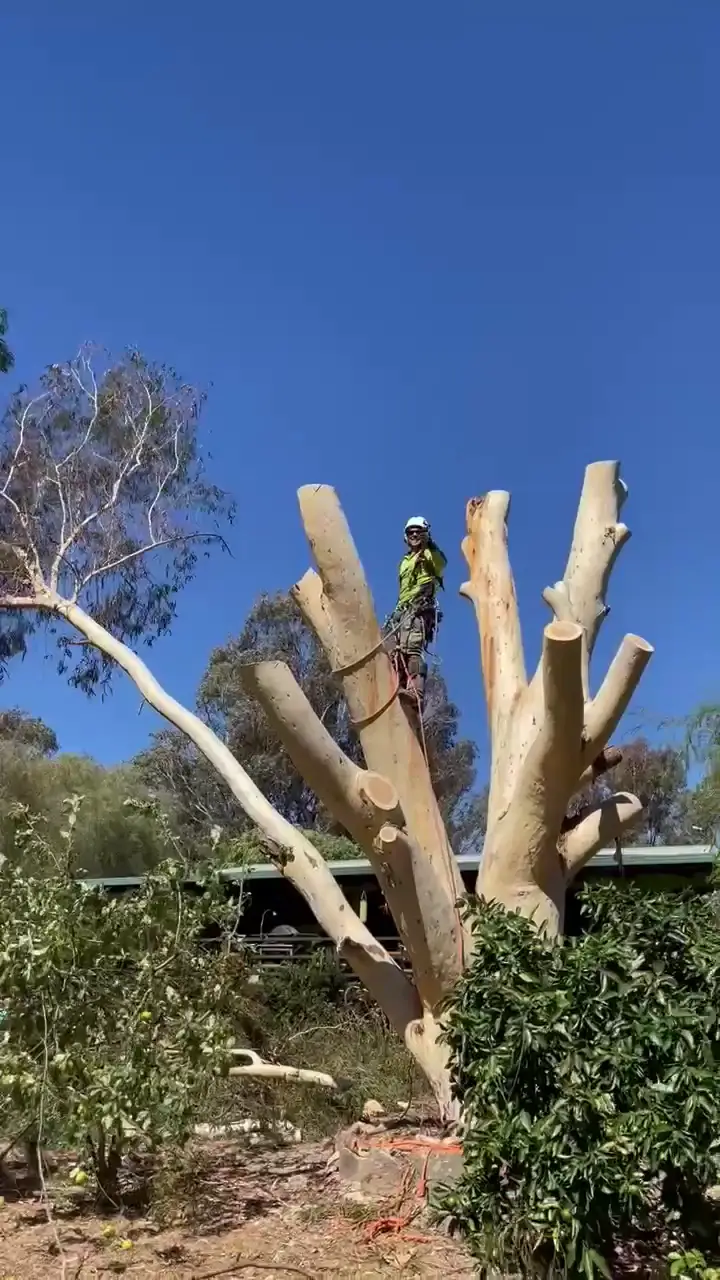
How to cut down a tree: what the job really involves

If you are searching for how to cut down a tree, the honest answer is that most trees should not be dropped by their owner. A backyard felling is skilled work with real ways to get hurt, and an article cannot teach it safely.
This guide does not give cutting steps. It shows what the job involves, what the national safety guide says, which rules might apply and how to tell a job you can leave alone from one that needs a qualified arborist.
A tree that looks easy from the lawn often hides a lean, a dead limb or a wire. Weighing the real job first costs nothing. Skipping that step can cost a great deal.
It is Saturday morning. The tree has annoyed you for a year. There is a saw in the shed, and the weather is fine. How hard can it be?
Harder than it looks, and this article is here to explain why. It will not teach you to cut. It will help you decide who should.
How to cut down a tree: the honest answer first
Here is the plain version. Felling is a trade skill. The national safety guide says managing the risks of tree felling takes a high level of competency, and it tells people to get advice from someone competent, like a qualified arborist [1]. It defines that person as someone who has gained the knowledge and skills through training, qualification or experience [1].
A homeowner can still pick up a saw for plenty of jobs. Felling a whole tree is the one where a small mistake is expensive in the worst way. So if you came looking for how to cut down a tree in ten easy steps, this is not that page. We would rather you read it than learn the hard way.
What the job really involves
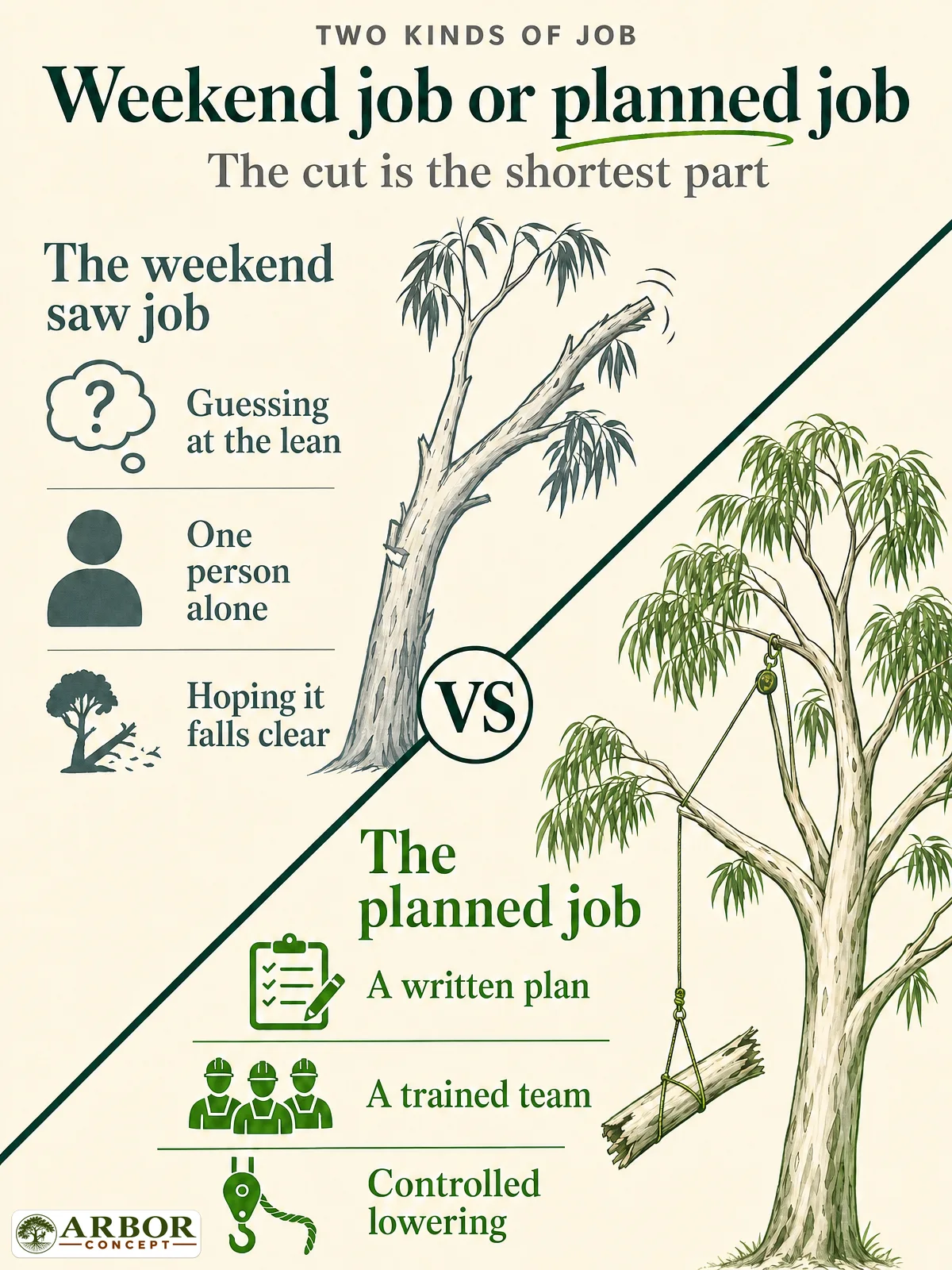
Most people picture the cut. The cut is perhaps the shortest part. Before and after it sit the pieces that make the difference.
What sits around the cutting
Notice that four of those five have nothing to do with the blade. That is where untrained felling tends to fall apart. People focus on the saw and forget the rest.
The national guide says a visual tree assessment should be done by a competent person before a tree is felled by any method, and that it should shape a risk assessment for the safest way down [1]. The assessment looks at decay, hollows, growth habit, species and the chance the root plate fails, along with wind, ground and where the tree stands [1].
Why a tree looks small from the ground
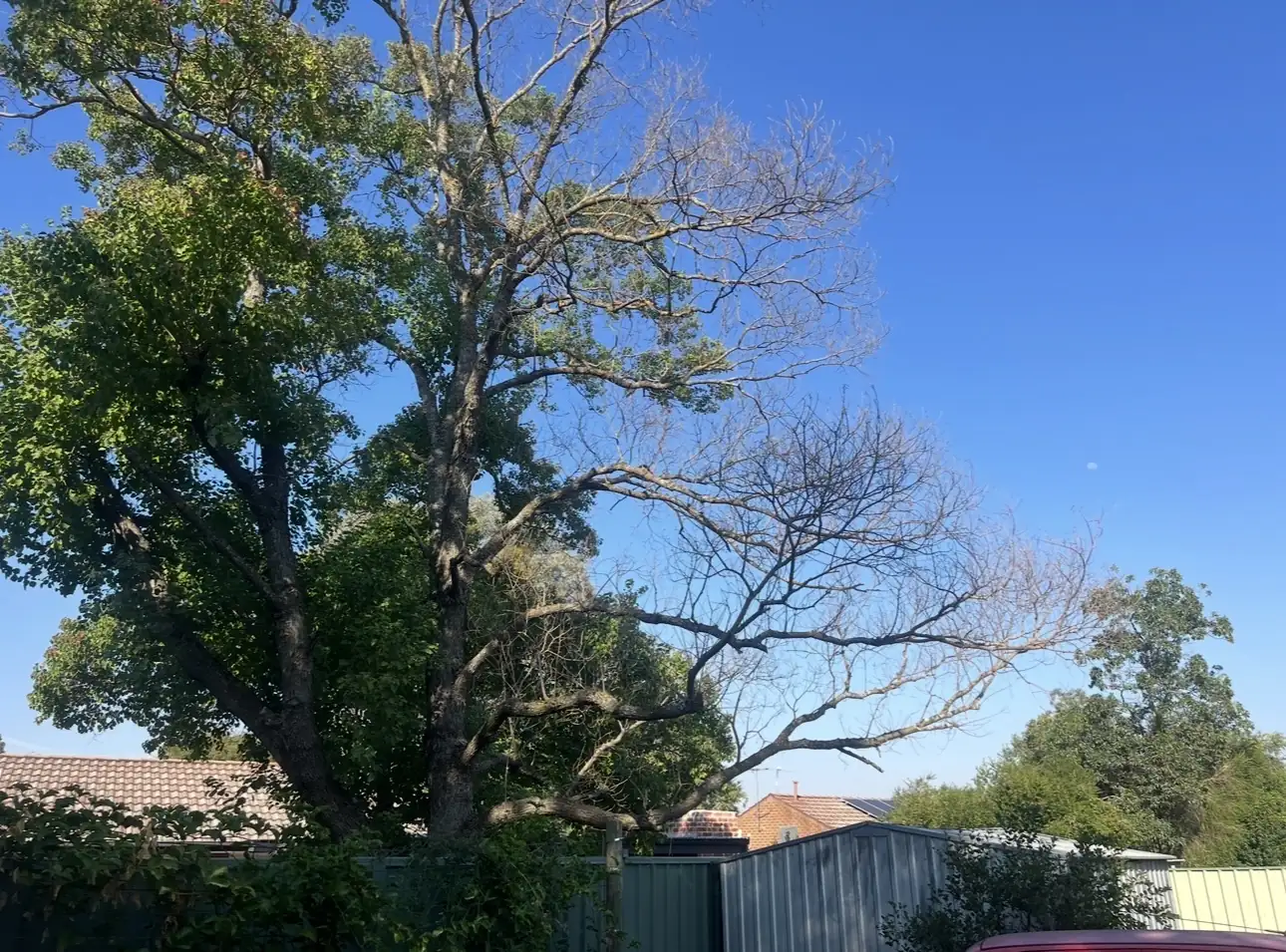
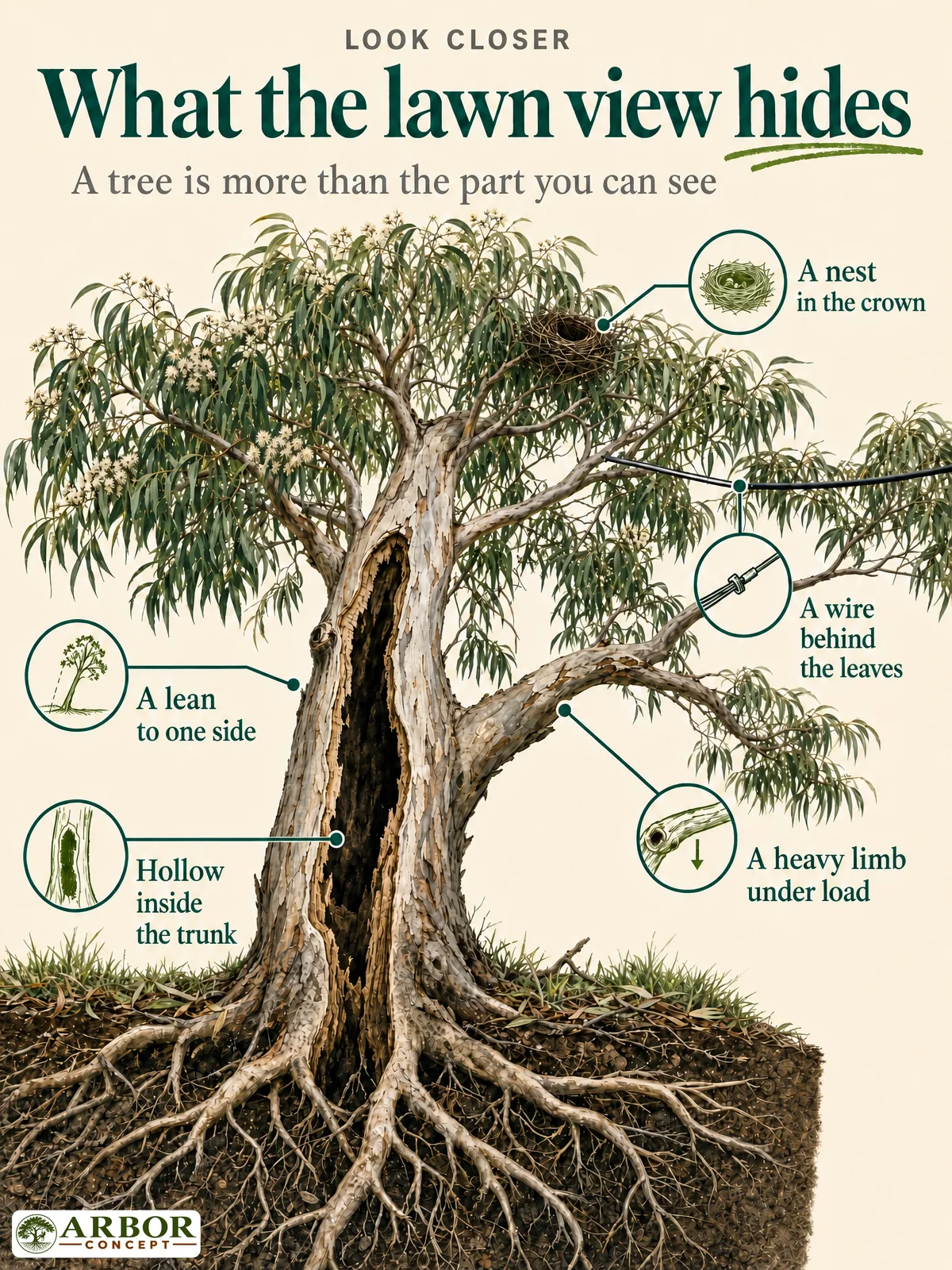
From the lawn, a tree is a tall green shape. Up close, it is a mass of wood that weighs far more than it appears. And the part you can see is only some of the story.
What the lawn view hides
| It looks like | It may really be | Why it matters |
|---|---|---|
| A sound trunk | Decay or a hollow inside | The wood can fail where you do not expect |
| A slight lean | A crown heavy on one side | The tree may not go where you plan |
| A quiet branch | A limb under load | It can spring or drop when disturbed |
| Clear air above | A wire behind the leaves | Current can reach a person or a tool |
| An empty tree | A nest, a den or a hive | Animals may be living or breeding there |
The guide gives questions an assessor should ask. Is the tree decayed or dead? Is it prone to branch failure under load? Is it stable in the ground? Is the crown leaning heavily in one direction? [1] Those are not questions a person answers by squinting from the patio.
Then there is the saw. The guide lists chainsaw kickback, push-back and pull-in reactions, severe cuts, eye injuries from flying wood fragments and being struck by falling trunks and branches [1]. It also notes that cut-resistant pants should be worn when using one [1]. Add noise, vibration and fuel, and a saw is a busy hazard even before the tree moves. SafeWork NSW also lists falls from heights, work around power lines and sun exposure among the major risks of tree work [8].
Another thing that surprises people is room. The guide describes three common ways to bring a tree down. One of them is felling the whole tree from the ground, and it needs a minimum of two tree lengths of open space in every direction from the base [1]. It adds that this is not a common option in towns and suburbs, because that much clear ground is hard to find [1].
Look at your own yard with that in mind. Where is the fence? Where is the shed, the pool, the neighbour’s carport? Most suburban trees have something close by.
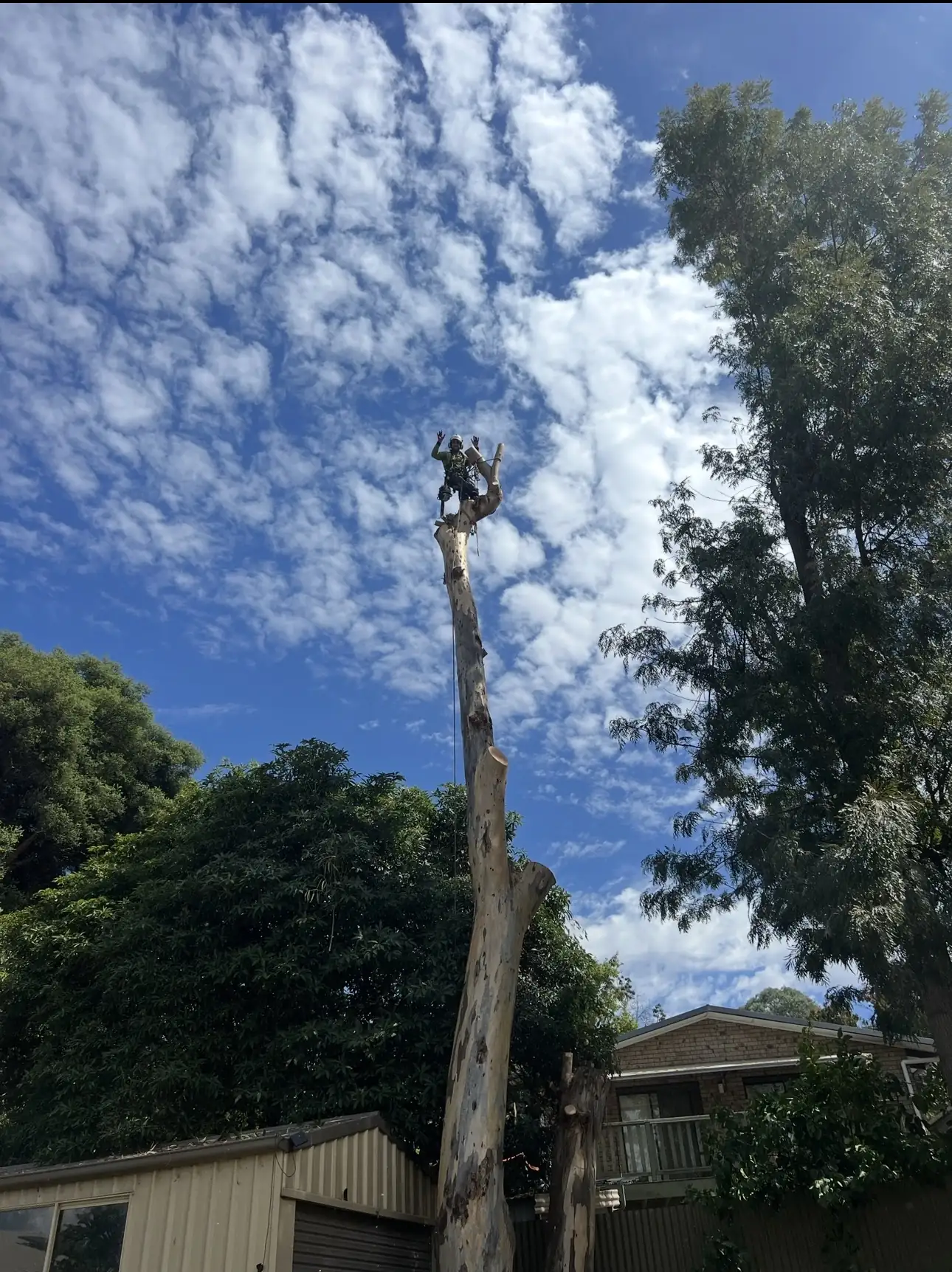
When open space is short, the guide says the second method should never be attempted by the untrained or inexperienced, and is for people with advanced felling training or substantial experience [1]. The third method is working at height and taking the tree down in sections, lowering each one in a controlled way [1]. Tight yards are where rope access and careful rigging earn their place, and none of it is a weekend project.
Did a fantastic job with a very difficult tree removal. Can not recommend highly enough . Great service and great price.
Power lines turn a hard job into a deadly one
If there is a wire anywhere near the tree, stop reading and call someone qualified. The Electrical Safety Office is blunt. It says not to trim a tree when any part of it sits in the exclusion zone, or might drop or be blown into that zone [5]. It also says to speak to the electricity distributor for safety advice first, and to treat every powerline as live [5].
The same page lists what can push a branch toward a line: wind, wet weather, and a saw kicking back [5]. It also warns that hot weather makes lines sag lower [5]. The national guide lists contact with energised overhead lines among the hazards of tree work [1].
We keep power lines out of any general advice, for a good reason. The network owner and the law decide what is allowed near them. When we work near a wire, we respect the legal limits of approach and bring in the power company if it is needed.
Is the tree yours to take down at all?
This is the question people skip. A tree on your land can still be protected, and the penalties for ignoring that can be sharp.
Who may have a say before a tree comes down
| Who | What they may decide |
|---|---|
| Your council | Whether the tree is protected and whether approval is needed |
| The tree's owner | Whether a boundary tree comes down at all |
| The network owner | What is allowed near their wires |
| A qualified arborist | Whether a tree is dead, unsafe or fine to leave |
Take Brisbane as one example of how this works. Its council says protected vegetation under its local law covers trees in bushland, along waterways and in ordinary suburban and rural settings, and that it is an offence to interfere with that vegetation without permission, even on your own property [3]. It lists penalties from infringement notices up to prosecution, and it says to phone the council if you are unsure [3].
The Gold Coast shows a different set of rules. Its page says you may need approval before removing or pruning trees on your property, and it offers a checklist to help you decide [4]. It lists some cases where no approval is needed, such as small native understorey trees growing beneath taller canopy on smaller lots [4]. It also lists trees that are actually or potentially dangerous, as decided by a council arborist of the right level, which means the owner does not make that call alone [4]. Tablelands Regional Council says trees on private land are protected under the state’s vegetation code, and suggests checking its trigger map before removing one [7].
Three councils, three sets of rules. That is the point. Councils set their own rules and alter them, so ask yours first, before any cutting. We never claim that a permit or rule applies to your tree, or that it does not. Drew can help you shape the questions.
If the tree belongs to a neighbour, the picture shifts again. The Queensland Government explains that the tree-keeper is generally whoever is registered as owner of the land under the trunk [2]. What the page gives you is a right to take overhanging branches and roots back to the boundary line, and it reminds you to respect any protection orders [2]. It does not give you the tree. The Queensland Law Handbook adds that protected trees generally need a council permit to remove, and that a tree owner can be liable for harm that was foreseeable and avoidable [9].
Want this looked at on your own property? The on-site quote is free.
What lives in the tree
A tree that looks empty may not be. WIRES says tree hollows are scarce and valuable, and that many native animals depend on them to shelter and breed [6]. It lists bats, possums, gliders, owls, parrots, ducks and kingfishers among them, along with snakes, frogs and skinks [6]. A small hollow can take about a century to form, and bigger ones longer [6].
The national guide also names biting and stinging hazards, including ants, bees, wasps and snakes [1]. So a nest or a hollow is a risk to you as well as to the animal.
If we meet a nest, a den or an animal living up there, the work stops or changes. Sometimes that means moving the day. Tell Drew what you have seen living in the tree. That detail can change the plan.
What about a small tree?
Some trees are small, and some owners are handy.
Here is what the sources we read actually say. None of them tells a householder that felling a tree is safe. The Gold Coast page, for one, names small native trees in certain spots as not needing approval [4]. That answers a permit question. It does not say the cutting is safe, and we will not pretend it does.
If you are weighing it up anyway, use the guide’s own questions. Is the tree dead, decayed or leaning? Is anything stored under it? Is a wire close by? Is anything living in it? A single yes is a reason to stop and ask someone qualified. Roots matter too. Tablelands Regional Council warns that cutting roots too close to the trunk can affect a tree’s stability and could lead to the whole tree failing [7].
Chose Drew and the team as they had great reviews. Wasn’t disappointed at all. Drew gave me a quote to remove a pine that split and advice on another tree that was looking at doing the same. They were able to get it done quickly and to a great standard. Very happy with the service.
How a qualified arborist approaches it
You do not need to know the technique. You do need to know the shape of the job, so that you can judge a quote.
The outline of a safe job
- A competent person assesses the tree, the site and the surroundings.
- The assessment shapes a written plan and a method for this tree only.
- People, pets and vehicles are kept out of the area under and around the tree.
- The tree comes down in controlled stages, using the gear the plan calls for.
- Timber, green waste and any stump are dealt with as agreed.
- The site is left clean, and you walk it with the arborist.
Each step answers a risk. None of them can be skipped without somebody paying for it later.
Calling an arborist, and leaving a tree alone
Bring in a qualified arborist for any tree that is big, tilting, cracked, dying or near a building. Do the same when a wire runs anywhere close, or when you cannot say what is living in the crown. And do it when you are unsure whether the tree is protected.
You do not need anyone at all for a tree that is healthy and sits well clear of everything. If it is not causing trouble, leaving it alone is a perfectly good plan.
Before you pick up a saw
- Check whether the tree is protected.
- Look up for wires, and look into the crown for nests.
- Ask a qualified person to assess a tree you doubt.
- Tell the neighbours if a tree is near the boundary.
- Working alone on a tree that leans or is split.
- Cutting while a branch or the tree is near a wire.
- Climbing a ladder with a running saw.
- Deciding a tree is not protected because it is on your block.
If you do ask us out, Drew visits first and quotes free on site. He is your contact from the first conversation, and he brings 20 years’ experience, a Cert III qualification and public liability insurance. He will tell you plainly if the tree can stay. If it has to come down, our team does the work, and you can read how that fits together on our tree removal service page. Our how we quote page covers the principles behind the price, and you can get in touch when you are ready.