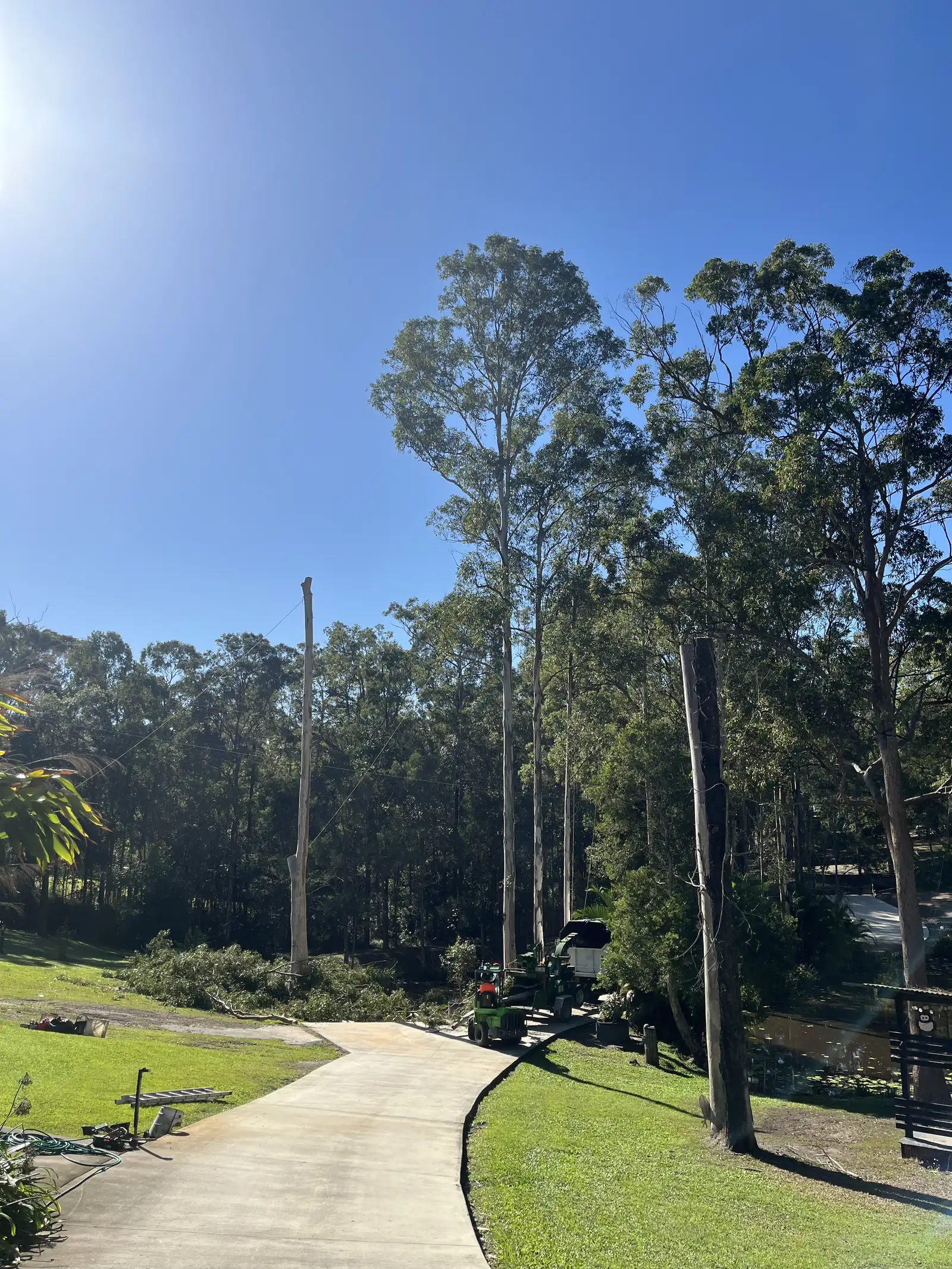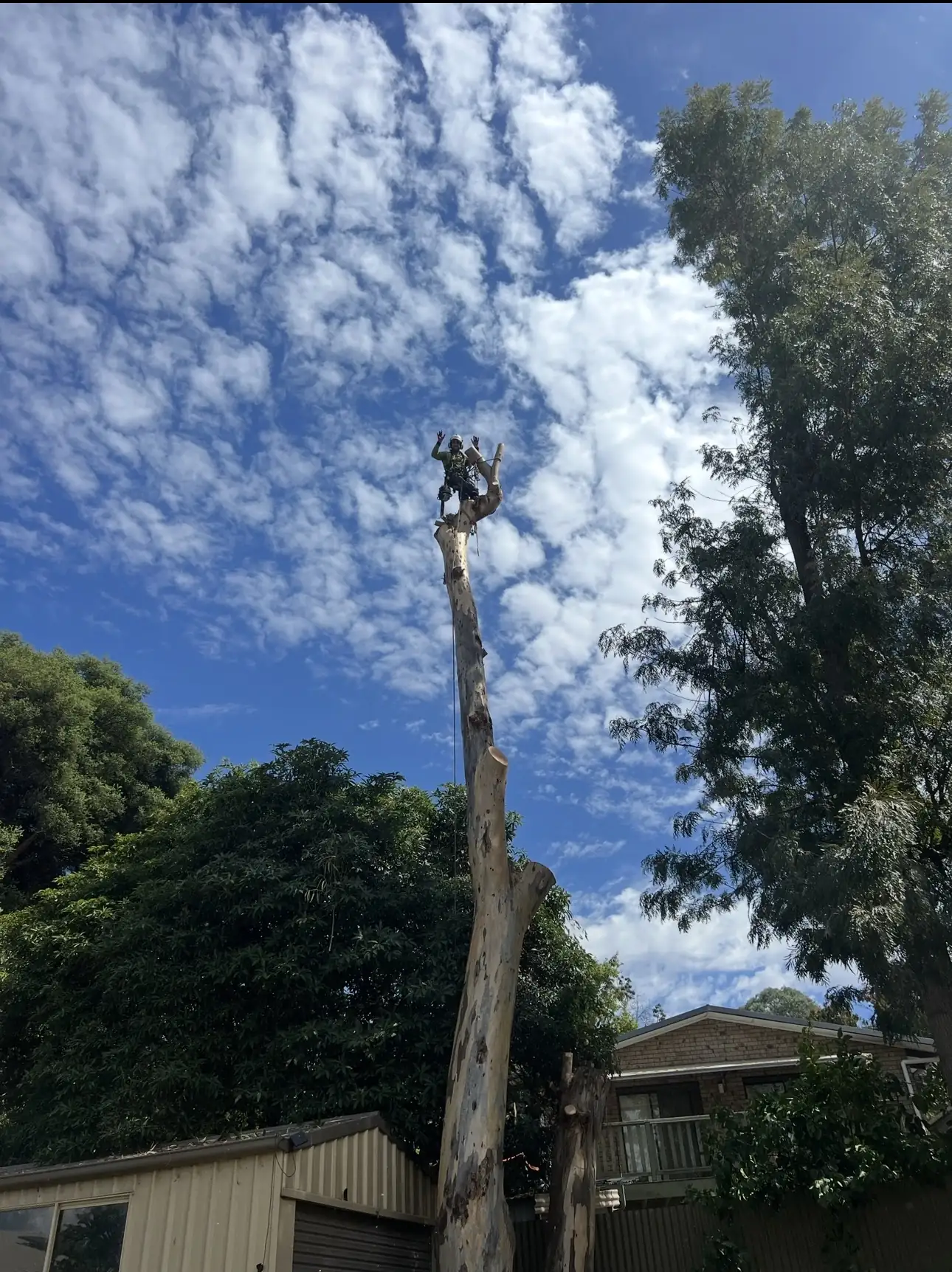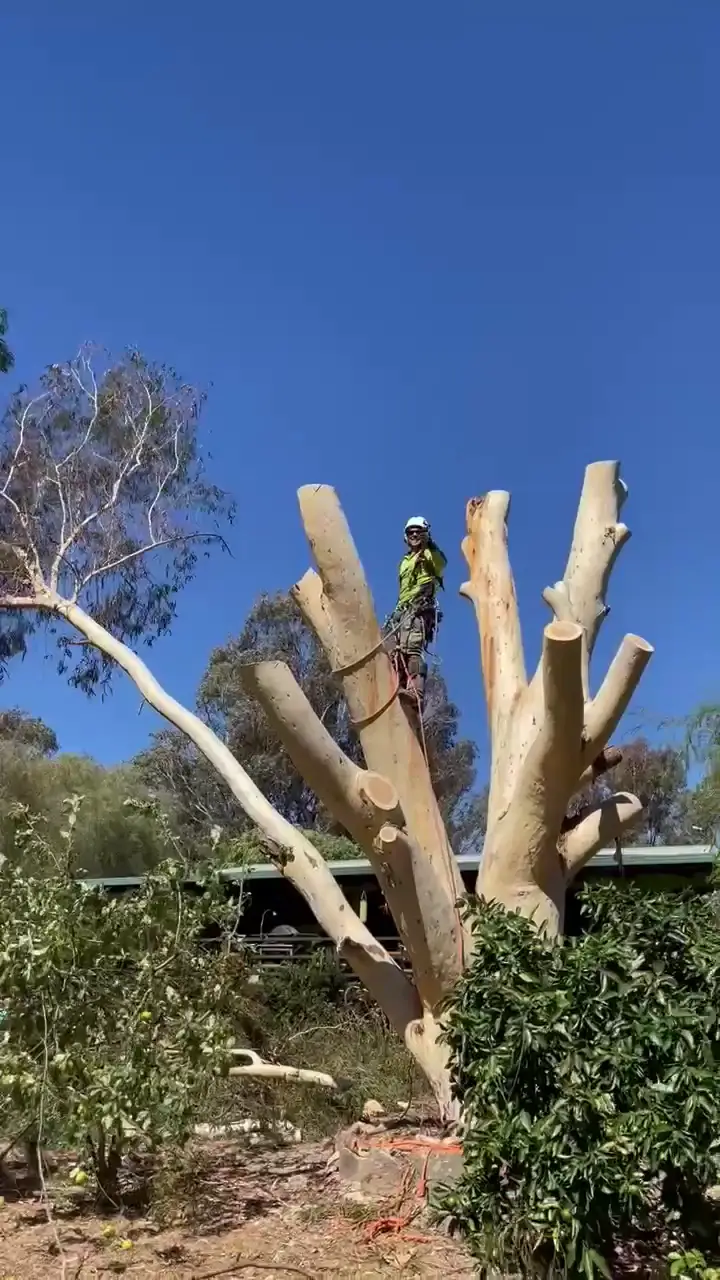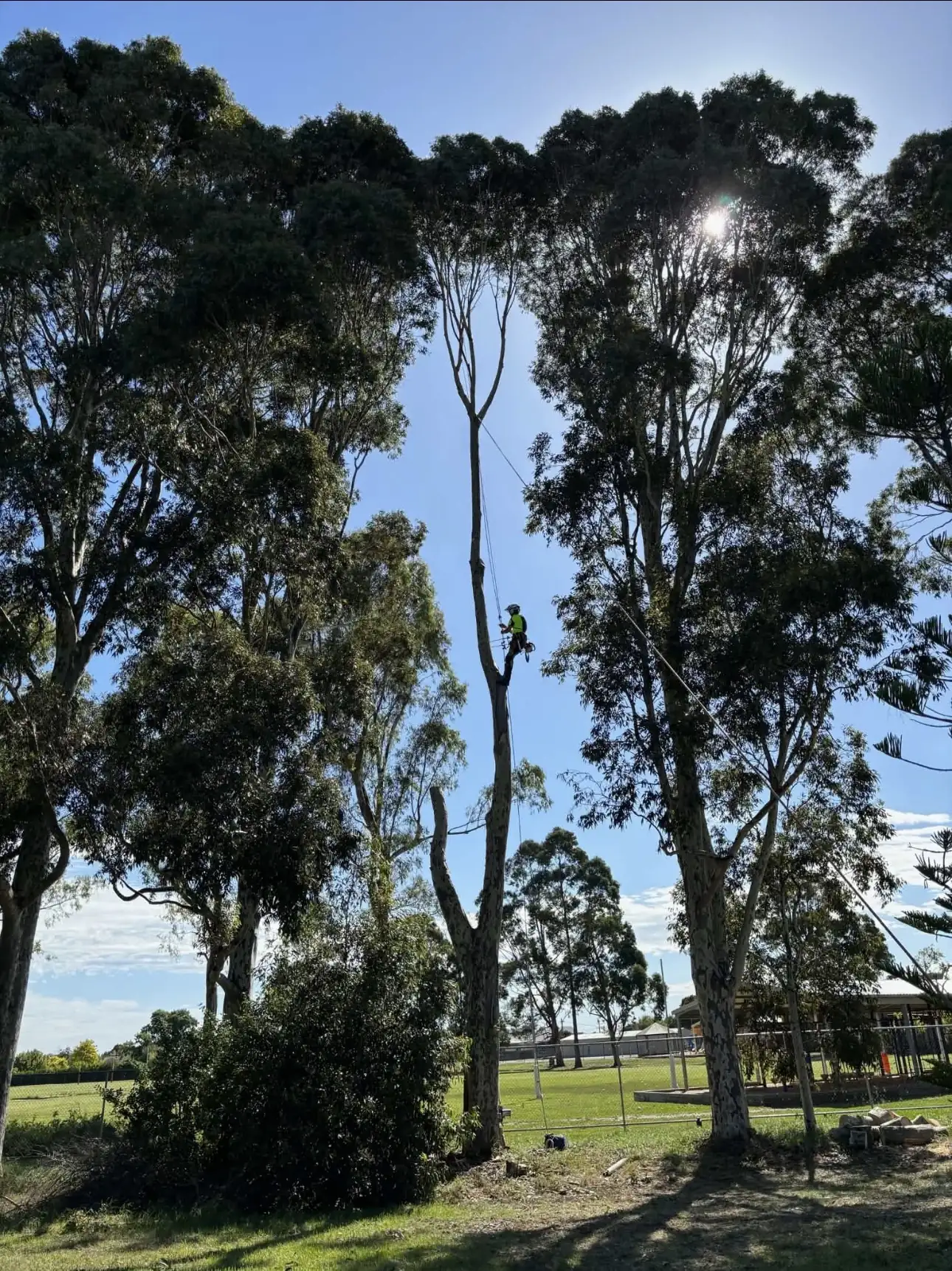
Who is responsible for trimming trees near power lines?

Who is responsible for trimming trees near power lines depends on two things: whose tree it is, and whose line it is. A council tree beside a street line is handled one way. A tree beside a private line on your own land is handled another.
This guide sorts the common cases into plain groups. It covers street trees, trees on your block, private poles, rentals and the moment a tree actually touches a wire.
The same tree can fall into different groups on different blocks. Looking at the real job, with the wires in view, comes before any plan to cut.
Ask three neighbours and you may get three answers. One says the power company does it. One says the council does it. One says it is on the owner. Each of them can be right, about a different tree.
Who is responsible for trimming trees near power lines: the short version
Two questions sort most cases. Whose tree is it? And whose line is it? Once you know both, the answer gets much simpler.
The word to know is network owner. That is the company that runs the poles and wires in your street. The Queensland Electrical Safety Office lists Energex and Ergon Energy as electricity suppliers you can contact [1]. Your bill, or a look at the pole, will show which one is yours.
A quick map of the common cases
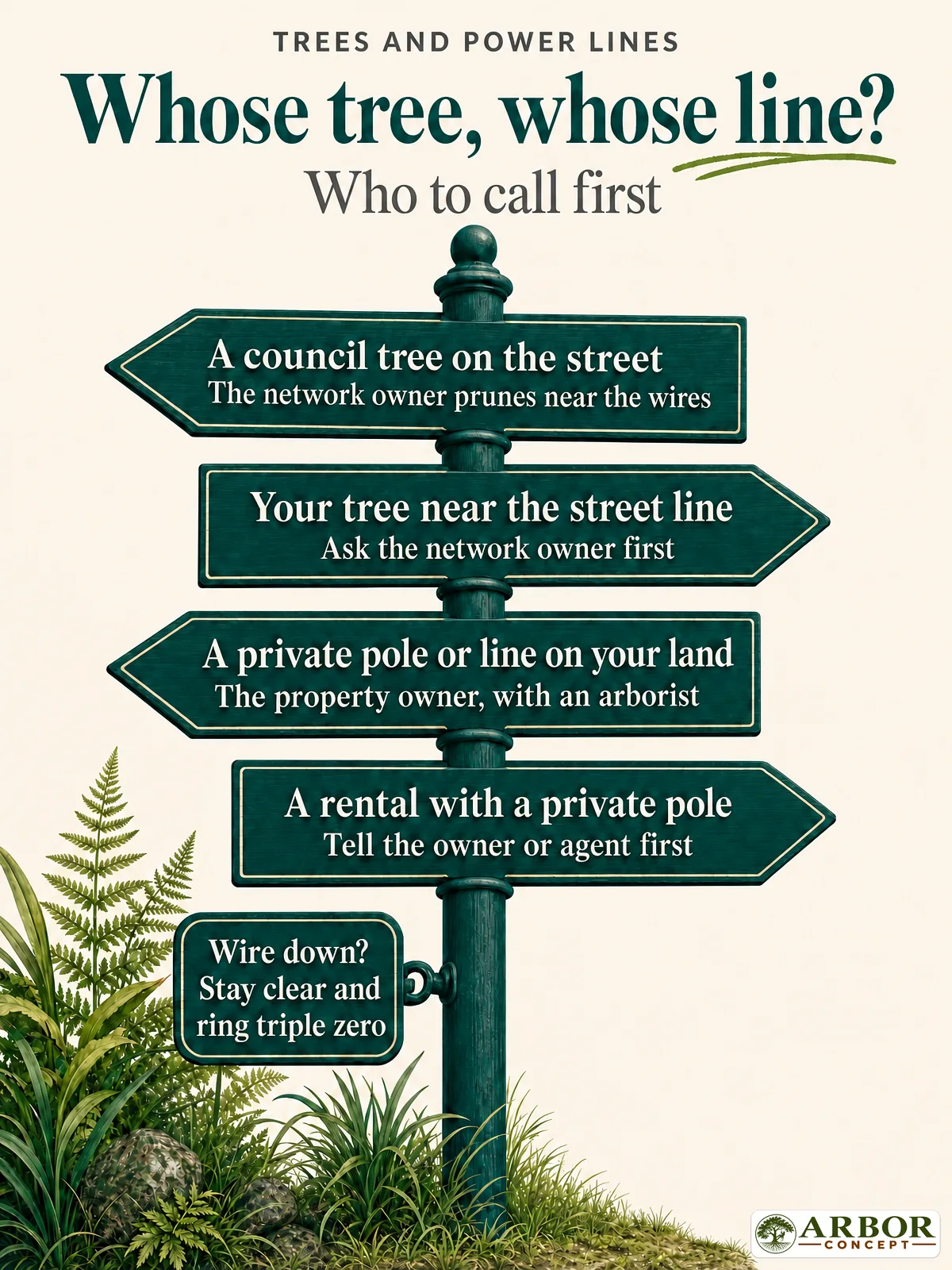
| The tree | The line | Where the pages we read point |
|---|---|---|
| A council tree on the verge | A street line run by the network owner | The network owner prunes near the wires |
| Your own tree, near the street line | A street line run by the network owner | No single rule: ask the network owner first |
| Your own tree, near a line on your land | A private line past the first pole | Generally the property owner, using an arborist |
| A tree on a rental block | A private pole or line | Tell the owner or agent first |
| Any tree touching a fallen wire | Any line | Emergency: stay clear and ring triple zero |
The rest of this guide walks down that table, one row at a time. The network owner and the law decide the final answer for your wires, so treat the table as a map and check your own case with the network owner.
When the tree belongs to the council
Street trees are the easy group. Noosa Council says Energex prunes council-owned street trees near powerlines, as routine work and also when needed between rounds [4]. The council keeps the pruning that is not about the wires [4].
Other councils say the same thing in their own way. The Sunshine Coast Council says pruning that close to a powerline must be done by Energex [5]. Brisbane City Council sends residents to Energex for street trees that grow through, or very near, overhead lines [6]. The City of Gold Coast says the same of trees growing close to overhead power lines [7].
Those three councils each name a different clearance at which Energex takes over. That is a good reminder of why we leave numbers out. The hand-over point is set by each council and each network owner, and it can change.
The practical rule is simple. If a tree on public land touches or crowds a wire, report it. Do not cut it yourself. The Gold Coast page asks residents not to try the maintenance on public trees themselves [7].
Trees on your own land
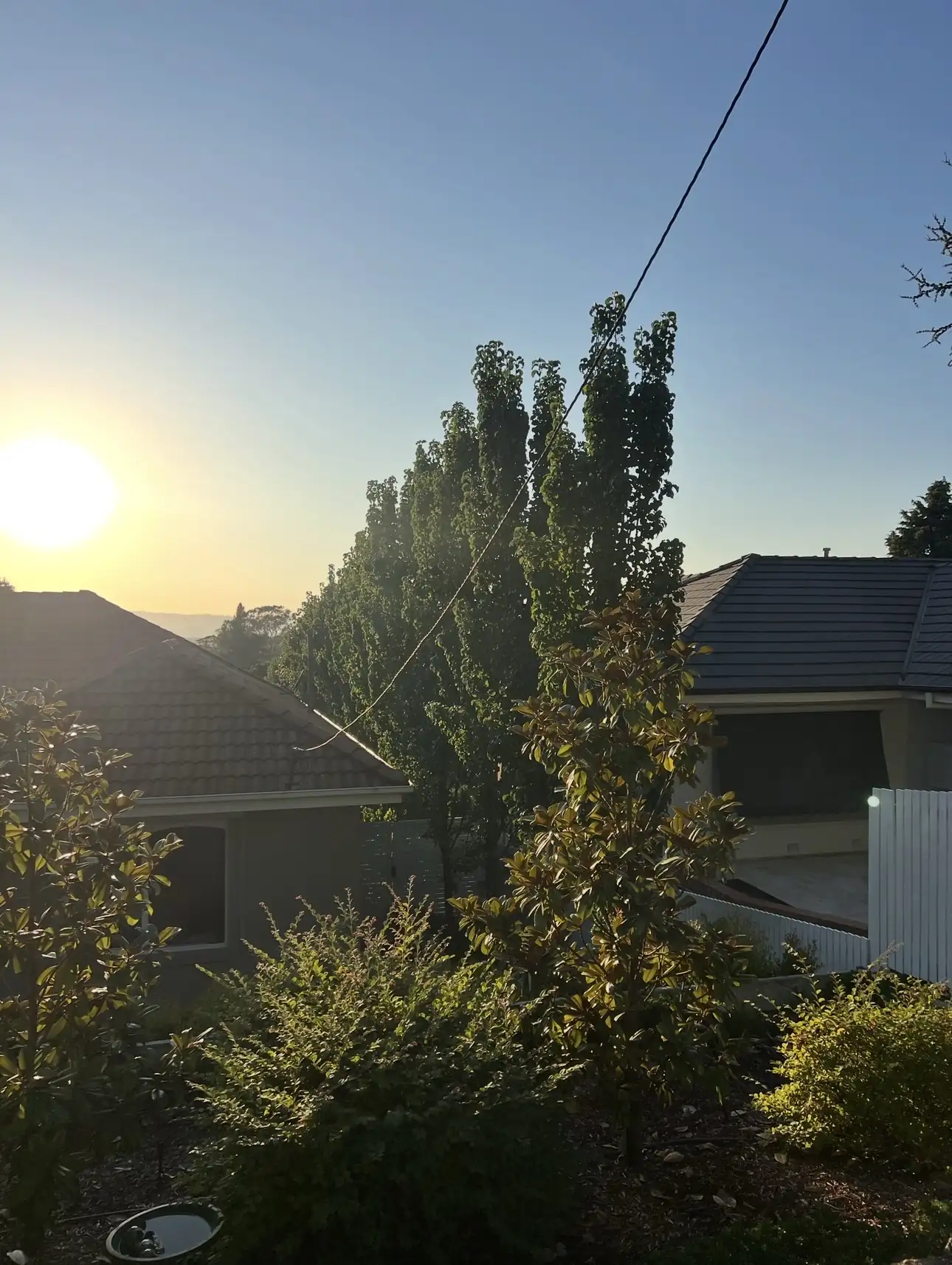
This is the group that causes the most confusion. When the tree is yours and the wire belongs to the network, who is responsible for trimming trees near power lines is not spelled out as one tidy rule on the pages we read.
What they do agree on is the danger and the first step. The Electrical Safety Office tells people to contact their electricity distributor for safety advice before any work starts [2]. It also says to treat every powerline as live [2].
A regional council in Ergon Energy’s area gives the same advice for growth near the service wire to a home or near lines over a footpath: ask a professional tree trimmer or the network owner, and do not do it yourself [9].
So the honest order of events looks like this. You spot a tree growing toward a line. You contact the network owner and describe the tree and where the wire runs. They tell you what applies to your case. Only then does a qualified arborist plan any cutting.
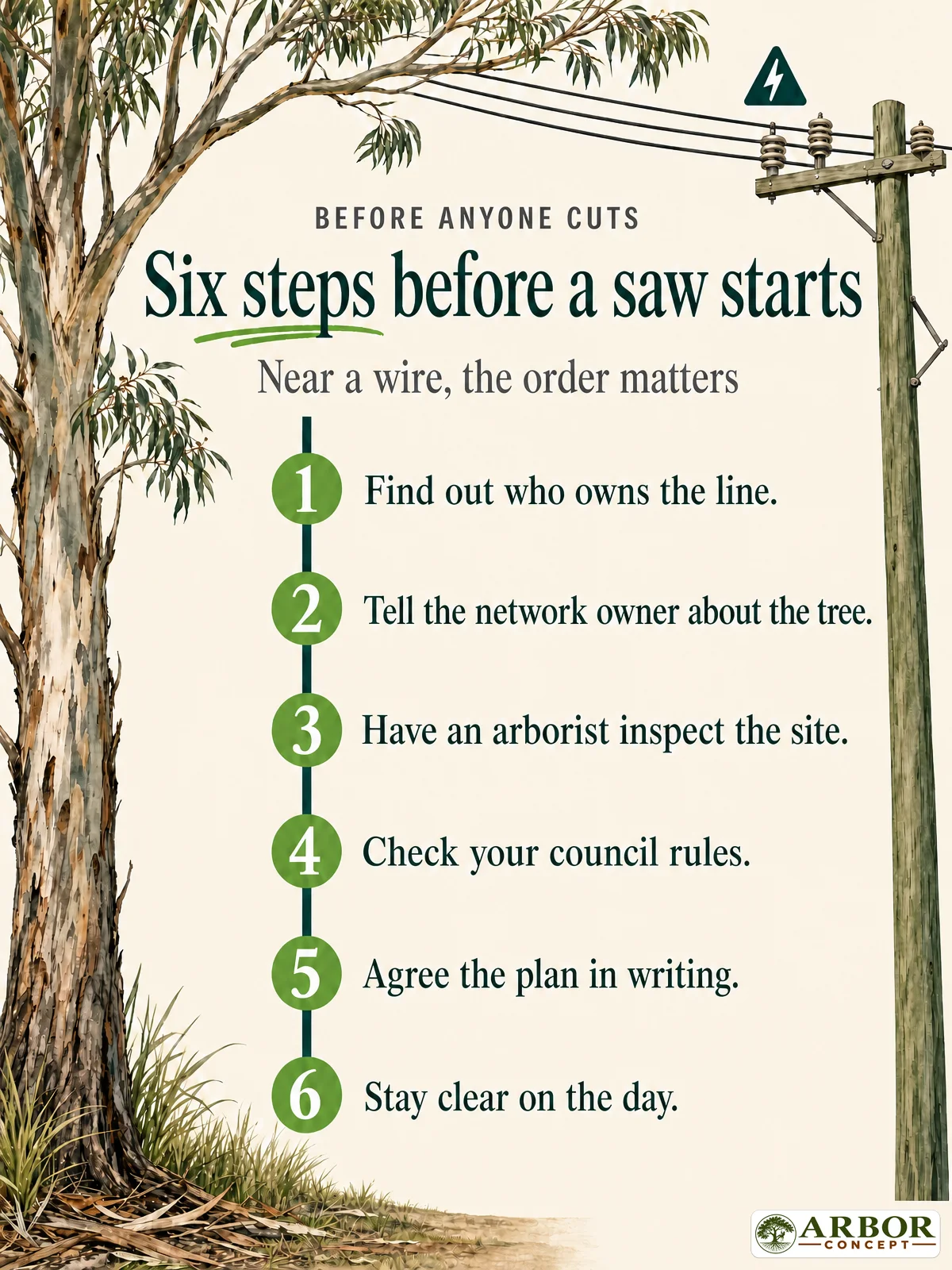
Before anyone cuts near a wire
- Find out who owns the line. Look at the pole, or check your account.
- Tell the network owner about the tree and ask what applies.
- Ask a qualified arborist to look at the real site, with the wires in view.
- Check your council's rules, in case the tree is protected.
- Agree the plan in writing, including who is arranging any power shut-off.
- Stay clear of the area on the day.
Nowhere on that list does it say to start with a ladder and some loppers.
Drew and his team were absolutely fantastic. They were patient while we worked with council for the appropriate approvals, on time and very professional. Drew was also happy to assist us with adding on additional pruning and palm removal. Will recommend to everyone and definitely use again in the future.
Private poles and lines past the first pole
Some homes have a pole inside the boundary that carries the supply to the house. The Electrical Safety Office says that pole belongs to the property and that checking and maintaining it is the owner’s job [1].
The same page adds a line about trees. It says trees growing into or near powerlines are dangerous, since they can bring lines down or cut your supply [1]. It then says that, generally, clearing trees away from privately owned powerlines is the property owner’s responsibility [1]. It tells owners to always use a professional arborist or tree pruning specialist for the work [1].
Noosa Council puts the boundary in a handy way. It says Energex looks after its lines up to the first point of contact on your property, and that all lines beyond the first property pole belong to the owner, with tree clearance on those lines being the owner’s job too [4].
So if you have a long driveway with a pole or two on it, look hard at that stretch. It may be yours to keep clear. If you are not sure where the network owner’s part ends, ask them.
Why this is not a do-it-yourself job
Trees and live wires make a bad pair. The Electrical Safety Office explains that electricity can arc across a gap of air, and that it can pass through objects people think of as poor conductors, trees among them [3]. So you do not need to touch a wire to be hurt.
Four ways a simple trim goes wrong
The Electrical Safety Office lists those same hazards in its own words: wind or wet weather pushing vegetation into the danger zone, hot weather making lines sag, and pruning gear kicking back [2]. The national tree work guide adds that a flashover can strike a person standing near a line without any touch, and that the plan for the job must meet whatever the electricity supply authority requires [8]. Its advice is firm. Do not trim a tree or manage vegetation where any part of it is in the exclusion zone, or could fall or be carried into it [2].
The wire that runs to your house needs the same respect. The Electrical Safety Office says service lines are usually insulated, but that the cover can turn brittle with age, and a simple knock can break it away and leave live wires bare [3]. A branch that rubs on that wire in the wind is doing the same job as a knock, over and over.
It also reminds us that powerlines are easy to miss. They can be hard to see in bright sun and harder at dawn, dusk or in cloud [3]. Tree trimming is on its list of tasks where lines must be treated as live [3].
Put that together and the message is clear. A qualified arborist works to the legal limits and knows when to stop. A neighbour with a pole saw does not. So when someone asks who is responsible for trimming trees near power lines, the safest part of the answer is who should hold the saw: a trained person, never a hopeful amateur.
Want this looked at on your own property? The on-site quote is free.
Renting, or sharing a boundary
If you rent, the first call is not to a tree company. It is to the owner or the agent. The Electrical Safety Office tells tenants to report a private pole or line that needs attention to the owner or agent straight away [1]. If they do not act promptly, it says to call the electricity supplier [1].
Boundaries add another layer. A tree can stand on one block while its branches lean over a line on the next. The tree still has an owner, and a short chat often settles who calls whom. If it helps, Drew will speak to the next-door owner for you and lay out the plan. A calm word beforehand saves a hard one later.
What to do when a tree is already touching a line
Sometimes you need to know what to do right now. The Electrical Safety Office says a fallen powerline gives no sign of whether it is live, so every one should be treated as live [3]. It says to keep well clear, even if the line is draped over a tree or fence, and to contact the distributor straight away so a repair team can be sent [3]. For a line that has fallen, it says to call triple zero [3].
Do and avoid when a tree meets a wire
- Treat every wire as live, even if it looks dead.
- Warn others and keep children and pets away.
- Ring triple zero if a line is down.
- Tell the network owner what you saw and where.
- Touching the tree, the wire or anything in contact with them.
- Moving branches that rest on a line.
- Cleaning up storm debris until the area is cleared as safe.
- Starting a saw "just to free it up".
Storm clean-up is a trap here. The same page warns that fallen branches and debris can hide powerlines after bad weather [3]. Wait for the all clear before you walk in with a saw. A pile of green branches after a storm can look like a chore. Under it there may be a wire carrying current, and nothing about it shows.
Drews quick response and booking was fantastic. Lads were on time and great to deal with, very knowledgeable on the tree trimming and lopping safety all the way and cleaned up their mess to boot. 5-star rating for a reason
When an arborist is worth calling, and when it is not
Not every tree in the street needs an arborist. A healthy tree that is nowhere near a wire can simply be left alone. A small garden plant by the letterbox is a job for a gardener.
You do need a qualified arborist when a tree is growing toward a wire, when branches have reached the service line, or when you cannot tell where the wire runs. You also need one for any tree on a private line. Our vegetation management service covers land with trees close to lines, along with the ground around them.
The person who comes to your gate is Drew. He holds a Cert III qualification, has 20 years’ experience and carries public liability insurance. He looks at the site with you first, and our team flags early when a tree is heading toward a line, so the plan is settled before the problem turns urgent.
How we work near power lines
Close to a wire, we work within the legal limits of approach and hold the gap the rules require. Where the job calls for it, the network owner is part of the plan. Sometimes the power has to be switched off for the work, and we say so at the quote, not on the day.
Rules differ between councils and between network owners, and they change. We never tell you a permit or a rule applies to your tree without checking. Ask your council, and lean on us to untangle the paperwork questions before a single cut is made.
A photo cannot show where a wire sits against a branch, so the quote always comes after a visit, and the visit is free. If you want to see how our quotes are put together, there is a page on how we quote. To book the visit, reach out here and describe what is growing near your line. Pensioner and local discounts are available; ask when you book the visit.