What to do about a tree too close to house walls

A tree too close to house walls is not always a problem, and it is not always safe either. The answer depends on the tree, the soil and what would be hit if something failed, so removal is only sometimes the right call.
Below you will find the signs worth watching, what roots and branches really do to a home, and where neighbours and councils come in. We also cover what to try before anyone reaches for a saw.
Two trees at the same distance can carry very different risks. A proper look at yours, from the ground and from above, is worth more than any rule of thumb.
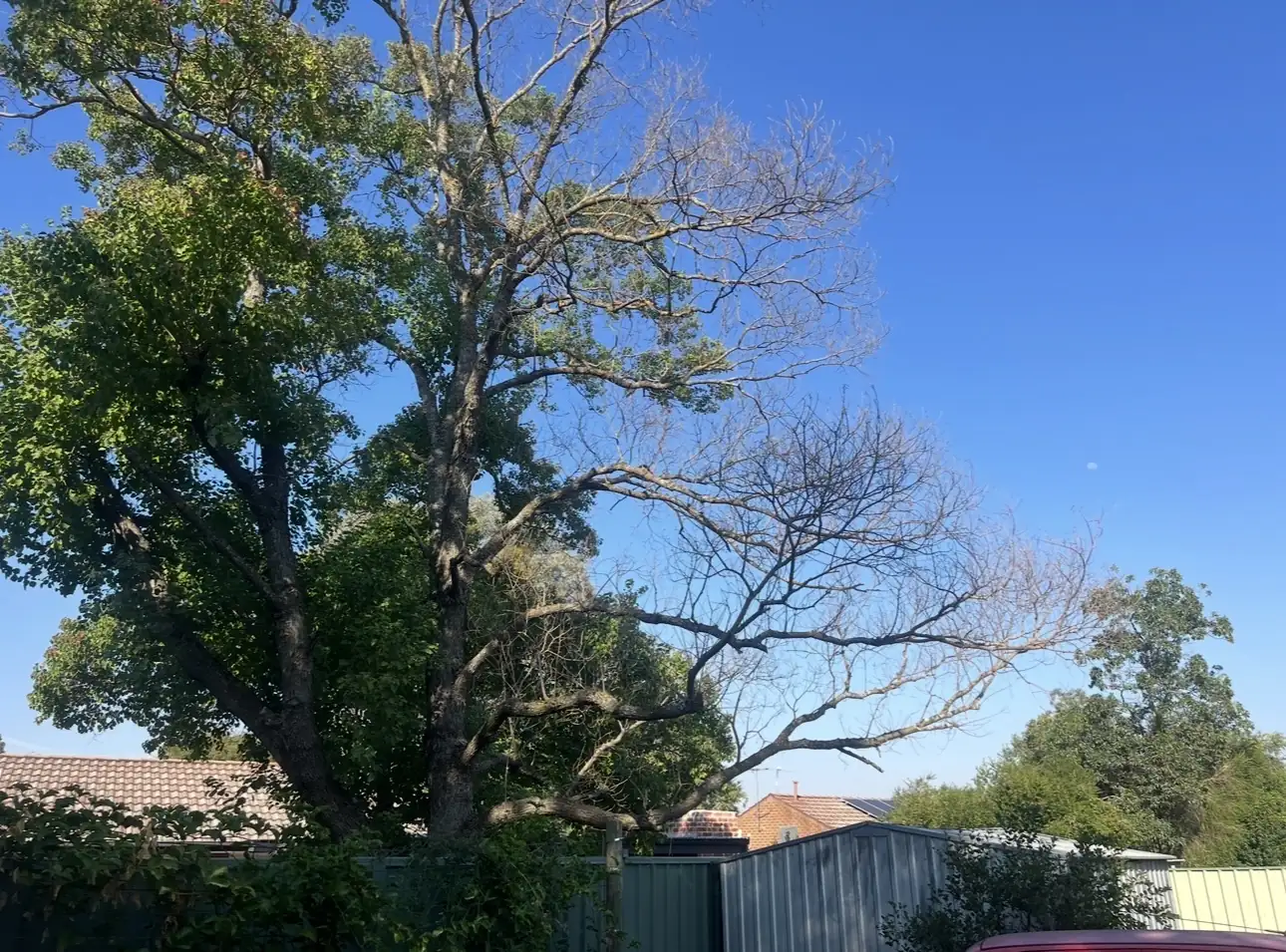
You hear it on a windy night. A limb scrapes the roof, or the whole canopy hisses and sways. You lie there and wonder if that tree is about to become a problem. Most nights it will not. This guide helps you work out which nights it might.
Is a tree too close to house walls really a problem?
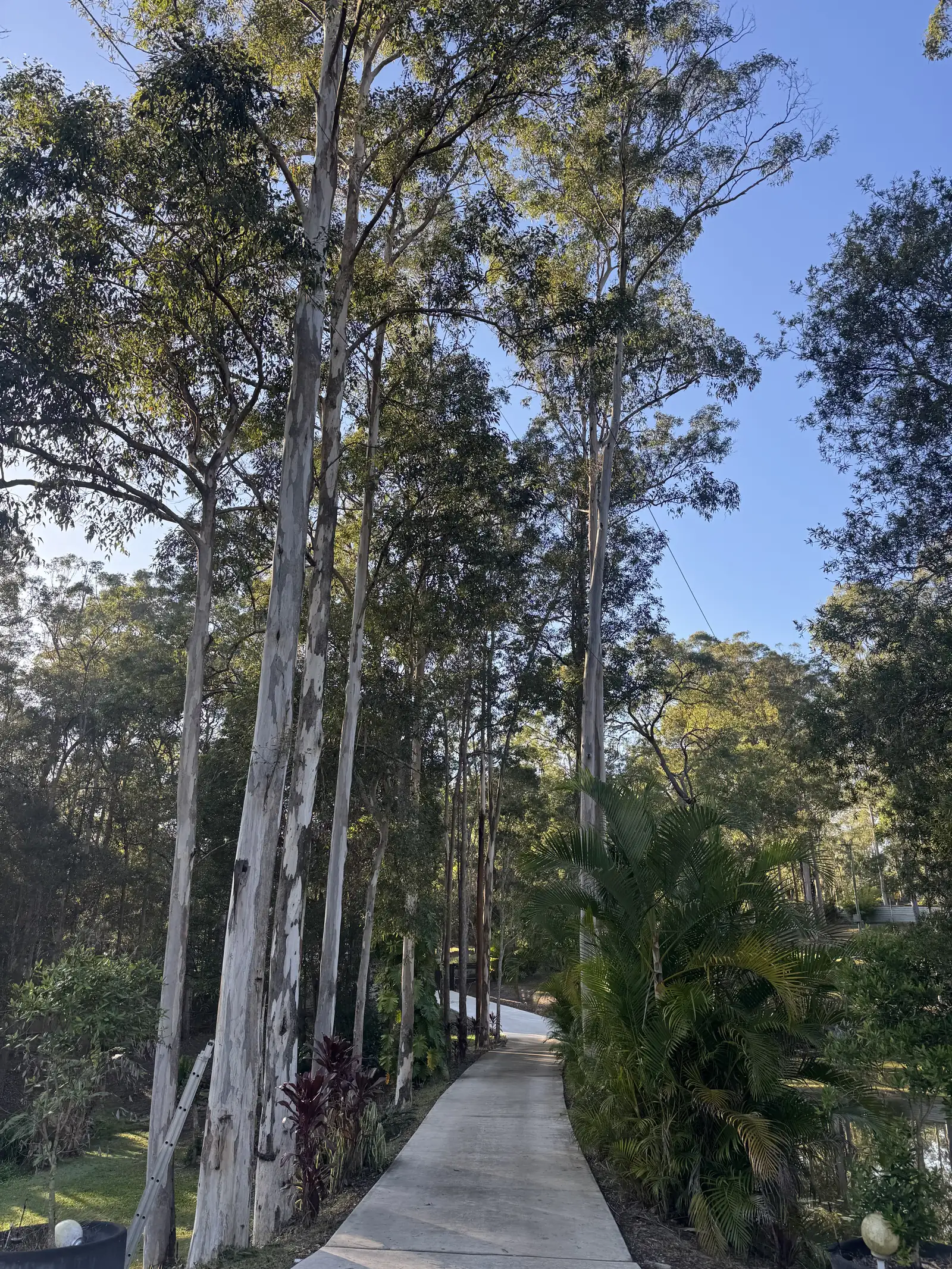
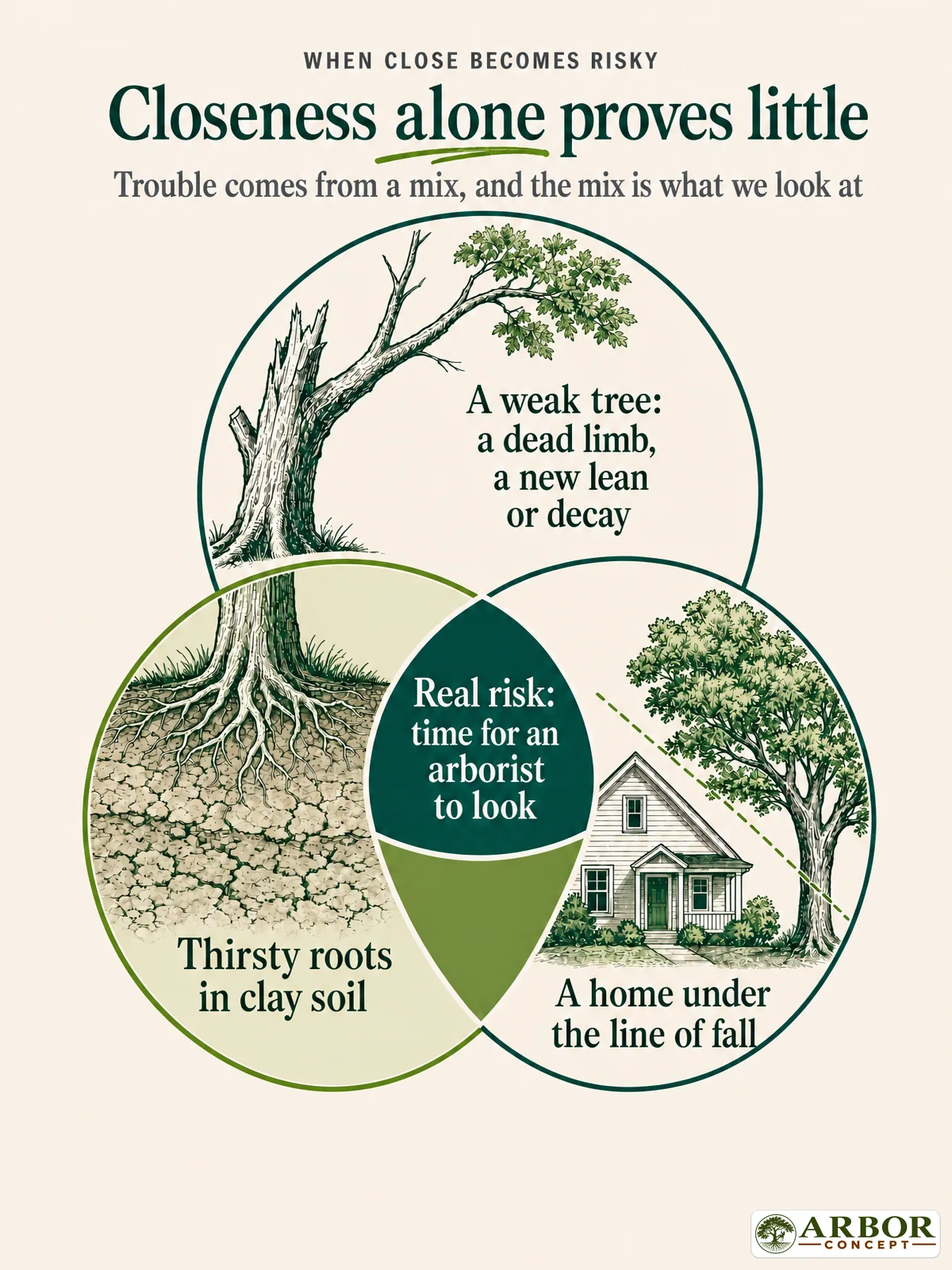
A tree too close to house walls is a common worry, but closeness alone proves little. Plenty of homes sit happily beside big, healthy trees. Trouble comes from a mix: a weak tree, a heavy limb, a leaning trunk, thirsty roots in clay soil, or a house right under the line of fall.
There is some official guidance on distance, but it is aimed at planting. The Queensland Building and Construction Commission says trees should be planted at least one to one and a half times their mature height away from a building, and that high water-demand trees should be kept well away [3]. That helps when you are choosing a spot for a new tree. It does not tell you to remove one that is already standing.
Ask a better question: what could it do, and how likely is that? The honest answer for a tree too close to house eaves is often “it depends”, and the sections below set out the factors that decide it.
What a close tree can do to a house
A close tree can touch a home in several different ways. Some are slow and some are sudden.
Where the trouble shows up
| Part of the home | What the tree can do | What to look for |
|---|---|---|
| Roof and gutters | Scrape tiles, drop leaves, block gutters, land a limb | Scuffed tiles, wet gutters, dead wood overhead |
| Walls and footings | Dry the soil, so clay shrinks and the ground moves | New cracks, sticking doors, gaps by window frames |
| Drains and pipes | Roots find joints that are already leaking | Slow drains, damp patches, lush green strips on the lawn |
| Fences and paths | Lift paving, push on fences, drop heavy fruit or pods | Uneven paths, leaning posts, marks on the ground |
The table looks long, but notice that only one row is about a tree falling. Most close-tree problems are slow ones. A roof that slowly fills with leaves, a drain that slows over a year and a crack that opens a little each summer all give you time. That gives you time to look, ask and plan, which is a better position than a rushed decision after a storm.
Footings, soil and moisture
The ground under a house is not still. The QBCC explains that building footings move with changes in the moisture in the soil [3]. It also says minor cracking and movement are normal for most buildings, and that minor cracks should be repaired as part of regular maintenance [3].
That matters for your tree. A big tree pulls a lot of water out of the ground. In clay, drier soil shrinks and the footing can drop on that side. The page also tells owners to keep moisture steady around the footings and to avoid overwatering or unregulated sprinklers [3].
A longer QBCC guide for home owners says most Queensland homes sit on reactive clay, and that trees, poor drainage and leaking plumbing are the usual abnormal conditions that can lead to movement and damage [7]. Roots can pull moisture from the clay under a building, and the soil then shrinks and the footing can sink [7]. If cracks appear, it says to check drainage and plumbing first, and that the fix may include moving gardens or trees [7]. It also tells owners to ask a builder or engineer when they see movement in the home [7].
Do not jump to the saw if you see a hairline crack. Cracks have many causes, and a plumbing leak can do the same harm. Check the water first. If the cracks keep growing, ask a builder or engineer to look at the house while an arborist looks at the tree. Never cut big roots near a trunk on your own. That can leave the tree less stable than it was.
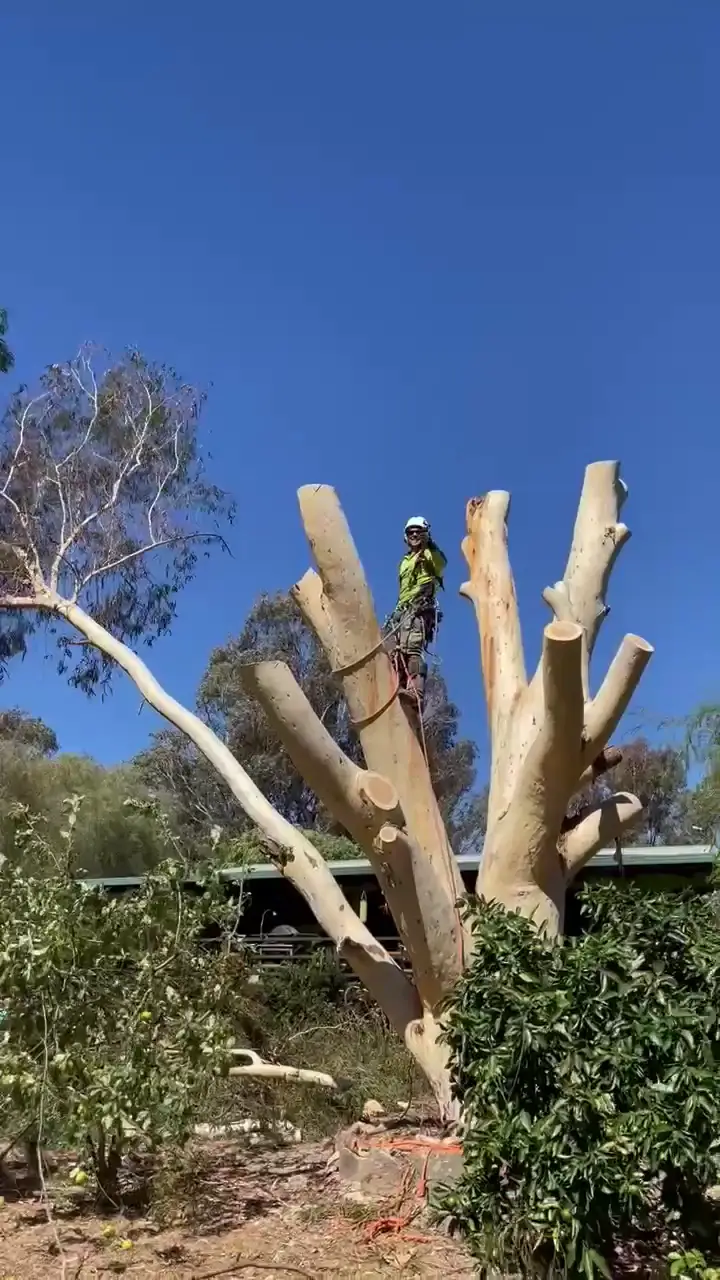
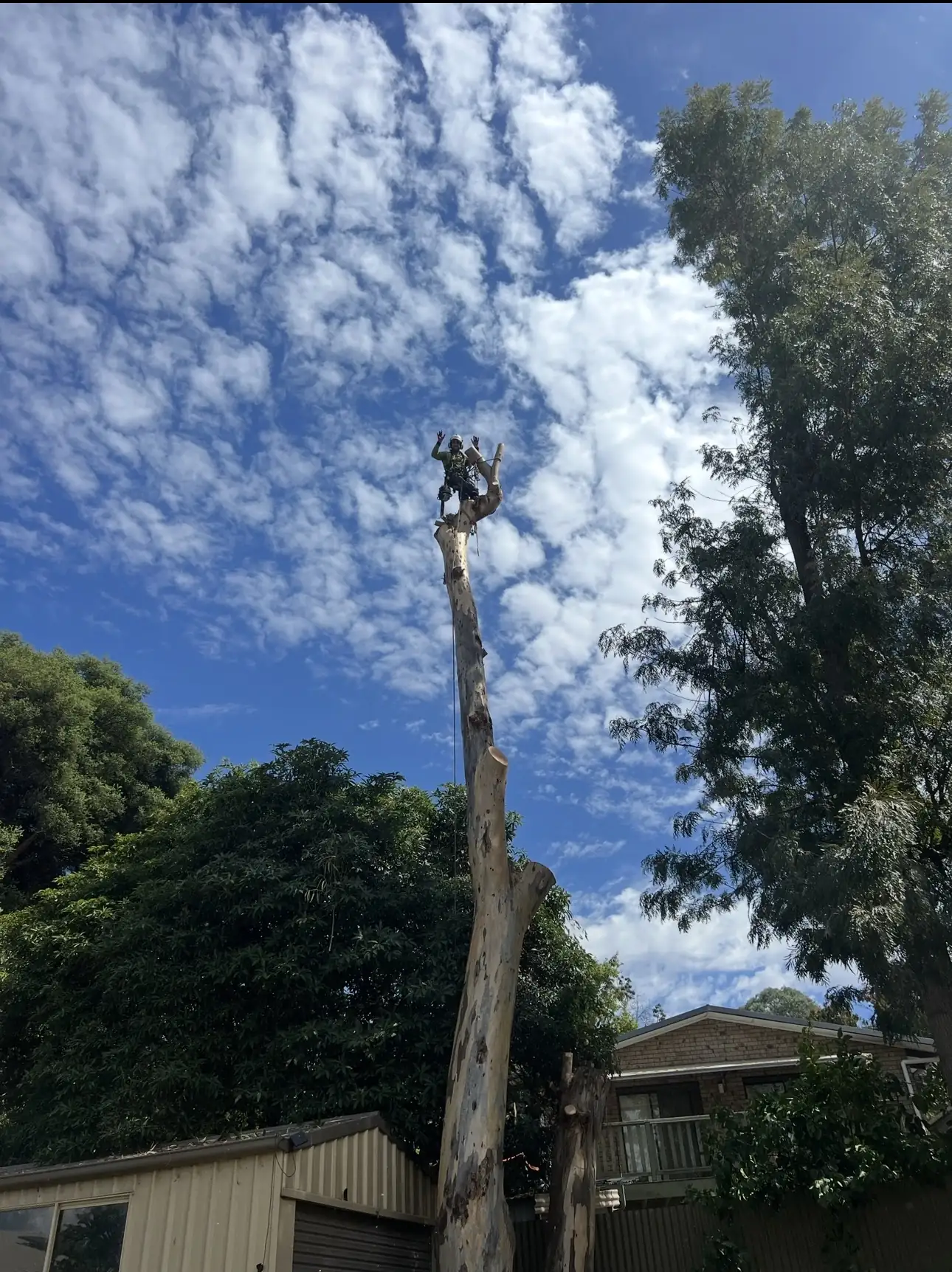
I needed two massive gumtrees removed from my back yard, which were over house and shedding. Drew and his boys did an amazing job cutting them down to ‘bird habitat size’… From the very start, drew was professional, and easy to work with. Kept me updated on where they were at, and well below other quotes I had received. They are trustworthy, take pride in their work and really listen to what the customer wants. Which is very rare nowadays. Highly recommend these guys if you want a proper job done. Ps… good job boys on not dropping anything onto existing buildings !….
Signs the tree itself is the worry
Some warning signs come from the tree itself, and these are the ones that make us look twice.
Four questions to ask about your tree
One warning sign is rarely the whole story. Trees are living things, and they often carry old scars that cause no harm. A past storm may have snapped a limb years ago, and the tree sealed the wound and moved on. Two or three together is a good reason to book a look. A tree with two main stems, one of them dead, is a different case from a healthy tree with a bit of rubbing on the gutter.
Branches, bushfire and wind
Branches over a roof are the most common close-tree complaint. They drop litter, trap damp and give embers somewhere to land. The Queensland Government tells owners preparing for bushfire to trim low branches, specifically those under two metres in height, and to clear dry leaves and branches from the yard [4]. It also asks owners to clear leaf litter from gutters before the season starts [4].
Low branches are the easy part. Heavy limbs over a roof are another. They need ropes, a plan and a qualified arborist, because a cut limb has weight and nowhere safe to go.
Removing a tree is also not automatically the safer choice. Noosa Council says healthy, well-maintained trees around a building can help dissipate wind force, and that taking one out may leave a property more exposed to wind [5]. That comment is about council trees, but the point holds at home. A sound tree can be a shield as well as a risk.
Want this looked at on your own property? The on-site quote is free.
Neighbours, boundaries and protected trees
Many close trees are not on your land at all. The Queensland Government advises talking to the neighbour first, because settling it early is quicker and less expensive than legal action [1]. If you cannot agree, you may trim overhanging branches and roots back to your boundary line, and you may return the cuttings but do not have to [1].
There is also a written notice. It covers branches that overhang by more than 50 centimetres and sit less than 2.5 metres above the ground, on a tree with no vegetation protection order [2]. The neighbour has 30 days to respond [2]. For branches that are higher, or in more serious cases, the matter can go to the Queensland Civil and Administrative Tribunal, which the state calls a last resort [1]. Root damage can count as serious damage to your land in that process [1].
Protection is the catch. A vegetation protection order stops branches being lopped, and it can apply near waterways, in bushland, on large significant trees or on heritage sites [2]. Council planning schemes can protect trees too. On the Sunshine Coast, council says that damaging or removing certain protected trees on private land is an offence, and a permit can be required [6]. Noosa Council says the same about protected trees and plants [5]. Some councils offer a site report that shows if your property has protected vegetation [6].
Rules differ between councils and they change. Check yours before anything is cut. We never assume a rule applies to a particular tree. We will help you check what applies to yours.
What to try before removal
Taking a tree out is the last step on a short ladder. Most of the steps below it cost less and keep the tree.
- Prune it back. Lift the canopy off the roof, take off dead wood, and thin the weight on limbs that hang over. We explain each cut before we make it.
- Support it. A tree with a split or weak union can sometimes be held with a cable and brace, which supports it without cutting it down.
- Fix the cause. A leaking pipe or poor drainage may be doing more harm than the tree.
- Watch and record. For a sound tree with a small worry, photographs every few months show whether anything is changing.
Think of it as a plan with stages. Each stage should be tried only if the one before it cannot do the job. A tree that only needs a lift off the roof should never end up as a stump.
Scenic Rim Regional Council’s policy for its own trees backs this order. It says removal needs good reason, because trees take a long time to grow and are not easily replaced, and it lists taking off part of a tree as a suitable alternative to taking the whole thing. It also does not treat minor lifting of paths as grounds for removal [8].
Removal makes sense when the tree is dead, badly decayed, split beyond saving, or leaning toward a building with no fix that holds. It also makes sense when roots and the building cannot share the space any longer. If a tree can stay, Drew will say so, even if that means losing the job.
Chose Drew and the team as they had great reviews. Wasn’t disappointed at all. Drew gave me a quote to remove a pine that split and advice on another tree that was looking at doing the same. They were able to get it done quickly and to a great standard. Very happy with the service.
When to call an arborist, and when you can wait
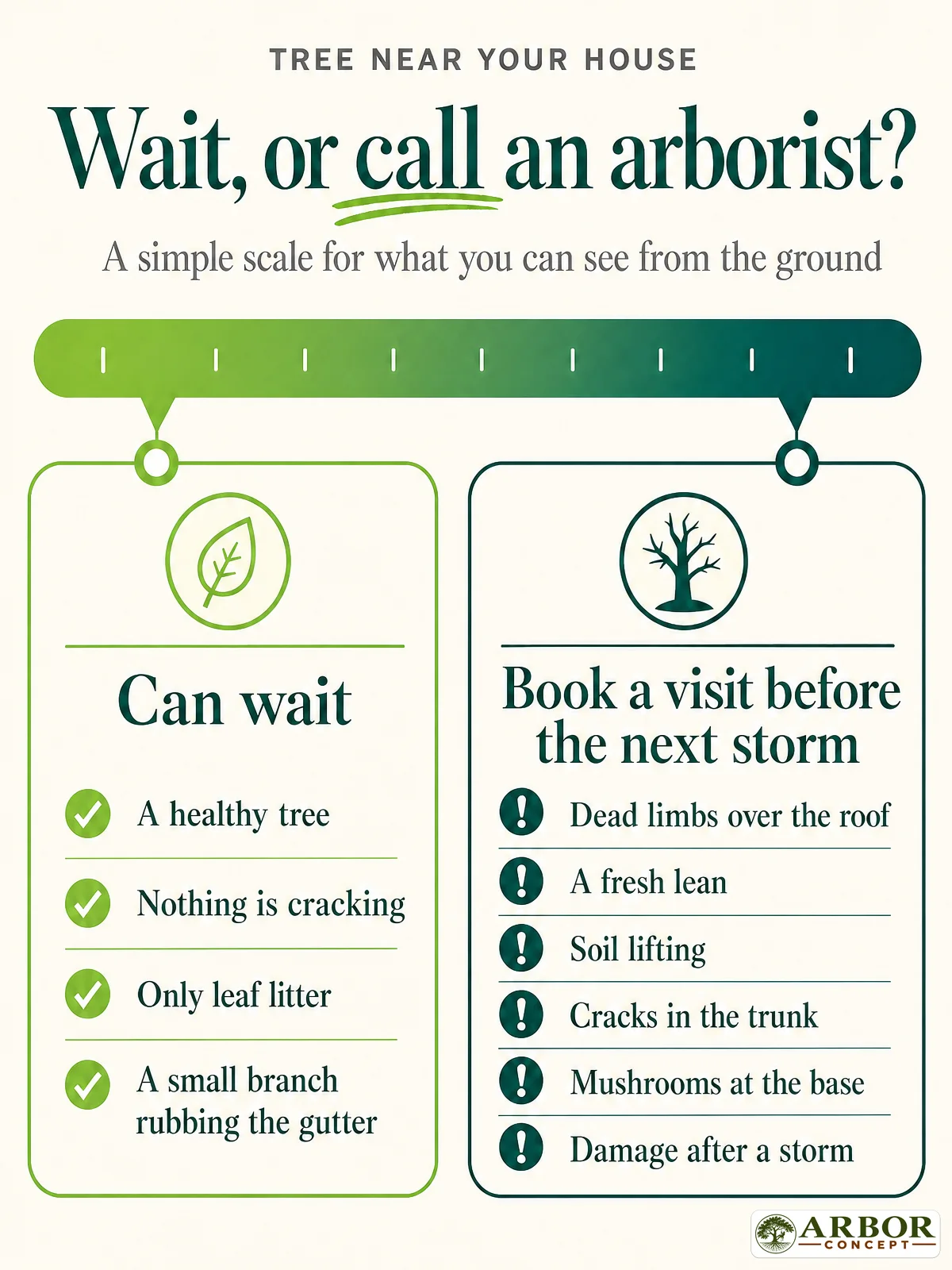
You can wait if the tree is healthy, nothing is cracking, and the only issue is leaf litter. A calm tree with a small branch rubbing the gutter is an annoyance and can wait for your next free weekend. A tidy gutter and a quick look each season may be all you need.
Call someone when you see dead limbs over the roof, a fresh lean, soil lifting, cracks in the trunk, mushrooms at the base, or damage after a storm. Book the visit before the next storm.
Doing it yourself
- Photograph the tree and the house from the same spots each season.
- Keep gutters clear and leaf litter off the roof.
- Check pipes and drains if cracks appear.
- Keep people out of rooms under a damaged limb.
- Climbing the tree or standing a ladder against it.
- Using a chainsaw over a roof.
- Cutting big roots beside the trunk.
- Pruning near power lines or service lines.
How a tree beside a house comes down
When removal is the answer, the method follows the space. There is rarely room to fell a tree whole beside a wall, so our team takes it down in sections. A climber works from ropes, or from a spider lift when the trunk is too weak to hold a person, and each piece is lowered to the ground. For a giant, the weight can be too great for ropes alone, and a crane then holds each section and lifts it clear.
Drew walks the job with you first. He looks at the tree, the roof, the access and the ground, then explains the plan. Heavy gear sinks into a soaked lawn, so when nothing is urgent the job moves to a drier day. If you want to protect a lawn, track mats can be quoted in.
Our team can also talk to your neighbours about the job, which matters when the tree leans toward a shared fence or throws shade over their yard. It is easier when an arborist explains what is happening and why. Your choice of what happens to the wood comes next: carted off, left as firewood, or milled by someone we organise.
What the visit looks like
- Drew looks at the tree, the roof and the ground around the house.
- He tells you if the tree can stay, and what it would need.
- If it must go, he picks the safest method for the space.
- You get the plan in writing, with the quote.
- Our team does the work and leaves the site tidy.
You can read how tree removal works from the first visit to the last cut, or read how pricing is worked out. Pensioner and local discounts are available. When you want a second pair of eyes on the tree, ask for a free on-site quote.