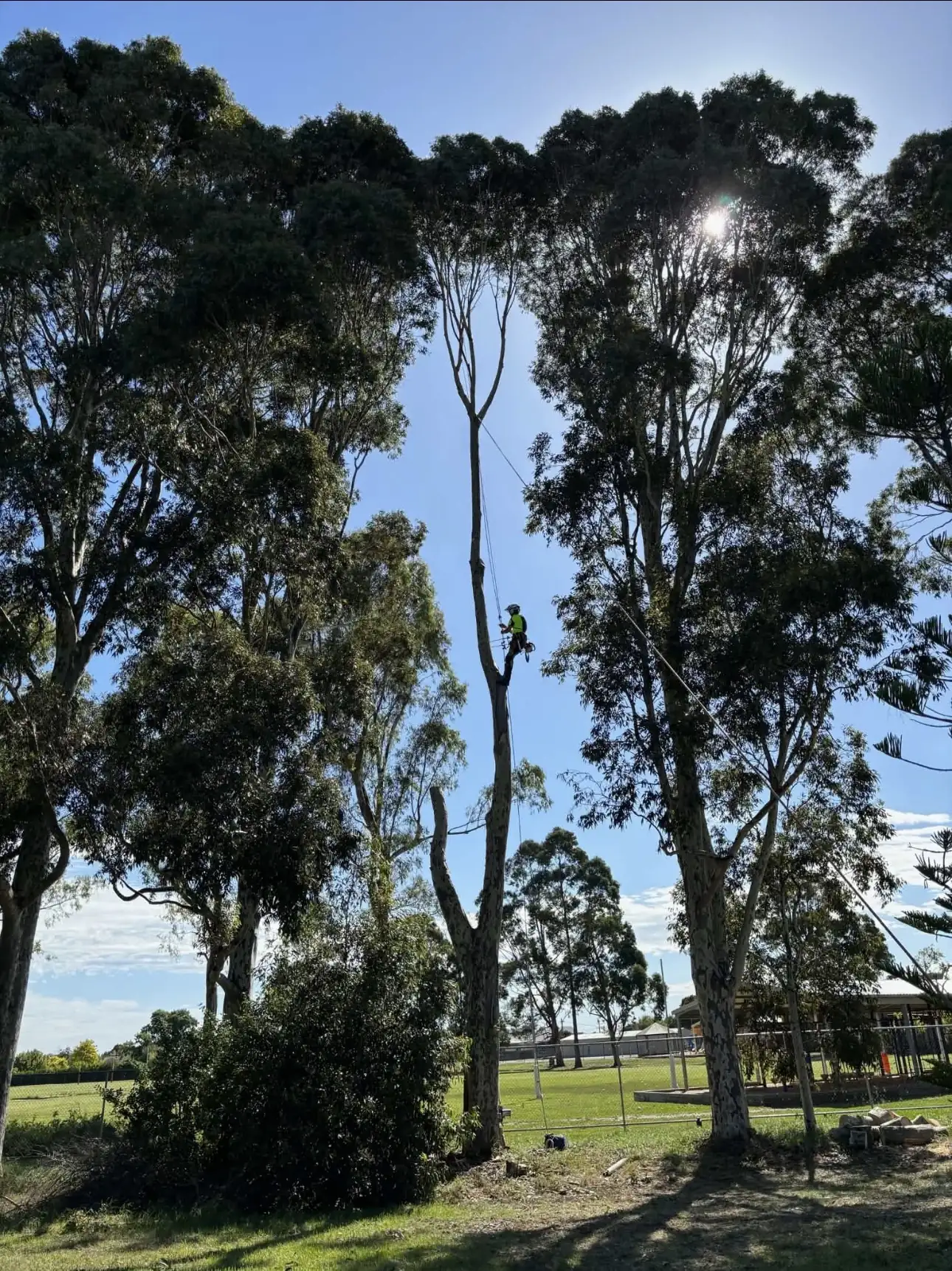
Tree lopping and pruning: what is the real difference?

Tree lopping and pruning are often treated as one job, yet they are not the same cut. Pruning is a planned cut at a chosen spot, where the tree can seal the wound. Lopping, in the strict sense, is a cut made between branch junctions, and trees tend to pay for it later.
This guide shows where the two words split, what each cut does to a tree, and how to read a quote that uses either word. It also covers branches over a fence and the times you do not need anyone at all.
A look at the real tree matters because the right cut depends on the species, the shape and the spot each branch grows from. A photo cannot show you that.
Ask five people what the words mean and you may get five answers. One says lopping is cutting big branches. Another says pruning is the gentle kind. A third says they are the same thing. Each is partly right, which is why quotes and expectations so often miss each other.
Why tree lopping and pruning get mixed up
In daily life, lopping is the word people reach for. It sounds like what you want: some branches gone, the tree smaller on one side. Pruning sounds like something done to roses.
Arborists use the words differently. For us, pruning is the whole craft of taking wood off a tree on purpose. Lopping is one way of cutting, and it is the one that causes trouble. Our own tree lopping service is built on that gap. When a customer says lopping, our team hears a job to be done as pruning.
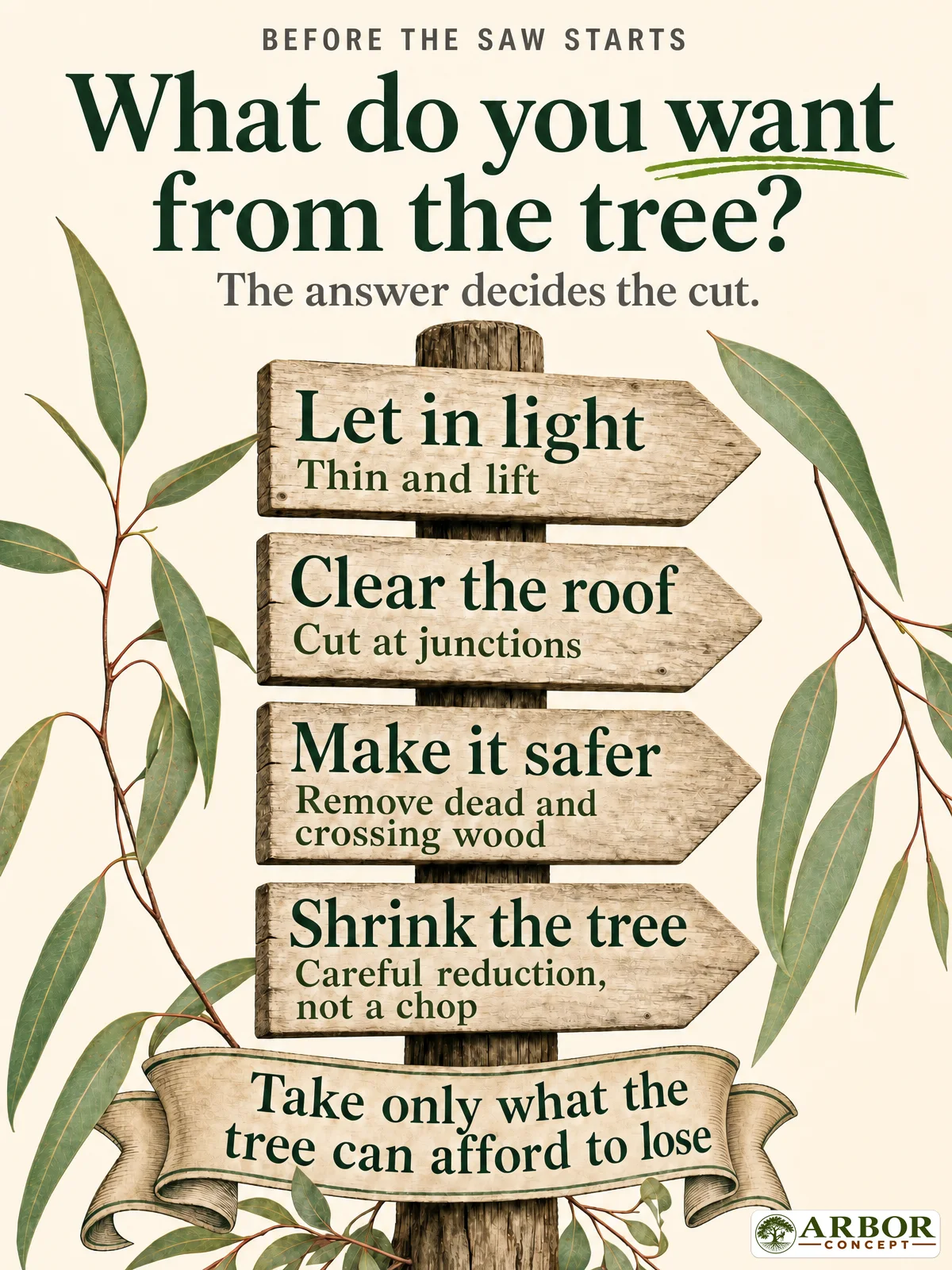
So the first answer to most calls is a question back: what do you want the tree to do afterwards? Fit the space? Let in light? Stay clear of the roof? The answer decides the cut.
What a pruning cut really is
A branch joins a tree at a junction. Around that junction sits a swollen ring of tissue, often called the branch collar. It is the tree’s own sealing kit. A Victorian council explains that a cut made near the branch bark ridge lets the tree grow over the wound quickly [1]. The same page says the collar holds tissue that helps close the wound, so the cut should land just outside it and never through it [1].
The City of Ryde, in Sydney, puts the aim of pruning in one line: build and keep a strong structure and a working form, and let the natural shape develop [2]. It adds that every cut spends some of the tree’s stored energy, so each one needs a good reason [2].
That is the heart of pruning. The cut goes where the tree can deal with it. Before the saw moves, there is a plan: which branch, which junction, and what the tree will look like afterwards.
What a good cut looks like
- Find the junction where the branch meets a bigger limb or the trunk.
- Spot the collar, the swollen ring around that junction.
- Cut just outside the collar, leaving it whole.
- Leave no stub and no flush scar.
- Step back and check the tree still has its balance.
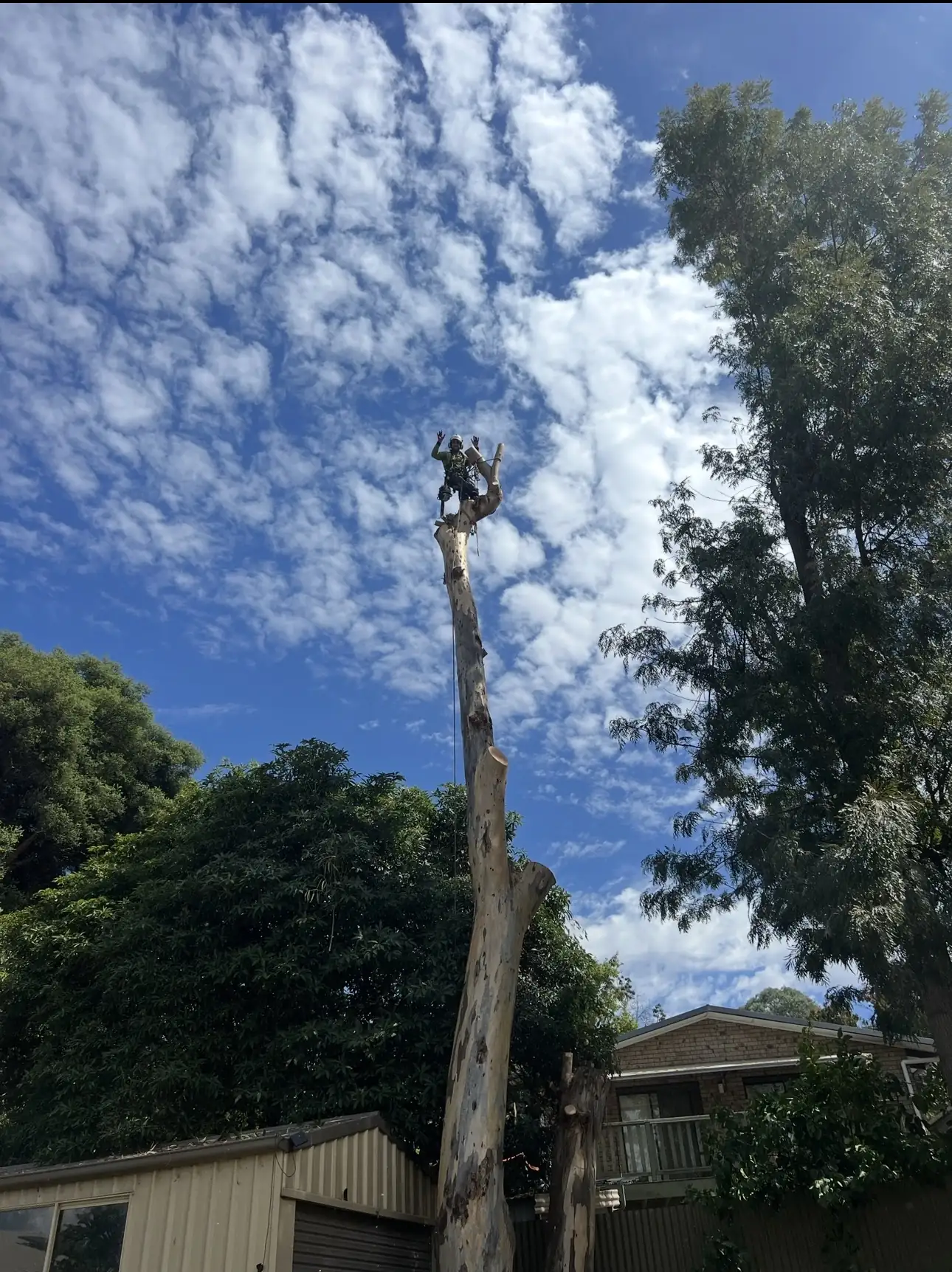
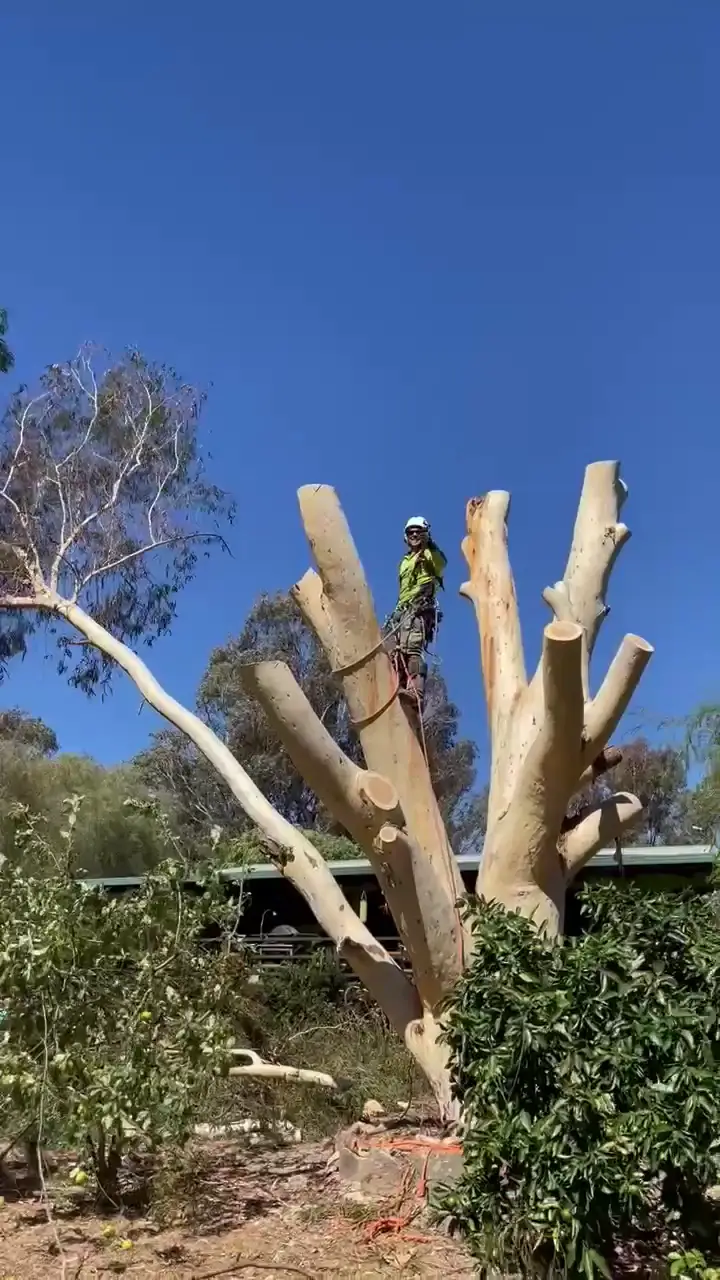
Heavy limbs add one more step. They come off in pieces, so the falling weight never rips bark from the trunk, and the climber stays clear of the drop zone.
The result is a tree that looks like a tree. You should not be able to spot where the cuts were made from across the road, because the shape is still natural and the wounds are small.
What lopping really means
Lopping, in the strict meaning, is cutting a stem or limb between its junctions. The Victorian council says this usually makes the plant throw bushy growth behind the cut, and it says outright that lopping is bad for the health of trees [1]. The cut sits at a spot where the tree has no ready way to seal over, which leaves it open to fungal infection [1].
A New South Wales council goes further. In its area, lopping means cutting between branch unions or at internodes, with a stub left behind, and it is prohibited [3]. The same council calls topping an old practice that damages a tree [3].
Redland City Council, in Queensland, points owners the same way. Routine pruning should follow Australian Standard AS 4373, and it advises a qualified arborist. Work that could harm a protected tree needs approval [8].
Your own council may not use these exact words. The point stands anyway. Where a rule exists, it exists because the cut hurts the tree.
Drews quick response and booking was fantastic. Lads were on time and great to deal with, very knowledgeable on the tree trimming and lopping safety all the way and cleaned up their mess to boot. 5-star rating for a reason
Tree lopping and pruning side by side
Here is how the two cuts compare, along with their rougher cousin, topping.
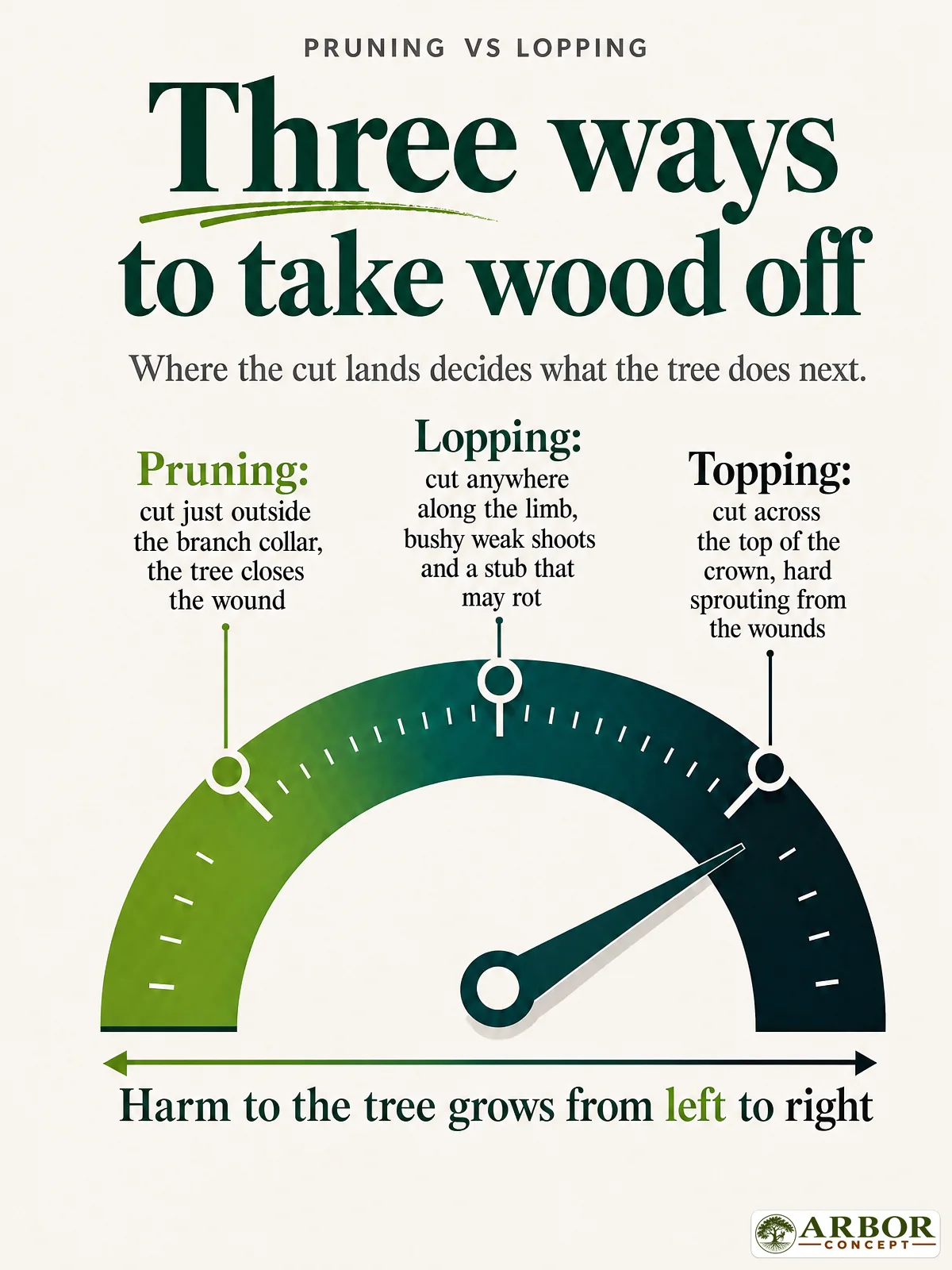
Three ways to take wood off a tree
| Cut | Where it goes | What the tree does next |
|---|---|---|
| Pruning | At a junction, just outside the collar | Closes the wound over time |
| Lopping | Anywhere along the limb, often leaving a stub | Sends out crowded shoots, may rot at the stub |
| Topping | Across the top of the crown or main stems | Sprouts hard from the wounds, often weakly attached |
Notice that only the first row comes with a plan. The other two are quick answers to a slow problem.
What a rough cut does to the tree afterwards
Think of a limb that has been cut mid-way. The tree cannot rest. It has lost leaves, so it makes more, fast. New shoots burst from the wound and from lower on the limb.
Whitehorse Council says the bushy growth after lopping is often poorly attached to the stem or trunk and can make the tree dangerous [1]. The City of Ryde lists weak regrowth from epicormic shoots, poor tree form and reduced life expectancy among the results of improper pruning [2].
So the tree looks full again within a season or two, but it now carries branches that hang on by a thin join. They are heavier than they look and they sit higher over your roof. That is the trade: a quick fix now, a bigger risk later.
There is a money side too. Fast sprouting means the job comes round again sooner, and a cut that has to be repeated is rarely the saving it seemed to be.
Four things people hope a cut will do
Want this looked at on your own property? The on-site quote is free.
How much should come off a tree?
Everyone wants a number. Honest answers are harder to give.
There is no single share that suits every tree. A young, strong tree can lose more than a tired old one, and a species that copes poorly with big cuts can lose very little. The City of Ryde shows how tight a rule can be: without an application, it lets owners take only a limited share of live canopy in a year, and only from small branches [2].
Our approach matches that. Our team takes only what the tree can afford to lose. If your tree needs less than you first asked for, you will hear that from us before any cut. Sometimes the best advice is to wait a season and take a little more then. Small steps beat one big cut, and the tree keeps its strength while it recovers from each one.
Whitehorse Council in Victoria sets a canopy-loss threshold above which pruning a protected tree needs a planning permit, and it gives the example of a lower limb whose foliage is a small part of the canopy and so will not severely hurt the tree’s ability to make food [1]. Whatever your area says, the idea is the same: take a little, take it well.
Before the saw starts
- Ask which branches will go and why.
- Ask where each cut will be made.
- Say what you want from the tree afterwards.
- Ask what the plan is if the tree needs more later.
- Asking for half the tree to go in one visit.
- Agreeing to a quote that only says top it or round it over.
- Leaving stubs because they look tidy.
- Cutting before you know if the tree is protected.
Read the quote itself, too. If words like topping or rounding over show up on it, ask what they mean before you agree.
Branches over the fence
Overhanging branches start more arguments than almost anything else in a street. They also raise the question of who may cut what.
The Queensland Government says the owner of the land where the tree stands is the tree-keeper, and is responsible for caring for and maintaining it [5]. It adds that you may trim branches that overhang a neighbour’s land, unless a protection order covers the tree [5]. QCAT, which handles tree disputes, says a formal notice route does not apply where such an order covers the tree [6].
If the tree belongs to the council, the picture changes. Noosa Council asks residents to get written authorisation before pruning a council tree back to the boundary, and it says a qualified arborist must do the work [4]. It also says it will not approve reshaping the canopy [4]. All pruning there must follow the Australian Standard for pruning amenity trees [4].
The City of Sydney is firmer still. It does not allow a cut that takes a neighbour’s overhang right back to the boundary, because that damages the tree. It wants an application first [9]. Two sensible habits help everywhere. First, talk to the neighbour. QCAT recommends trying to settle things informally first, and it notes that free mediation is on offer [6]. Second, check the tree before you cut. Our team is happy to speak to neighbours for you, because it is easier when an arborist explains the job.
Rules differ from place to place and shift over time. We do not know whether a rule covers your tree until we see it, so we never claim one does.
Drew and his team are professional in all aspects their business. We have used them from pruning, maintenance and emergency tree removal. I find them reliable, knowledgeable, helpful and thorough. Highly recommended. Maz Ashlarstays
Getting an arborist in, and when to skip it
You do not need an arborist for everything. A low shrub, a few twigs at head height or a hedge you can reach from the ground is yours to look after. Use sharp, clean hand tools and cut at a junction.
Bring in a qualified person if any of these fit:
- The branch is high, thick or heavy, or you would need a ladder.
- The limb hangs over a roof, a pool, a car or a neighbour’s yard.
- Anything is near a power line.
- The tree may be protected, or you are not sure.
- The tree looks sick, split or dead in places.
The reason is simple. SafeWork NSW lists falls from heights, being struck by falling objects and working around power lines among the major risks in tree work, and it counts lopping and pruning as tree work [7]. Those risks are why ladders and chainsaws do not belong in a weekend plan.
An arborist also reads the tree. Dead wood, a bad union or fungus at the base can change what ought to be cut, or whether to cut at all. If a tree is fine as it stands, we say so, even when that costs us the work.
How we handle tree lopping and pruning
If you ask us for lopping, you get pruning. That is the short version.
The longer version starts with a visit. Drew walks around the tree with you and listens to what is bothering you: the roof, the light, the fence, the view or the fear of a storm. He explains what each cut would do, and our team agrees a plan with you before a single branch comes off. Nothing is priced from photos, because a photo cannot show a hidden union or the way a limb leans.
Our pruning follows the Australian Standard, AS 4373, and the business carries public liability insurance. Drew brings 20 years’ experience and a Cert III arborist qualification to every visit. Our team explains each cut before it is made. You are welcome to stay and watch, and to say so if you would like less taken.
Cut branches have to go somewhere, so settle that early. Some people want everything chipped and carted off. Others want the thick pieces stacked as firewood, or the leafy material left on the garden beds. All three are fine. Say which you prefer, so the price covers the same thing every time you compare quotes.
Payment is simple. Half locks in your day, and the promise runs both ways: the day is yours and our team makes sure it happens. The balance is due at the end, once you are satisfied. Pensioner and local discounts are available. Just mention it.
To see how a price is built, visit the how we quote page. Then get in touch and ask for a free quote.