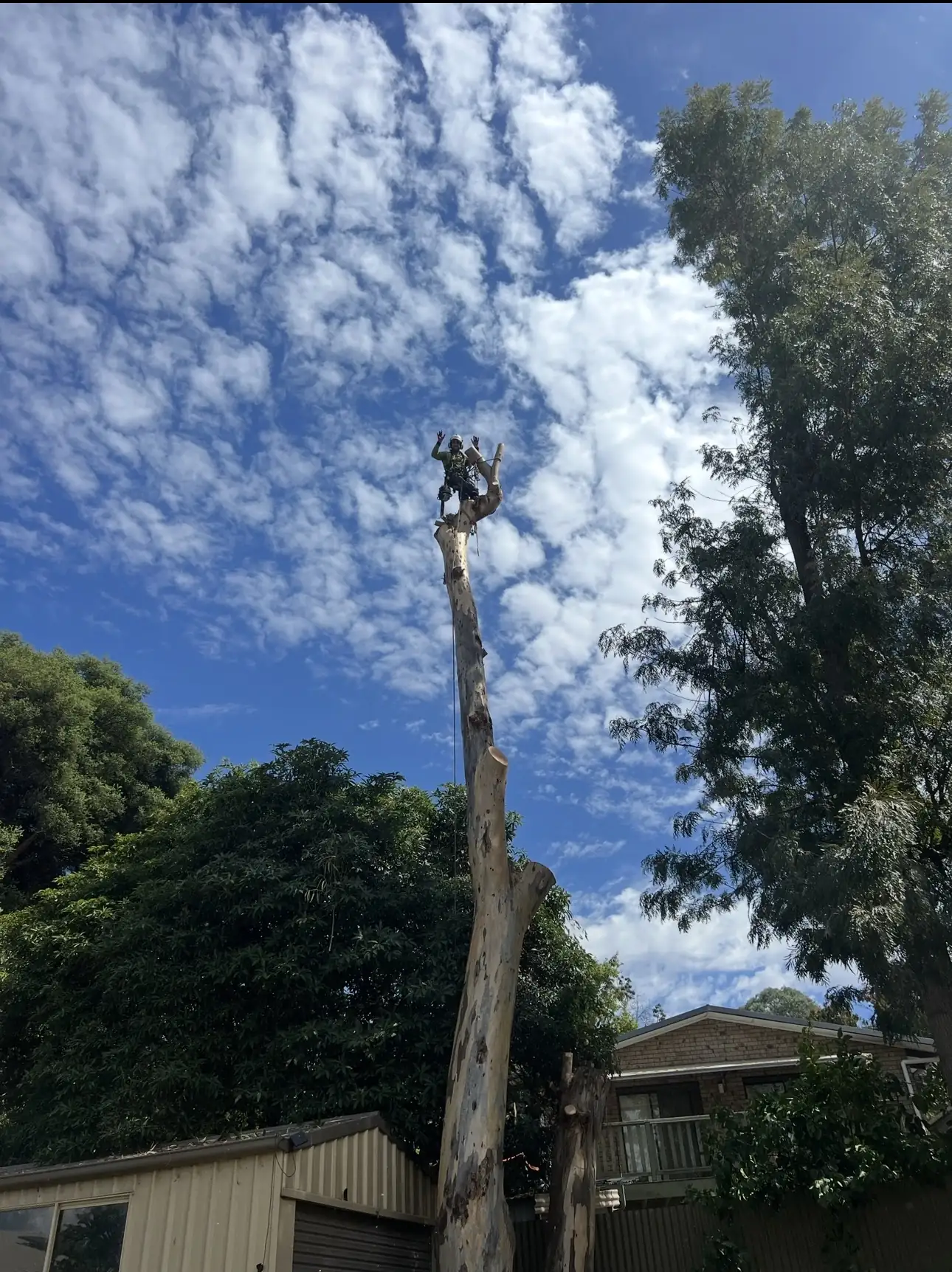
Why tree topping is bad, and what to ask for instead
Why tree topping is bad comes down to one thing: it swaps a problem you can see for one you cannot. The tree looks tamer for a few months. Inside, it is carrying a pile of fresh shoots that are poorly joined to the old wood.
This guide explains what topping is, what a tree does in reply, and what councils and tree scientists say about it. It also covers the rules, the neighbour angle and the better ways to get light, privacy and space.
A tree can look the same from the street while two very different cuts are possible. That is why a look at the real tree, from someone qualified, matters before any cutting starts.
A lot of people picture topping as a haircut. Take a good slice off the top and the tree is back in its box. That picture is the trouble. A tree grows differently from a hedge, and it handles a flat cut badly.
What tree topping is
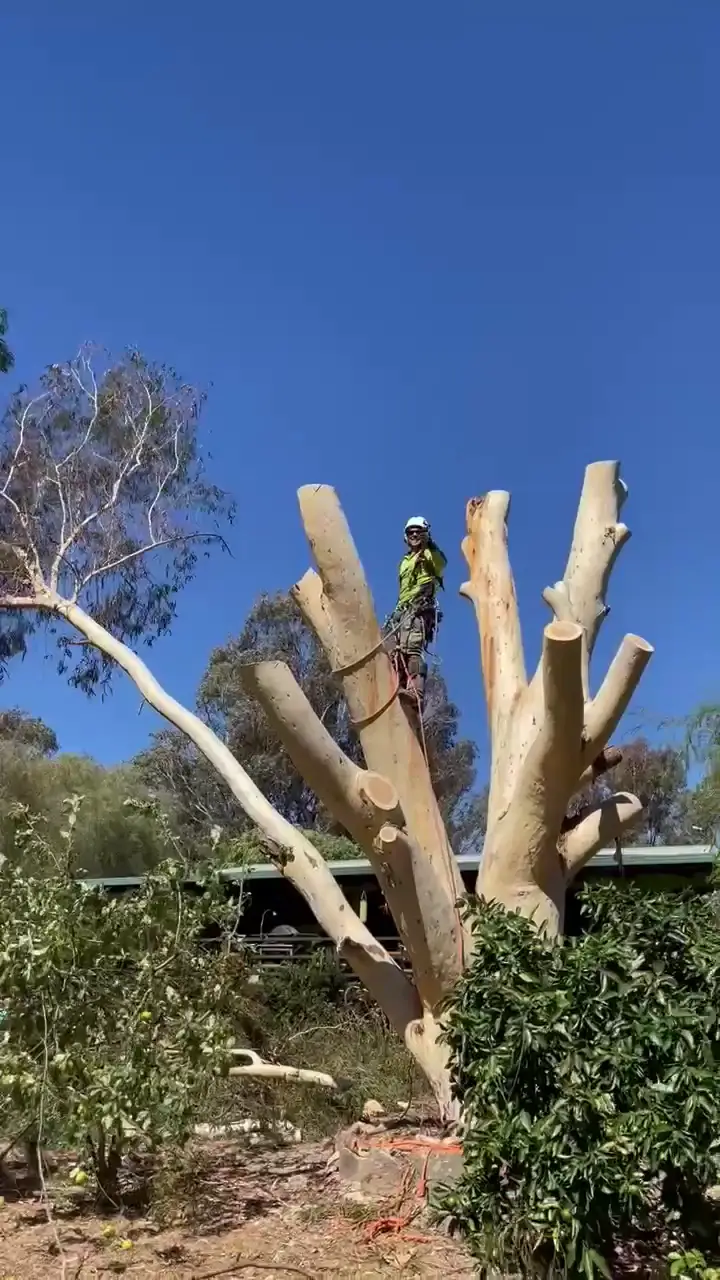
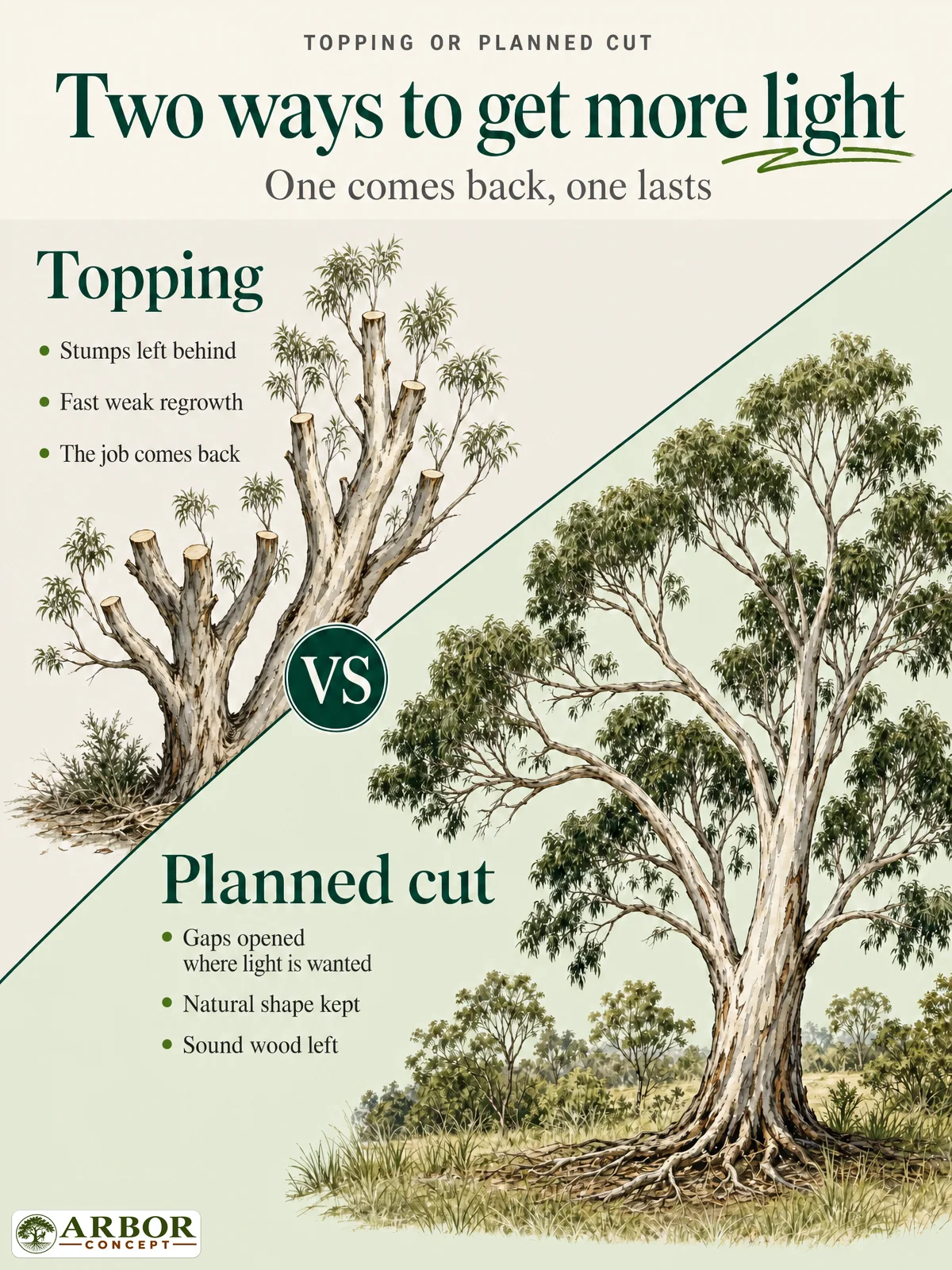
Topping means cutting the main stems of a tree back to stubs. The cuts land wherever the saw happens to reach. No side branch is picked to carry on as the new leader. The tree is left as a few bare stumps, often with nothing green close to the cut.
Pruning is a different job. A pruner decides which limb goes, how far back, and what stays to carry the crown. The tree keeps its shape and most of its leaves. Our tree lopping and cutting work is planned that way, cut by cut.
So why tree topping is bad starts with how it is done. There is no plan inside it. It removes size and calls that a result.
Why topping feels like the right answer
Nobody tops a tree out of spite. The reasons are usually fair ones. The tree has grown past where you wanted it. It shades the pool, drops leaves in the gutters or blocks the view. A tall gum that drops limbs, or a camphor laurel leaning over the roof, can feel scary when the wind picks up.
Topping answers every one of those worries in an afternoon. The crown comes down, the light comes in and the yard looks open. That quick win is why the practice has lasted. It is also why it is worth slowing down, because the win does not last.
What a topped tree is trying to do
The regrowth is weak where it counts
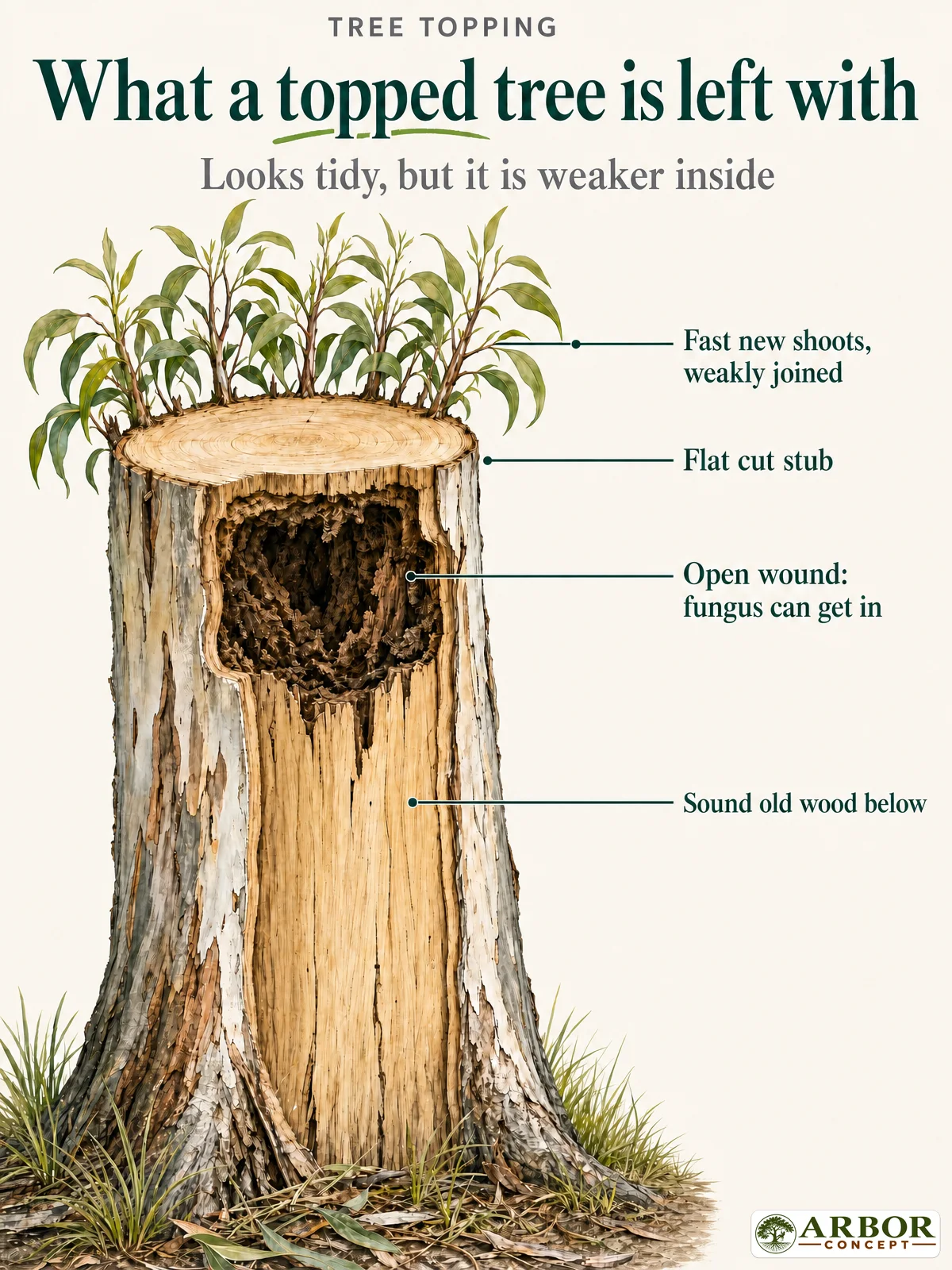
This is the heart of why tree topping is bad. The shoots that appear after a topping cut are called epicormic shoots, or water sprouts. They grow fast and look healthy. But they start from buds buried in the old wood, and the join between the new shoot and the old stem is poor.
A normal branch is built into the tree as it grows. Wood from the branch and wood from the trunk lock together over the years. A water sprout has none of that. It is stuck on, then asked to grow long and heavy. The City of Ryde lists weak regrowth, the epicormic shoots, among the faults that improper pruning can cause [2]. In wind, a heavy shoot on a weak join is the first thing to let go.
Redland City Council puts it in a sentence. It says topping may make a tree dangerous because of the regrowth of epicormic branches, and may worsen the tree’s structure [1]. That warning comes from a council that looks after trees on public land. A Queensland council policy goes further. It calls topping an unacceptable practice under the Australian Standard, and says the regrowth is vigorous, generally vertical, weakly attached and dense [8]. A state fact sheet explains the join: shoots like these form shallower, weaker unions than normal branches, and when they grow fast and get too heavy they may fall, more so in windy conditions [9].
Think about where the trouble sits. The weak shoots are high in the tree. They hang over whatever is below, which is often your roof, your car or your kids’ cubby. A tree that was fine for decades can become the one you worry about every storm. Queensland summers test every weak join, and the wet season adds the weight of water to a crown full of new shoots.
Drews quick response and booking was fantastic. Lads were on time and great to deal with, very knowledgeable on the tree trimming and lopping safety all the way and cleaned up their mess to boot. 5-star rating for a reason
The cut ends do not heal over cleanly
A tree cannot repair a wound the way skin does. It walls the damage off and grows new wood around the edge. A big cut on a thick stem is hard to wall off. It stays exposed to rain, insects and fungus for a long time.
Redland City Council warns that topping can lead to fungal infection or weaken the tree, leaving it unstable or open to failure [1]. Tablelands Regional Council repeats the same warning, that topping may worsen the structure of a tree, lead to fungal infection or weaken it [3].
You often cannot see the damage. A stub can look sound on the outside while the wood inside softens. Years later, a limb that looks solid lets go. By then nobody connects it to the cut that started it.
Topping against a planned cut
| What you want | What topping gives | What a planned cut gives |
|---|---|---|
| More light | A bright spell, then a thick flush of shoots | Gaps opened where the light is wanted |
| A smaller tree | Stumps, then fast regrowth to the same height | A smaller crown with its natural shape kept |
| Less risk | Weak shoots high up and open wounds | Heavy or weak limbs reduced, sound wood left |
| Low upkeep | A job that comes round again and again | Less regular work, and a check on how it is going |
The job comes back, and so does the bill
Here is the part that costs real money. A topped tree does not stay topped. It rebuilds what was cut, and it does it fast. Brimbank City Council says improper, outdated pruning such as topping and lopping can cause damage that lasts the life of the tree and shortens its life expectancy [4]. A tree rebuilt from shoots does not return to its natural shape, and it needs cutting back again and again.
That matches what we see in the yard. You pay to cut the tree back. Months later the shoots have refilled the space. You are looking at the same stumps with a green fuzz on top, and the question is the same: do it again?
Each round makes the next one worse. More cuts on the same stubs. More weakly joined shoots on top. The tree gets harder and more dangerous to deal with, not easier. Brimbank City Council notes that improper tree care can take many years to correct, and in some cases it never can [4]. At some point the honest answer is to take it out and plant something that suits the spot.
Our quote shows the whole picture instead. Drew looks at the tree, the space and what is underneath. He explains what each option does now and what it does next year, so you can compare a quick fix with a lasting one.
Want this looked at on your own property? The on-site quote is free.
What councils say about topping
Councils are blunt about it. Tablelands Regional Council says a resident may not remove, prune or top a council-owned tree, and that penalties can apply under local and state laws [3]. Redland City Council says much the same for trees on its land [1].
North Sydney Council takes it a step further. It does not support practices that fall outside Australian Standard AS 4373-2007, and it names topping among them, because such work can harm tree health, safety and amenity [5]. It also says cosmetic pruning must comply with that standard [5]. The standard is the one for pruning amenity trees, and anyone doing the pruning should know it. Its own sample pages say lopping, topping and flush cutting are unacceptable practices, and that trees should be assessed by a suitably qualified arborist [10].
The same page mentions a rule of thumb for the live crown: take only a small share in any one pruning event, or as the species allows [5]. That idea sits behind our own approach. We take what the tree can afford to lose, and we will tell you when it needs less than you asked for.
Questions to put to anyone quoting on your tree
- Which branches come off, and why those ones?
- Where will each cut sit on the limb?
- What will the tree look like in a year?
- Does the plan follow the Australian Standard for pruning?
- A plan to cut every stem back to the same height.
- A price given without anyone looking at the tree.
- No answer on what happens to the regrowth.
- Pressure to decide on the spot.
Rules on your own land
Topping on a private block is not always your choice to make alone. Some councils treat it as a form of clearing. The City of Moreton Bay lists topping and lopping in its meaning of clearing, and says you may need council approval before clearing or cutting trees on your property [6]. It also says many kinds of work need no approval at all [6].
Sunshine Coast Council lists pruning so hard that the tree is likely to die among the things that may need a permit when vegetation is protected [7]. Whether a tree is protected depends on the property, so the page points owners to a site check [7].
Councils set their own rules, and the rules get revised over time. No article can tell you that one applies to your tree. Ask your council before a single branch is touched, then bring us the answer.
Drew was fantastic. Responsive, efficient, knowledgeable and accommodating. Will definitely be calling on Drew and his team again.
Better ways to get light, privacy and space
Most of what people want from topping can be had without it. The first step is to be clear about the real goal. Is it light on the lawn, a clear view, a smaller shadow, or fewer leaves in the gutter? Each goal has its own answer.
How we sort out a tree like this
- Drew walks the yard and asks what you want from the tree.
- He checks the tree, the lean, the wood and what sits underneath.
- He tells you what can be done, and what should not be.
- We mark up each cut, and explain what it will do.
- Our team does the work, and you are welcome to watch.
Often the answer is to open up the crown so light and wind pass through. Sometimes it is to lift low growth, or to take one limb that is causing the shade. A big tree may need a gentler, staged reduction over time. Brimbank City Council says correct pruning reduces the risk of branch and stem breakage and improves a tree’s health and appearance [4].
We can also check back with you later. A short look in a year shows how the tree has responded, and whether a small tidy now saves a large job later. Regular light work is kinder to the tree than one drastic cut after years of growth.
Which tree jobs call for an arborist
Plenty of tree jobs are small. A low shrub, a short branch within reach of the ground, nothing underneath and no line nearby: that is a garden task, and you can ask a few questions and decide for yourself.
Bring in a qualified arborist when the tree is tall, the limbs are heavy, the cut sits high up, or a power line, a roof or a neighbour is close. Climbing and chainsaw work at height is where people get badly hurt. It needs training and the right gear, not a free weekend.
Do the same if the tree has already been topped. A tree carrying a crowd of fresh shoots needs a careful look. Some can be guided back to a safer shape over time. Others are better removed. He will say which, even when removal is the bigger job for us.
The visit and the quote cost nothing, and nobody prices your tree from a photo. Drew is your contact from the first call to the quote. He has 20 years of experience and is a Cert III qualified arborist. He looks at the tree, the access and the neighbours, and talks you through your choices in plain words.
If a lighter cut lets the tree stay and do its job, he will say so, even if it costs us the work. Our team does the work, to Australian Standards, council rules and safety rules. Public liability insurance is in place.
The page on how we quote sets out how a price is built. Whenever you like, get in touch for the free visit and describe what you want from the tree. Drew starts with that goal.