How long does a tree stump take to rot, and what decides it?


How long does a tree stump take to rot? There is no single answer. A soft timber in damp ground can break down in a handful of years, while a dense hardwood can sit there for decades.
This guide explains what sets the pace: the type of wood, the moisture, the fungi and the termites. It also covers what a rotting stump does to the soil around it, and whether anything really makes it go faster.
We are not here to push you into grinding a stump that is doing no harm. We would rather you understood the process, and then decided. If you want a second opinion on one particular stump, a look at it on site settles most questions.
Walk into any bush block and you will find old stumps in every stage of decay. Some are soft and crumbling. Others look as solid as the day the tree came down. Same forest, same rain, very different results. The reasons are worth knowing, especially if you are deciding whether to wait or to act.
How long does a tree stump take to rot? Start with the wood
The wood itself is the biggest factor. Different timbers hold up to decay at very different rates, and Queensland publishes ratings for many of them. These ratings were written for timber used in building, but they show the spread well.
Grey ironbark is rated Class 1 for use in the ground, with a life expectancy of more than 25 years [1]. It is also listed as termite resistant. Brown quandong, a softer rainforest timber, is rated Class 4 in the ground, with a life expectancy of under five years, and it is not termite resistant [2].
Two timbers, two timelines
| Measure | Grey ironbark | Brown quandong |
|---|---|---|
| Rating in the ground | Class 1 | Class 4 |
| Life expectancy in the ground | More than 25 years | Under five years |
| Life expectancy above ground | More than 40 years | Under seven years |
| Termite resistance | Resistant | Not resistant |
Be careful with these numbers. They describe the strong heartwood of cut timber, not a living tree’s whole stump. A stump also has softer outer wood, which goes first. So read the table as a sign of the spread. It does not promise a date. A stump of a durable species will outlast one of a soft species by a wide margin, and that is the point.
What sets the pace
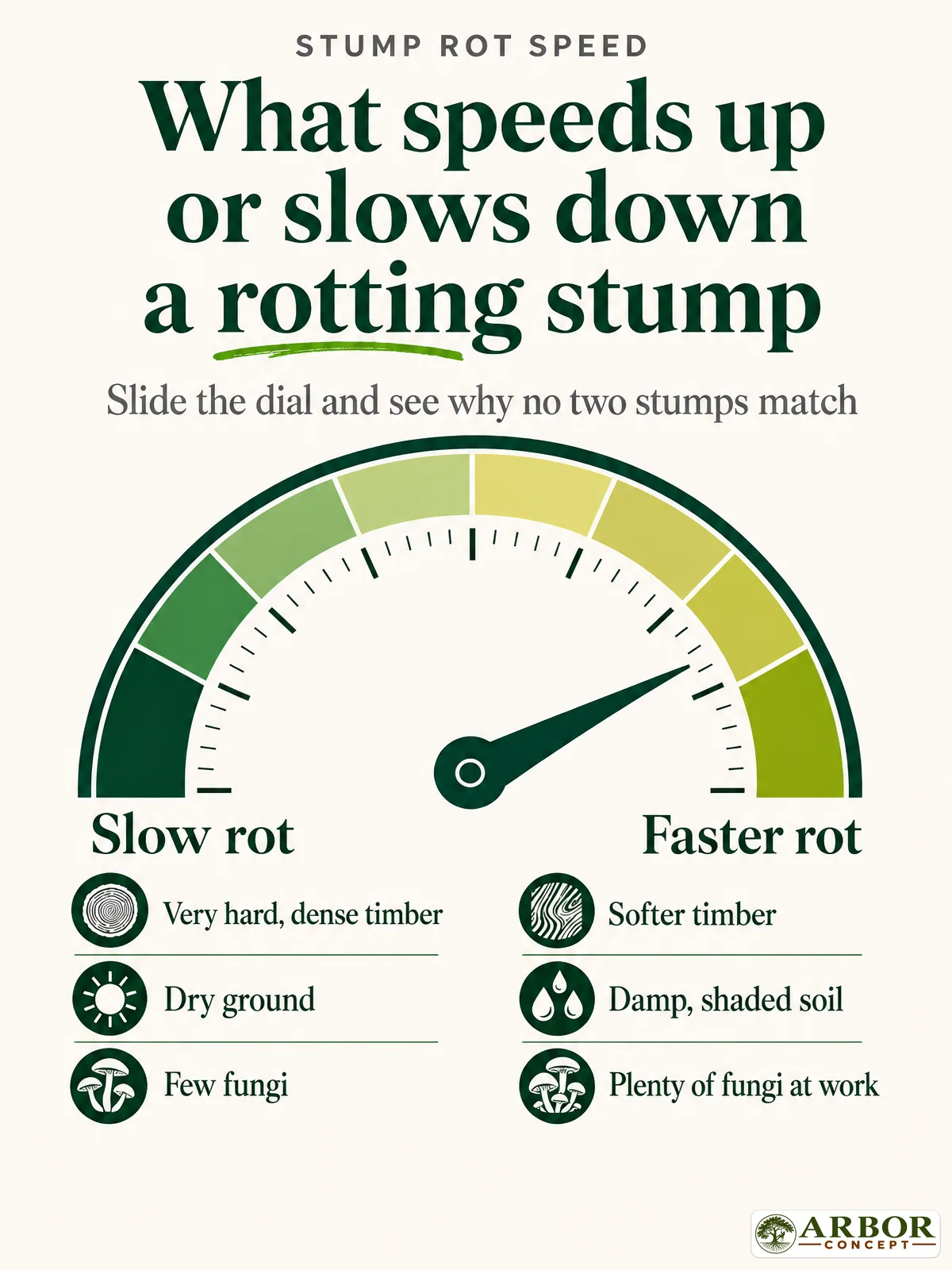
Species is only the start. A handful of other things push the clock one way or the other.
Six things that set the pace
None of these works alone. A tough species in a wet gully might rot faster than a soft species on a dry hilltop. This is why neighbours with the same kind of tree can see very different results.
It also explains why no honest person can name a date. When someone asks how long a tree stump takes to rot, the fair reply is a range, and a request to see the stump. Species, wetness and what has already moved in can all be checked on the day.
Moisture matters more than most people expect
It is easy to assume that insects do the heavy lifting. A study from James Cook University tested this in north Queensland. Pine blocks were put out at a rainforest site and a savanna site, some with mesh to keep termites away [3]. Mass loss was higher at the rainforest site, and the authors put that down to the role of moisture [3].
Their idea was that termites might matter more in dry country, since termites stay active when microbes slow down. That was not supported [3]. Termites were more common in the savanna, but they were not more important there [3]. In other words, how common an insect is does not tell you how much wood it eats.
For a home yard, the lesson is simple. A stump in a shaded, damp, mulched corner will go down faster than one in a dry, sunny spot beside a driveway. The wood needs water for the decay to run. A stump that is cut low, kept under shade and sitting in damp soil has the best conditions. A tall stump left in full sun dries on top, and the dry part decays slowly.
They were very prompt and professional the guys were all friendly the job was done with ease and they cleaned up afterwards, I thought it was value for my money I am very happy with this experience thank you so much Guys
The fungi doing the quiet work
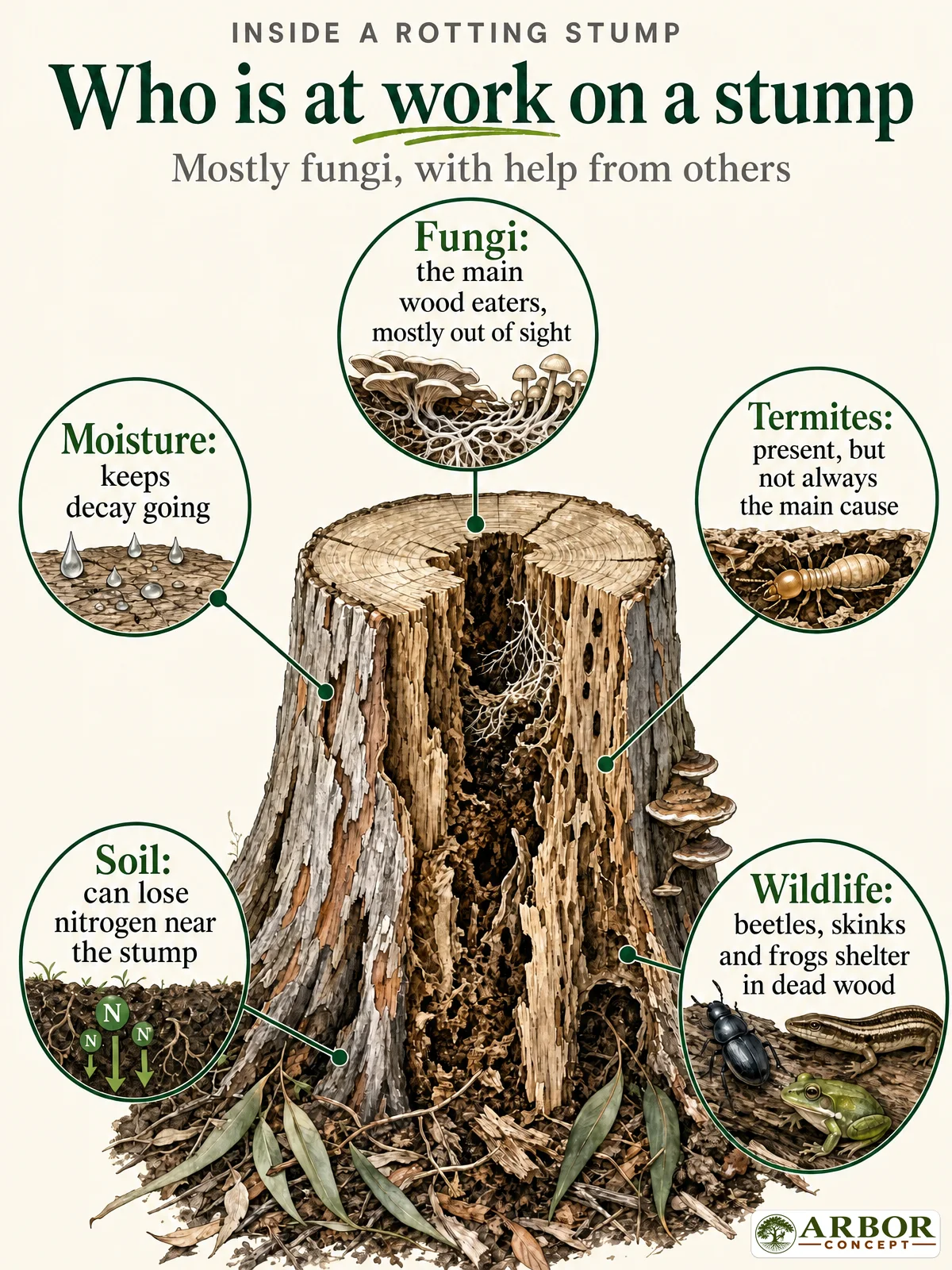
When people ask how long a tree stump takes to rot, the answer is mostly a story about fungi. Gardening Australia explains that the mushrooms and brackets you see on a stump are only the fruiting bodies. Most of the fungus lives out of sight in the roots that remain [4].
Those fungi digest the wood. Some types leave it pale and stringy, which is called white rot. Others leave it brown and broken into cubes, which is called brown rot [5]. Wood has little nitrogen in it, but many of these fungi grow well on very little and are good at recycling what they find [5].
A big root system gives them a lot of food. The Gardening Australia segment says a large tree can feed these fungi for decades [4]. It also names three fungi that gardeners should watch: Ganoderma, Phellinus and Armillaria. If they reach the roots of nearby trees or shrubs, they can shift from dead wood to living tissue [4]. The presenter’s advice is that removing the stump reduces the fuel and helps protect nearby woody plants [4].
Inside a stump as it rots
- Fungal threads already in the soil and wood move into the cut surface.
- They spread along the roots, digesting the wood as they go.
- The wood turns pale and stringy, or brown and cracked, depending on the fungus.
- Soft, damp wood draws in beetles, ants and sometimes termites.
- The centre goes hollow or spongy, and the stump slumps.
- The ground over the old roots settles, often years later.
A mushroom is not proof of danger. The Botanic Gardens note that some species are mostly decomposers of dead wood and that mushrooms at the base of a tree do not always mean serious disease [5]. But the point stands that a feeding stump close to garden plants is worth a look.
Where termites fit in
Termites are the part that worries people. Queensland has many kinds, and most of them are harmless to buildings. Business Queensland says many termite species feed on grass or decaying wood, and that only about ten native subterranean species damage timber in the state [6].
Subterranean termites generally live in the ground and need soil contact or a steady source of moisture, because they dry out easily [6]. Some keep a central nest in the ground or in a dead or living tree [6]. A damp, rotting stump gives them what they like.
That does not mean every stump has a colony. It means a decaying stump is a place to check, and an old one near a building deserves a closer look than one at the back fence. If you see mud tunnels or trails, leave them alone and ask a pest controller to inspect. Disturbing a nest makes a problem harder to solve.
Want this looked at on your own property? The on-site quote is free.
What a rotting stump does to the soil and the yard
As wood breaks down, the microbes doing the work take nitrogen from the soil. Gardening Australia calls this nitrogen drawdown. It can take nitrogen from plants growing nearby, and affected plants often turn yellow [7]. The program gives advice for woody mulch, not stumps, but the process is the same.
So a young tree or a vegetable bed right beside a decaying stump can struggle. It is worth planting a little away from the stump, in soil that is not full of old wood. Give the new plant its own patch of clean soil and it will get off to a better start.
A rotting stump has an upside as well. Dead wood is a home for beetles, fungi, skinks and frogs, and decay recycles nutrients back into the soil [8]. The NSW Government lists termites, some ants and cockroaches among the animals that depend on dead wood, and warns that taking fallen wood away can change the moisture in the soil beneath [8].
Living with a stump while it rots
- Check it now and then for wobble or mud tunnels.
- Keep young plants a little way off.
- Cut down any suckers that sprout.
- Tell us if mushrooms appear near prized shrubs.
- Standing or sitting on a stump that has gone spongy.
- Disturbing a mud trail or a nest.
- Piling firewood or soil against it.
- Assuming it will be gone in a year.
Can you make a tree stump rot faster?
The internet is full of tips for speeding up rot. The sources we read do not test any of them, so we will not promise one. What the evidence does show is that the process runs on moisture, fungi and time. Keeping a stump damp helps the decay, and a dry one lasts.
Some people add a nitrogen source because wood is short of it. The Botanic Gardens say that wood-rotting fungi already cope well with low nitrogen [5], so we would not count on it. We would also be careful with anything that burns or poisons the ground near a stump, since it can harm plants and soil life.
If the aim is to reclaim the space, the dependable route is to have the stump taken out. That is quicker than any home remedy, and the outcome is known before you start.
Excellent experience with tree removal. Careful work professionally carried out and good clean up on completion. Cheerful crew,respectful and polite. Highly recommended.
When to leave it, and when to act
Anyone asking how long does a tree stump take to rot is usually really asking whether to wait or to act. Both are fair answers. Not every stump needs a machine. A small stump in a back corner, away from buildings and play areas, can simply be left. It will soften with time and give shelter to small animals. Keep an eye on it, and take action if it moves or if termite signs show up.
Act sooner when:
- the stump sits where you want a lawn, a path, a bed or a slab,
- it is a species known to regrow, and shoots keep appearing,
- fungi are showing near shrubs or trees you care about,
- termite signs turn up anywhere close to the house,
- it is a trip hazard for children, pets or anyone mowing.
A stump that has half rotted is no reason to wait. The soft outer wood is easy to remove, and the job is often quicker than for a fresh one.
In the end, a stump takes long enough, and the outcome is uncertain enough, that most owners decide the space is worth more than the wait. If you are happy to watch it slowly sink, that is a fair choice. If you want the area back this season, grinding gets it done.
How we deal with a stump
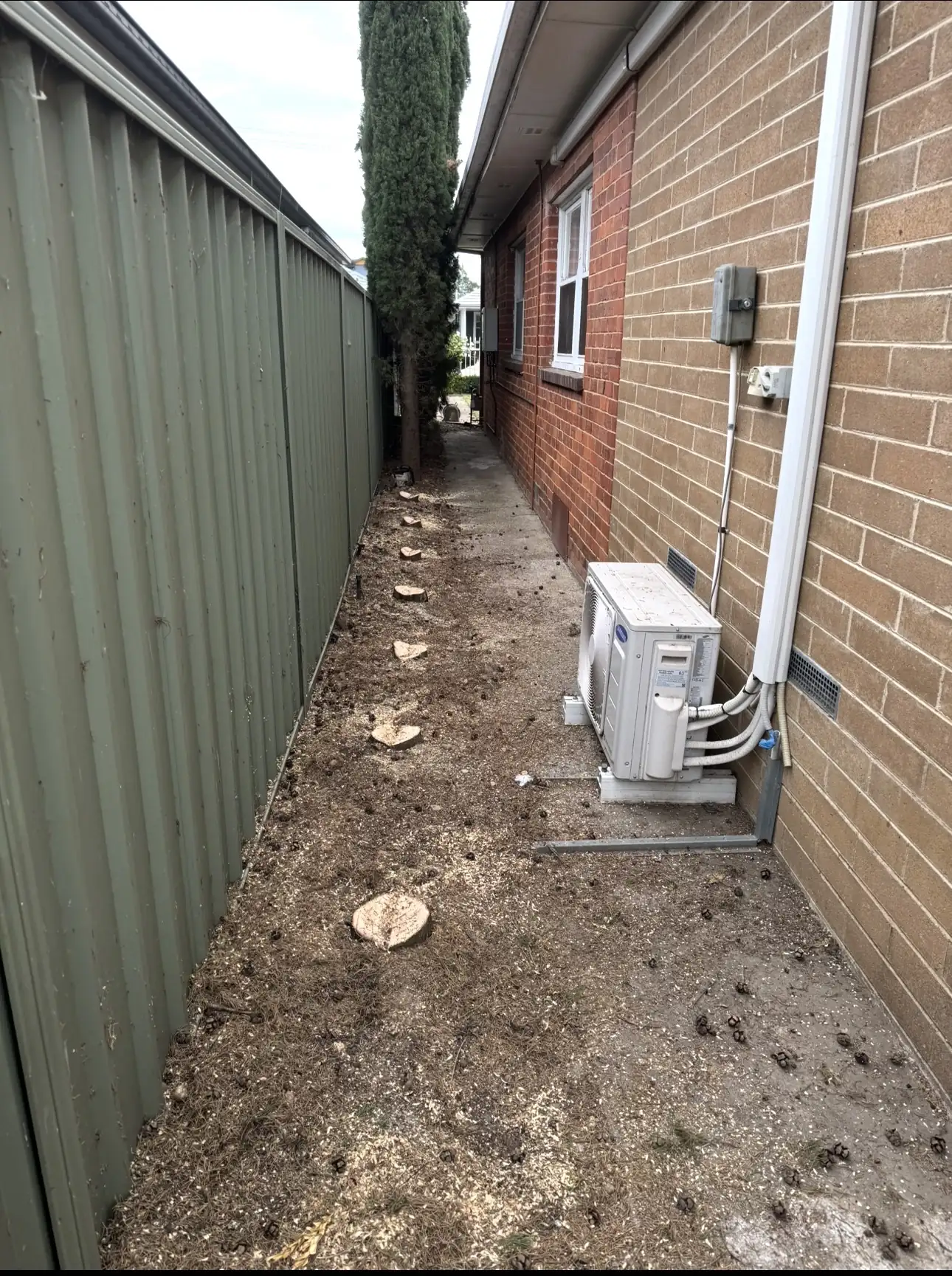
If you would rather not wait for nature, our stump removal is done with a large tracked grinder. The machine chews the stump away from the top and takes it below the surface in one visit. Nothing is dug up, so your lawn and beds stay mostly as they are.
Drew is the person you talk to. He inspects the stump on site, asks what the space is for, and gives you a free quote. Our team then checks the ground for pipes, cables, sprinklers, fences and paving before the grinder starts. The grindings are yours to decide: left as mulch, used to fill the hollow, or carted off. Some hardy species send up shoots again, so a stump may be treated to stop that. Our how we quote page covers the pricing principles, and you can get in touch to arrange a look. Pensioner and local discounts are available.