How long does tree removal take on a real job?

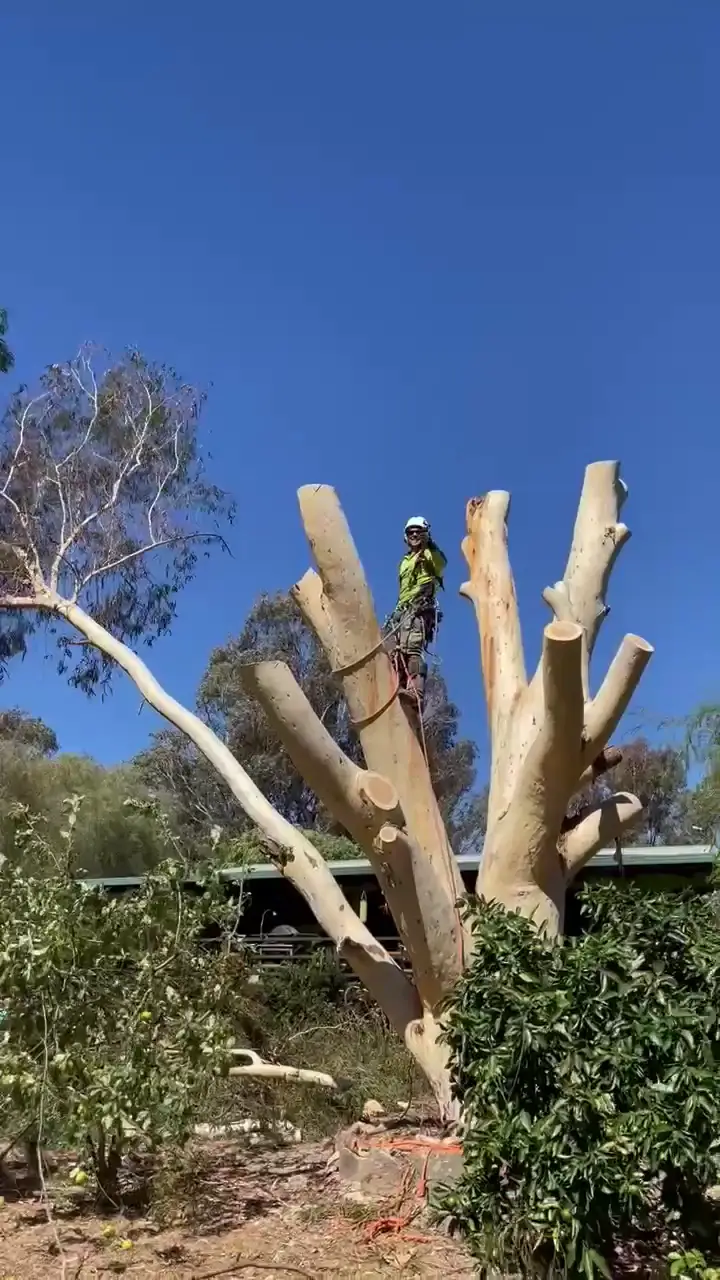
How long does tree removal take? A small tree with room around it can come down in a morning. A tall tree in a tight yard can run over more than one day. The tree is only part of the answer, because access, weather, wildlife and council checks all move the clock.
This guide follows a job from the first visit to the last rake. It shows what makes a job quicker, what slows it down on purpose, and what to ask so you can plan your week around it.
A guide can give you the shape of a job, but only a look at the real site gives you the time. That is why every job starts with a free visit, not a guess over the phone.
People ask for a time before they ask for anything else. It’s a fair question, because a tree coming down touches your whole week. Cars have to move, pets have to be kept in, and sometimes a neighbour needs warning.
How long tree removal takes in short
There’s no single number, and anyone who gives you one without seeing the tree is guessing. What you can know is what the time is made of. Four things do most of the work.
What sets the length of a job
So how long does tree removal take once the date is set? Cutting is the part you see. The other three are the part you do not, and they often decide whether the job is one visit or two.
Size and shape decide the cutting time
A tree with one trunk and a light crown is quick work. A tree with several heavy stems, a leaning trunk or a thick, dense crown takes longer. Each limb has to be cut, controlled and put down without damage.
Condition counts as much as size. Sound wood holds a rope and behaves. Dead or hollow wood can be brittle, so the team slows down and picks a gentler method. That isn’t wasted time. It’s the cost of doing a hard tree safely.
The type of tree matters too. Some drop limbs without warning. Some are dense and heavy. Some snap in odd places. Drew asks about all of this at the visit, because the answer changes the method, and the method changes the time.
Access decides how fast the pieces move
This is the part people forget. Out in a paddock, a trunk can be dropped whole and hauled off with a machine. Put that trunk behind a house, at the end of a side passage, and every piece may have to be carried out by hand.
Picture two jobs with the same tree. How long does tree removal take in each? In the first, the trunk drops into a clear space and gets cut into rounds. In the second, a climber takes it apart in small sections and lowers each one on a rope. The second job is slower on purpose. You are paying in time for a lawn, a fence and a roof that stay unharmed.
Quicker or slower: what to expect
| Part of the job | Usually quicker | Usually slower |
|---|---|---|
| The tree | One trunk, light crown, sound wood | Many stems, heavy lean, dead or hollow wood |
| The yard | Wide gate, flat ground, room to drop | Narrow passage, steps, slope, fences close by |
| What is below | Open lawn or paddock | Roof, pool, shed, garden beds |
| The gear | A crane lifting sections out whole | Rope work where no machine can reach |
| The wood | Left on site as mulch | Chipped, stacked and carted away |
A crane sounds like a big deal, but it often saves time. Lifting a heavy section out in one go beats lowering it in many small pieces. Drew will say whether a crane suits your job. The labour it saves can bring the price close to what a hand job would cost.
Drew came same day to give a quote which was accepted and came that week to do the job. He did an excellent job cutting down 2 palms, very professional. The mess was all cleaned up and taken away with no effort. I would recommend him to others as we were very satisfied with his work.. Thanks Drew for your help.👍
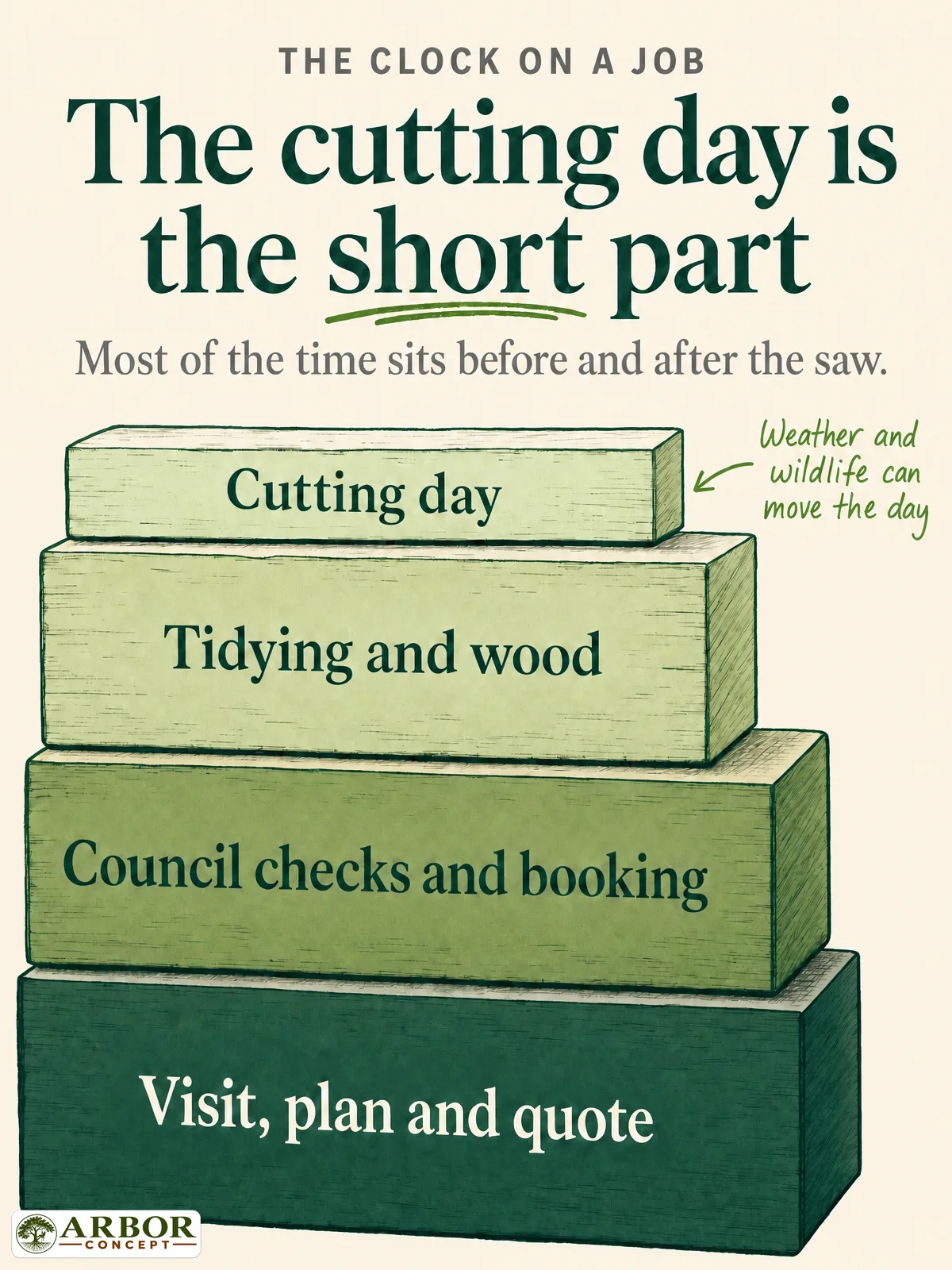
Why the tree removal clock starts before the cutting
The cutting day is the short end of the story. A visit, a plan, a quote and a booked day all come first. If your tree raises council questions, those sit in front of the booking.
A job from first look to last rake
- Drew visits, studies the trunk, the way in and the ground below, and gives a free on-site quote.
- You agree the plan, the wood choice and any extras such as track mats.
- Any council check is finished, if one applies to your tree.
- A deposit locks in a day that suits the tree and the weather.
- On the day, the team sets up, cuts, lowers, chips or stacks, and clears.
- A last walk round with you, and the balance is settled once you are happy.
Nothing in that list is padding. Each step answers a question that would otherwise come up in the middle of the job, when it costs more to fix.
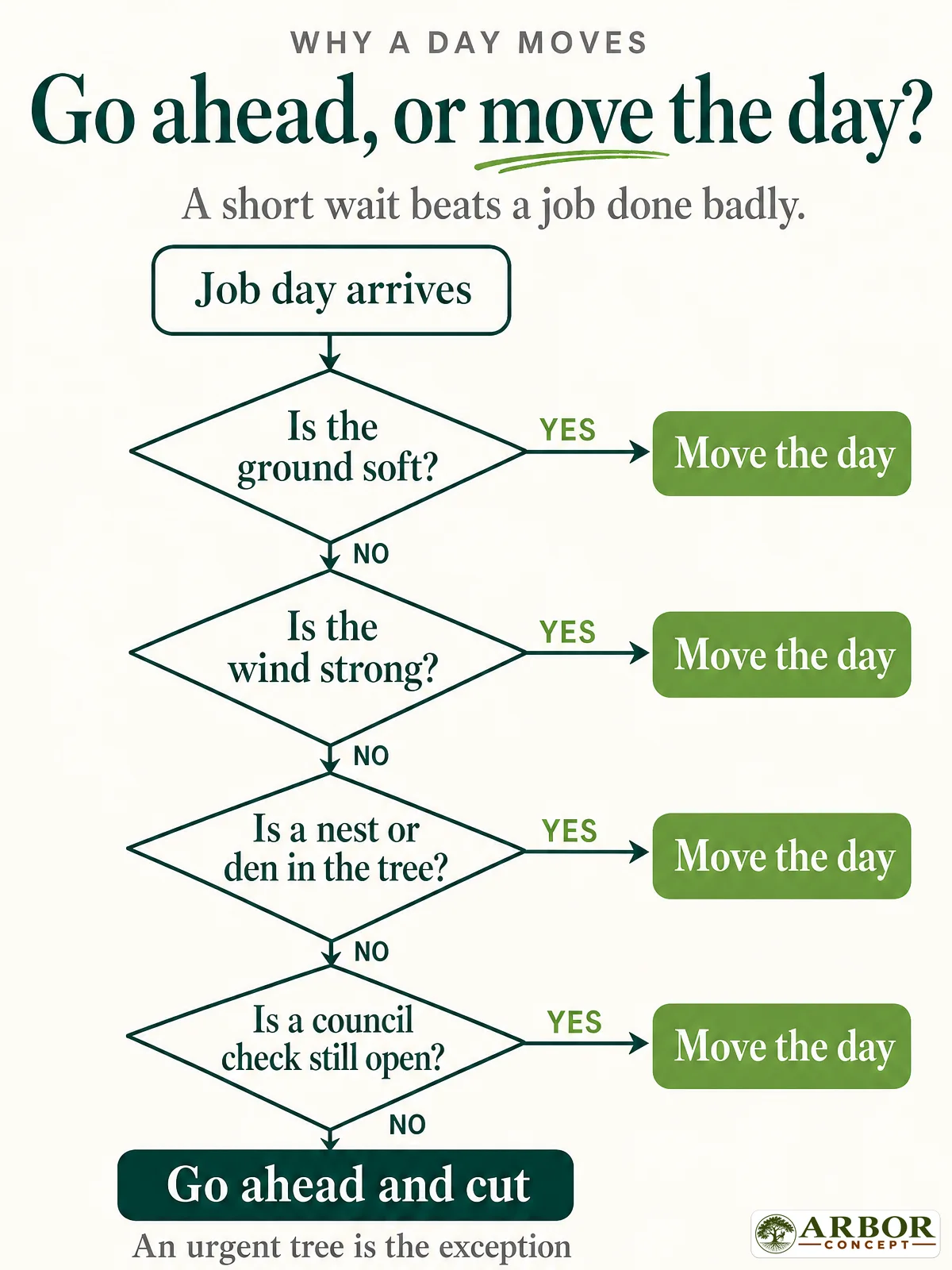
Weather and wet ground can move the day
The national tree work guide says the work area should be assessed for sunlight, wind, weather and ground conditions [1]. It also says a local forecast should be checked before anyone goes up a tree, and checked again as the day goes on [1].
Wind is the usual reason for a stop. A tree that sways is harder to control, and so are the limbs coming off it. Rain brings its own trouble. Soaked ground can be wrecked by heavy gear, and a leaning tree can be unsafe to climb when the soil is soft.
A soft yard can push a normal job back by a week or two. We accept that, because a ruined lawn is a worse result than a short delay. An urgent tree is different: if it is about to hurt someone or something, the plan changes and we move fast.
Want this looked at on your own property? The on-site quote is free.
Power lines, houses and animals slow things down on purpose
Some slow parts are there for a reason. The guide sets a duty to keep people, machines and loads out of the unsafe zone around an overhead electric line. Where a safe gap cannot be kept, it calls for a risk assessment and for the rules of the electricity supplier to be followed [1]. It also describes a spotter on the ground who watches the gap for the person in the tree or lift [1]. This planning adds time, and it is worth every minute.
The same guide wants an exclusion zone under and around the tree, so nobody walks beneath falling pieces [1]. For climbing and lift work it wants a rescue plan, with another trained person on site [1]. It also says to site the chipper with clearance from the drop zone, so the ropes cannot be dragged in [1]. All of this is arranged before the first cut.
Then there are the animals. Hollows in trees are scarce, and WIRES says the small ones take about a hundred years to form [5]. Bats, possums, owls, parrots and many other animals rely on them [5]. When something is living in your tree, we don’t carry on regardless. The job is paused or reshaped until the animal is safe, and sometimes that means a new date.
Council checks and neighbours come before the cutting
Many people are surprised by this part. Tree rules vary from council to council and shift over time, so ask your own council what applies to your tree. We can help you sort out which questions to ask.
A few Queensland councils show how different the answers can be. The Sunshine Coast Council says protected vegetation on private land may need a permit before it is cut, and it points owners to an online site report that shows whether a property has protected trees [2]. It also says assessment fees apply [2]. Noosa Council says its planning scheme asks for a permit to clear vegetation on all private land in the shire, and says taking out protected trees with no permit or exemption can bring penalties [3]. Noosa also invites owners to request a tree assessment through council when a tree on their land is a hazard [3].
Redland City Council says protected trees generally need approval, and that a protected tree needs an arborist’s assessment report with the application [4]. It says a dead tree on an urban lot may come out because it is a potential high risk, while dead trees on rural land that carry hollows are usually protected [4]. It suggests taking photos of the tree and its surroundings before a high-risk tree is removed [4].
Brisbane City Council says one-off removal or pruning of protected vegetation goes through a short-term permit, and that it contacts applicants within twenty business days, though applying does not mean a permit will be given [7].
These are four councils, not an answer for your tree. If approval is needed, that waiting time sits before the booking and not inside the job.
A tree near a boundary adds one more step. QCAT says people are expected to try to settle a tree dispute informally before applying to the tribunal [6]. Its notice process for overhanging branches gives the tree keeper thirty days to respond [6]. None of that matters if you speak to the neighbours early. We can do the explaining for you, which tends to calm things down. A short chat before the day avoids a stop on the day. ABC News tells owners to speak to the neighbour first, agree who keeps any cuttings, and use a qualified arborist rather than doing it themselves [8].
Great experience, quick prompt service and clean up. Highly recommend.
Wood, waste and clean-up come last
Every tree leaves a lot behind. Branches, leaves and timber have to go somewhere, and you choose where. Your options: chipped and carted off, stacked as firewood, left on the ground as mulch, or sent to a miller we can line up.
Say what you want before the day. Carting everything off takes longer than leaving the wood where it fell. Neat stacks take longer than a chipper. None of it’s hard, but it’s real labour, so it belongs in the plan.
Getting the yard ready
- Move cars, bins and garden furniture clear of the tree.
- Mark the tree that is to come out.
- Keep pets inside on the day.
- Tell your neighbours, or ask us to.
- Say what you want done with the wood.
- Leaving a car under the tree.
- Asking for a time or a price from a photo.
- Starting on limbs yourself before the visit.
- Booking a visitor or a delivery for the same spot.
When you need an arborist, and what the quote tells you about timing
Bring an arborist in when a tree is large, leaning, split, dead, over a building or near a power line. The national guide calls practical tree work, especially at height, a dangerous task that should only be done by people assessed as competent [1]. It tells duty holders to seek the advice of a qualified arborist when they manage the risks [1]. Please don’t climb a big tree yourself to save a few days.
Not every plant needs a team. A small shrub or a young tree that you can reach from the ground can often be handled by its owner with basic tools. If you cannot tell which kind you have, ask. Drew will say plainly whether the tree needs a team or whether it can stay.
The best answer to how long tree removal will take on your block comes from someone standing in it. Drew is a Cert III qualified arborist with 20 years’ experience, and he is public liability insured. He walks the job with you, checks the trunk, the gate, the ground and what lies below, and tells you what he sees.
You then get the plan in writing: the method, the gear, the wood choice and the day. A deposit holds the date, and that goes both ways. You have your day, and our team commits to turning up and making it work. You pay the rest when the work is done and you like what you see. Our page on how we quote has the detail.
For the full picture, read about our tree removal service, from the first visit to the last rake. When the tree is on your mind, reach out and book the free visit.