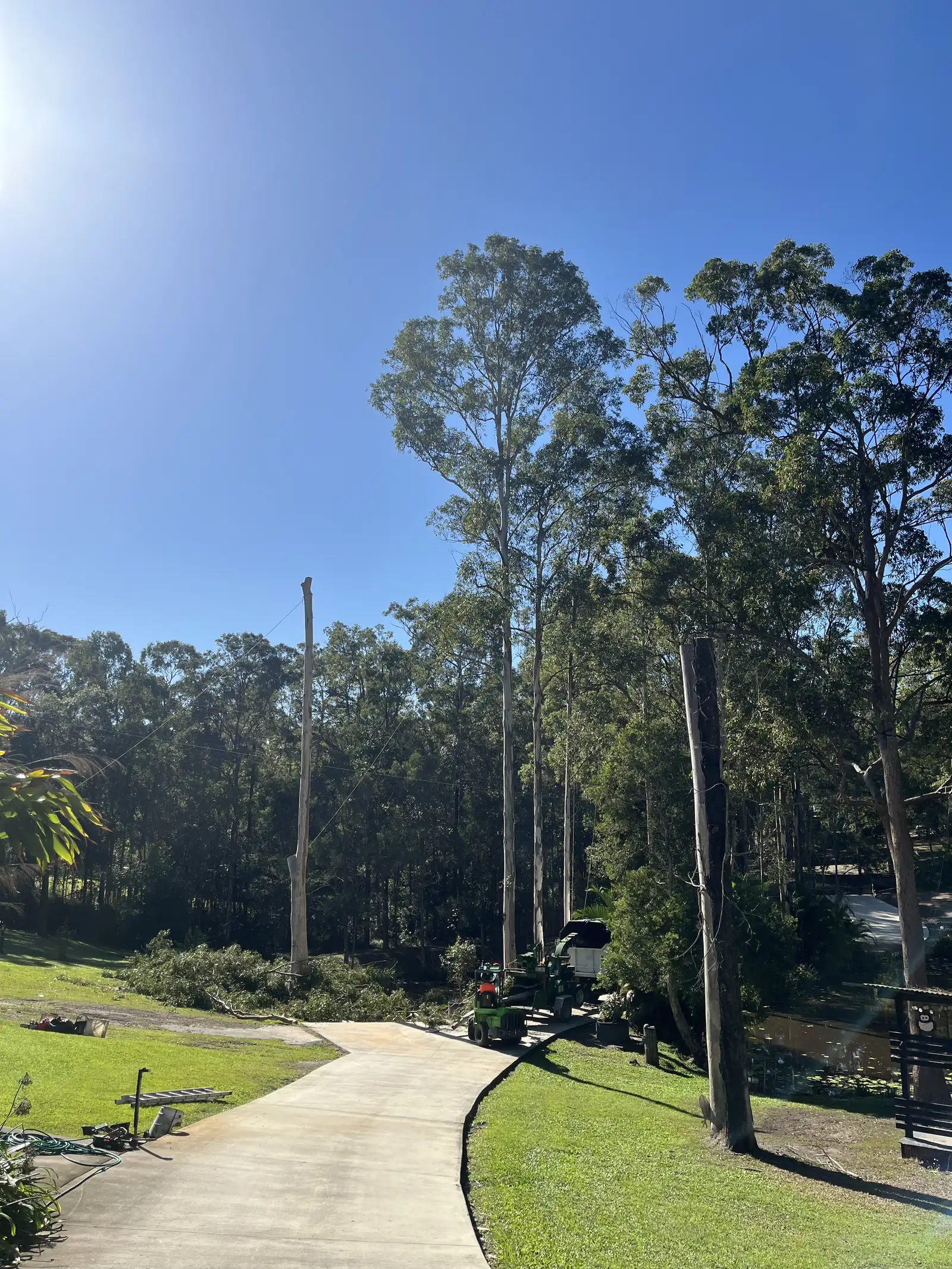
Vegetation management property owners should plan for


For most owners, vegetation management property work comes down to one aim: keep the undergrowth, weeds and regrowth under control while the trees you value stay standing. It is care for the ground, and it is rarely a single visit.
This guide explains what the job covers, how the state's vegetation maps work, and where weeds and fire breaks fit in. It also covers the point where a job outgrows a weekend, and the small jobs you can handle yourself.
Every block grows differently. Slope, creeks, old fence lines and neighbours all change the plan, so a look at the real ground always comes before a price.
Ask a few landowners what vegetation management means and you will hear a few answers. One thinks of weeds. One thinks of fire breaks. One thinks of the scrub that has taken over the back paddock. They are all right. The term is wide, so it pays to pin it down before you plan any work.
What a vegetation management property job includes
On a property, vegetation management is the clearing you cannot easily do with a mower or a pair of loppers. It deals with growth that is thick, tall, steep or spread over a big area. The target is the thick growth around the trees you want to keep.
The people who use it are varied: councils and utilities, farmers and landowners, builders preparing a site, and golf courses and resorts that need scrub on the edges kept open. A family on acreage has the same need on a smaller scale.
What a job can cover
A good job ends tidy. Whatever is left standing after the heavy work is ground over, so the place looks cared for and not chopped about. That finish matters to a resort, a golf course or a council as much as it does to a family on acreage.
Why overgrown ground costs more the longer it waits
Thick growth is easy to ignore until it is a problem. It hides fence damage. It lets weeds seed in the shade. It feeds a fire when the dry weather comes. It crowds the trees you want to keep, and it makes every track harder to use.
Growth that is left to run also competes with the trees for light, water and room, so even the good trees can suffer. A woody weed that is easy to pull this season can be a stump to dig out in three.
The cost of dealing with it rises as the growth gets taller and thicker. A light clear this year can save a heavy one next year. That is the real case for a vegetation management property plan that runs for seasons, not days.
Reading the Queensland vegetation map
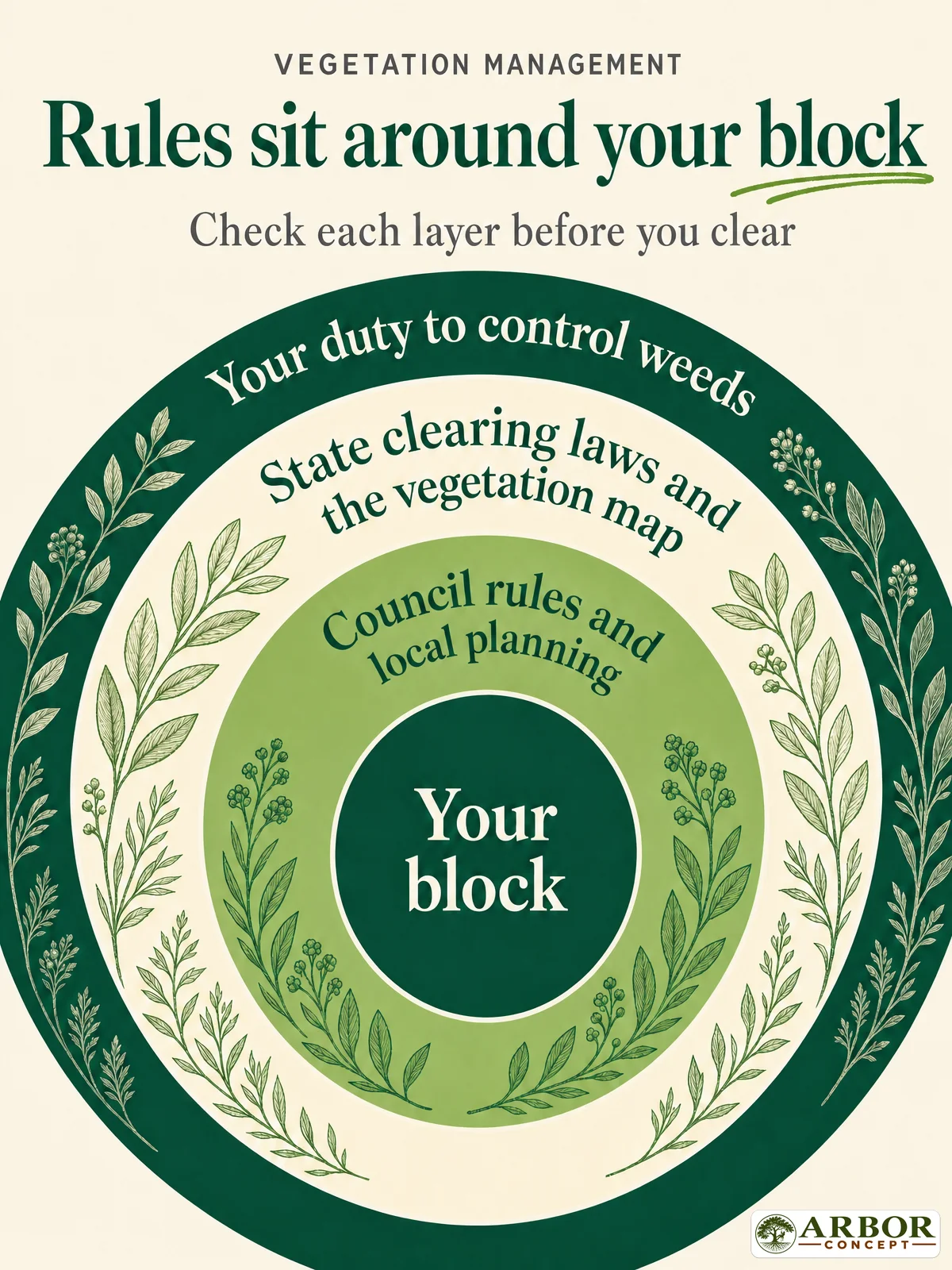
Before any serious clearing, find out what the state map says about your land. Queensland groups vegetation into categories, and each one has a colour on the regulated vegetation management map [1].
The five map categories
| Category | Colour | What it covers |
|---|---|---|
| A | Red | Compliance areas, environmental offset areas and declared areas |
| B | Dark blue | Remnant vegetation, which is the original canopy largely intact |
| C | Light blue | High-value regrowth on certain land not cleared for a long time |
| R | Yellow | Land beside watercourses and drainage features in Great Barrier Reef catchments |
| X | White | Everything not mapped as A, B, C or R |
The Queensland Government describes Category C as high-value regrowth on certain freehold, Indigenous and leasehold land that has not been cleared for at least 15 years [1]. Category R covers land within 50 metres of a watercourse or drainage feature in Great Barrier Reef catchments [1]. A separate supporting map adds regional ecosystems, wetlands, watercourses and essential habitat [1].
You do not have to read these maps alone. The state will send a free vegetation management report for a property, and it includes the regulated map, the supporting map, a flora survey trigger map and a koala habitat map [2]. The page says to look at the report before any clearing, and that it usually arrives within three business days [2].
A category does not decide your plans for you. A lot of weed control and undergrowth work sits comfortably inside the rules. But some clearing needs approval or notice, and the map is how you find out which. Rules differ and they change, so check the current position with the department or your council. We never assume a rule applies to your land, and neither should you.
Drew and his team are professional in all aspects their business. We have used them from pruning, maintenance and emergency tree removal. I find them reliable, knowledgeable, helpful and thorough. Highly recommended. Maz Ashlarstays
Weeds are the landholder’s job
Weeds are the part of vegetation management that no one can skip. Under Queensland’s biosecurity rules, landowners must take all reasonable and practical steps to minimise the risks from invasive plants under their control [4]. The rule is known as the general biosecurity obligation. Business Queensland adds that this covers every landowner, state and local government included, and that the duty comes from the Biosecurity Act 2014 [8].
There are extra duties for some plants. A prohibited plant must be reported within 24 hours, and some restricted plants cannot be moved, kept or distributed without a permit [4]. Councils and Biosecurity Queensland can step in and enforce these duties if they have to [4].
Start by knowing what you have. Councils sort weeds into risk classes of their own. Moreton Bay Council, for one, lists lantana as low risk and says low risk weeds must be controlled when a property borders an environmentally significant area [9]. Some plants are common nuisances and some are listed pests with tougher rules, so identify them before you treat them. The council handbook links to a form for identifying and reporting invasive plants [6], and the council weeds team is a sensible first call.
Weed control done once and left is weed control that fails. Seeds in the soil germinate for seasons. That is why a return visit, a few months after the first clear, often does more than the first clear did. Sunshine Coast Council’s rural landowner handbook is a good starting point for weed and vegetation guidance, though it says plainly that it is general guidance and not legal advice [6]. Other councils publish their own material, so look for yours.
Fire breaks and fence lines
Fire breaks and fence lines are the most common reasons people call about vegetation. They are also where the rules can catch you out.
The Queensland Government has separate guides on clearing to protect property from bushfires without approval or notification, on clearing firebreaks, on when a development approval is needed, and on Fire Department permits [3]. In an emergency, the page says to follow the directions of authorised fire officers [3]. These are different situations with different rules, so read the guide that matches yours.
Fence lines come under local planning. Sunshine Coast Council says you can clear within three metres on your side of a boundary fence when it is reasonably necessary [7]. It also says to tell your neighbours first and to confirm with council that the vegetation is not protected [7]. Other councils set their own rules, so do not assume yours matches.
Before you clear a fire break or fence line
- Look up your property on the state map first.
- Ask your council if the vegetation is protected.
- Tell the neighbours before you start along a boundary.
- Clear only as wide as the job needs.
- Keep notes and photos of what you cleared and why.
- Assuming last year's rule still applies.
- Clearing beside a creek or drain without checking.
- Starting work on soaked ground.
- Pushing a break wider just to be safe.
- Leaving a dead tree standing in the cleared strip.
Want this looked at on your own property? The on-site quote is free.
Protected plants, wildlife and waterways
State clearing laws are only part of the picture. Protected plants fall under the Nature Conservation Act, and a clearing permit may be needed before they are cleared [5]. In parts of South East Queensland, koala habitat on mapped lots can need a development approval [5]. Local laws and planning schemes may also apply [5].
The same page says exemptions may apply for clearing under accepted codes for weeds, encroachment and fire management [5]. That is useful news, but it only helps if the work fits the code. Native vegetation, trees near waterways and some areas are protected, and whether you need approval depends on your council and the land.
Animals matter too. Thick scrub is home to birds, possums and reptiles. Before the machine starts we do a risk assessment of the site, and if we find animals, they come first.
Why a machine suits big, overgrown ground
Hand clearing a hectare of dense scrub is slow, hard and risky. A remote-controlled, tracked forestry mulcher does it differently. It drives along and chews the undergrowth into mulch. It passes through the middle of the trees and leaves them standing.
It handles growth up to stems around 150 mm thick, and it works on steep ground where people and other machines cannot go safely. Nobody stands near the cutting head, because the machine is driven by remote control from a safe distance. For large areas it is often more cost-effective than cutting small growth by hand and carting it off.
How a typical job runs
- Drew walks the site with you and works out what stays and what goes.
- The trees and larger work are done first.
- A risk assessment is made, and traffic management is arranged if the job is near a road.
- The mulcher comes in last and grinds over the remaining growth.
- The ground is left tidy and presentable.
- Return visits are booked if you want the ground kept under control.
The work is done on private property, away from roads. Heavy gear on wet ground can leave marks, so unless something is urgent we wait for the ground to dry.
Drew was fantastic. Responsive, efficient, knowledgeable and accommodating. Will definitely be calling on Drew and his team again.
Knowing when the job is beyond a weekend
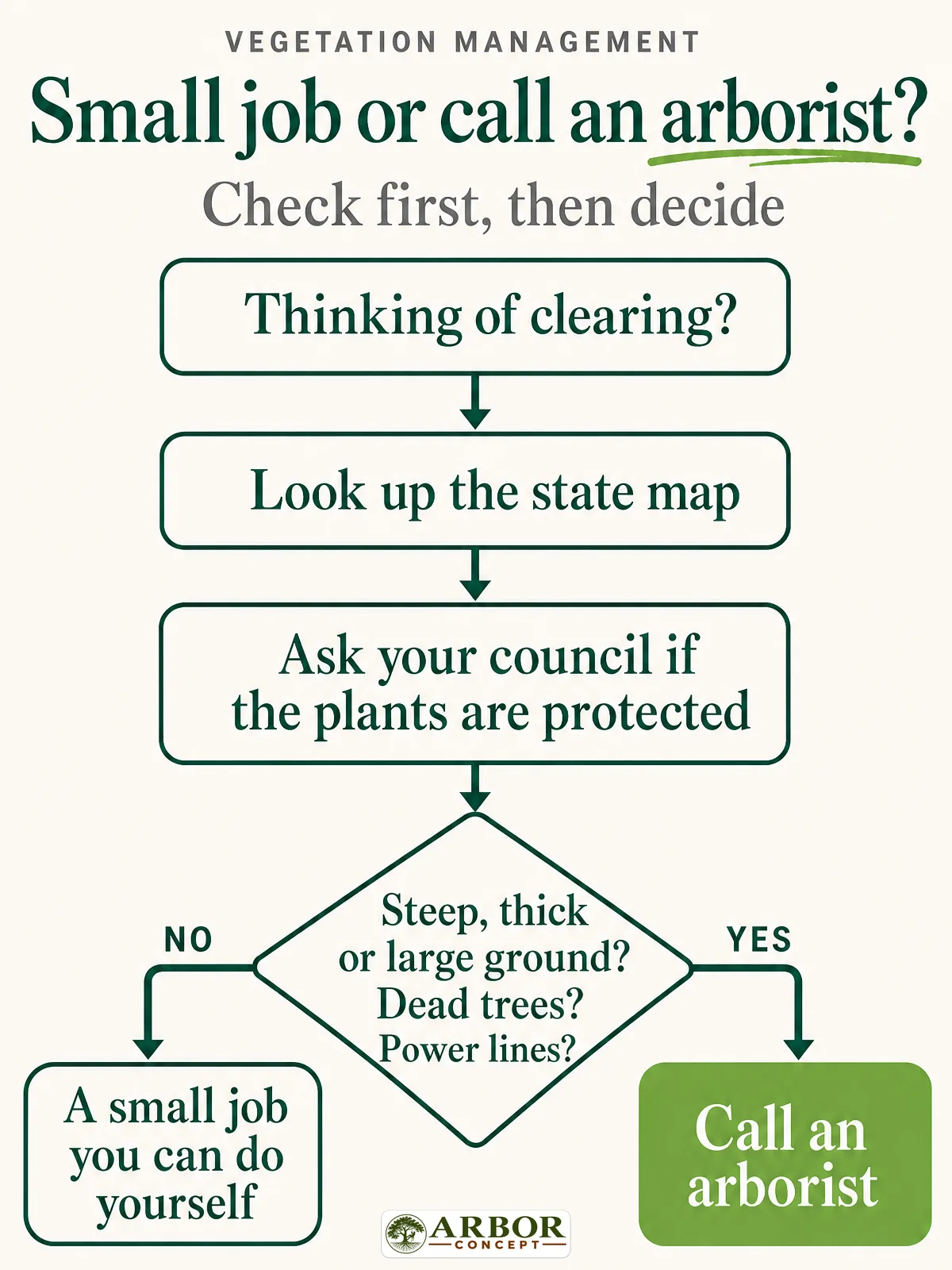
Not every patch of scrub needs a professional. A small patch of weeds on flat ground is a weekend job. A few saplings by the shed can be pulled or cut by hand. Mowing a paddock is just mowing.
Bring someone in when the job is bigger than you can do safely and well. Honest advice comes first with us: if the answer is a mower and a free Saturday, we will say so. These are the common signs:
- The ground is steep, wet or rough.
- The growth is thick, tall or woody.
- Trees, dead or alive, are mixed in with the scrub.
- The area is large, or it takes in a creek line, easement or road verge.
- You are unsure about a protected plant or a mapped area.
- Power lines run through or beside the area. That work is for a qualified arborist, never for the owner.
Chainsaws, climbing and work near lines are not weekend jobs. Please leave them to a qualified person.
Dead trees deserve a special mention. Dead wood is brittle, and it can fail without warning, so a dead tree standing in thick scrub is a hazard for anyone working below it. An arborist assesses it first, and the clearing follows once the tree is dealt with.
How to plan vegetation management on your property
Start with the map, then walk the ground. Write down what must go, what must stay and what needs a closer look. Mark the creeks, the fence lines and any tree you are fond of. Tell the neighbours if the work reaches the boundary.
A tidy plan also makes the quote easier to compare. Note the size of the area, the slope, the access gate, any wet spots and what you want done with the cleared material.
Then ask for a free quote. Drew comes out, walks the site with you and quotes on the spot, and our team does the work. If you want to know more about the service, read about our vegetation management work, or see how we quote and price jobs. When the plan is ready, reach out through the contact page and describe the block to Drew.