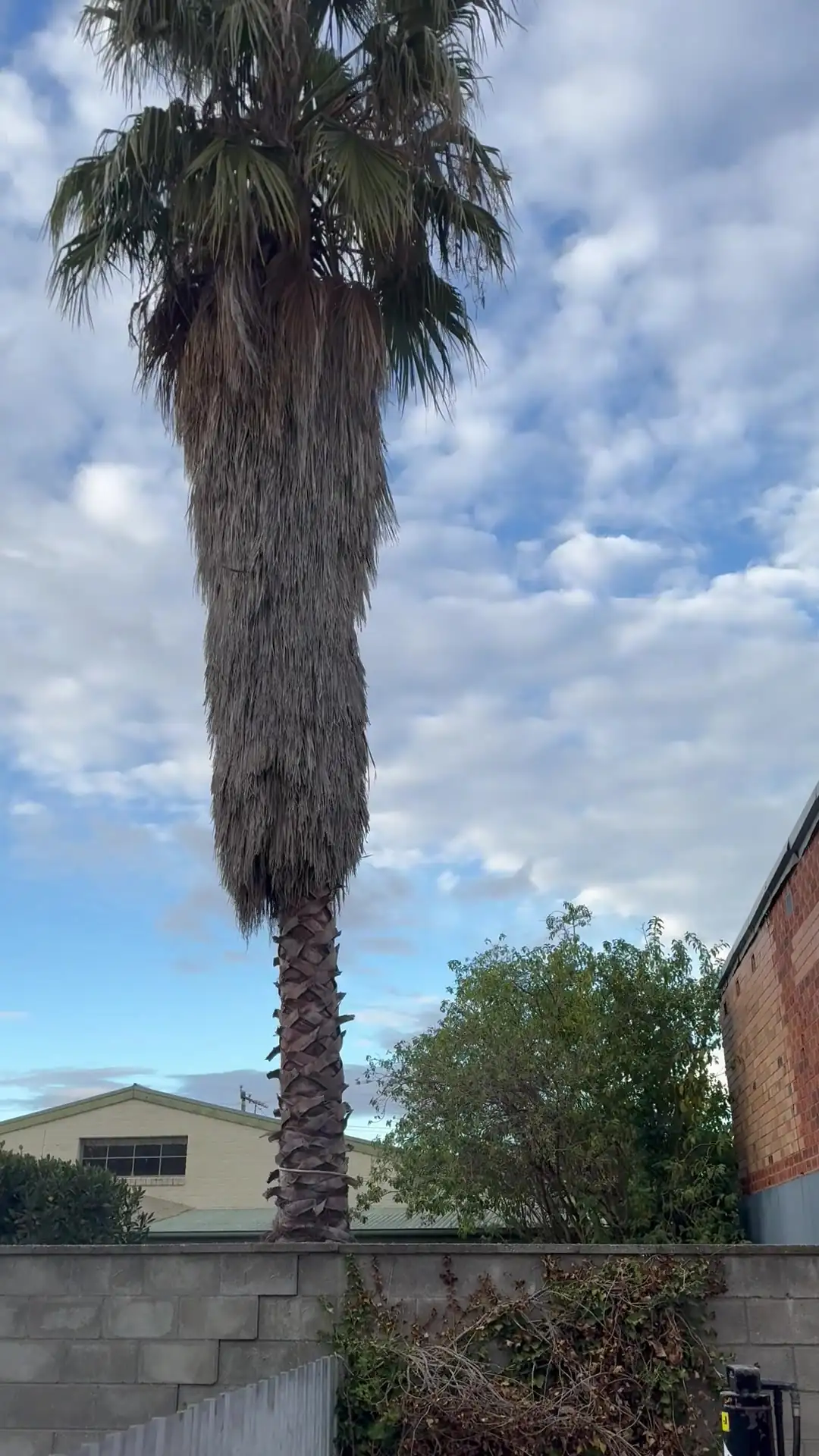
What to do with dead palm fronds

Dead palm fronds should come off once they are fully brown, and the heap should go to green waste, not onto a bonfire or into the bush. Anything still green or half green stays on the palm. If the palm is tall, the cutting is a job for a qualified arborist.
This guide covers which fronds to take, what can go wrong when they come down, where the heap can go, and what moves in when a palm is left to droop.
Every palm and every yard is different. A look at the real palm, and at what sits beneath it, is the only way to plan a clean-up that suits your place.
A palm sheds its old leaves the way a dog sheds hair. Slowly, all year, and always over the spot where you wanted to sit. At some point the skirt of brown gets heavy, and you have to decide what to do about it.
What counts as dead palm fronds
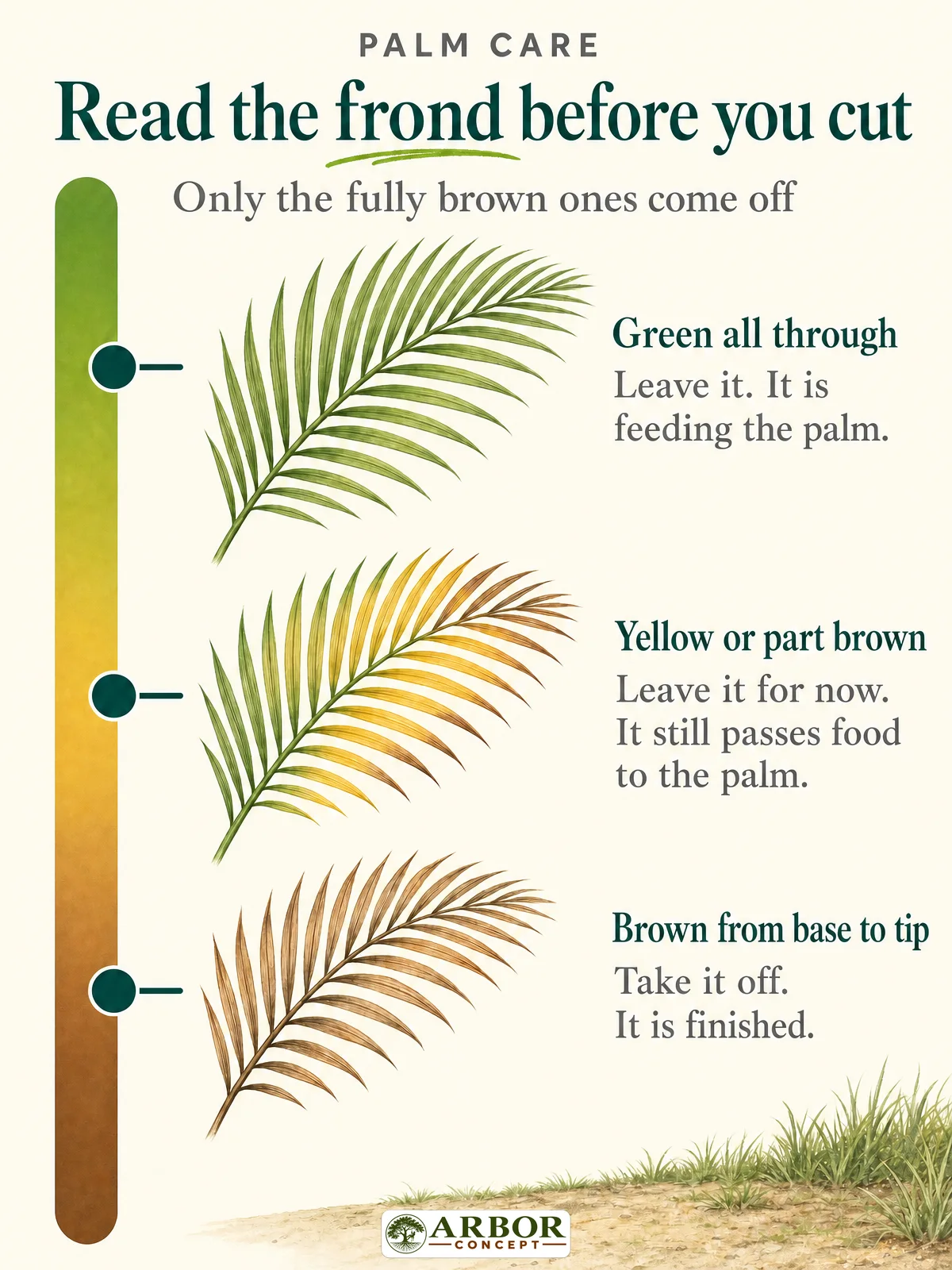
Not every brown tip means a dead frond. A palm moves nutrients out of an old leaf as the leaf ages, so a frond can look tired and still be doing a job. The clear rule among arborists is to take only the fronds that are fully brown.
Leave yellow or half dead fronds alone. They may point to a feeding problem, and they still pass some food to the palm. The first rule of palm pruning is never to remove live, green, healthy fronds.
Reading a frond before you cut
That is the whole test. If you can say yes to “fully brown, from the trunk end to the tip”, it is a dead frond. If you hesitate, it is not ready.
Why dead palm fronds are worth taking off
Left alone, a dead frond keeps drying until it lets go and lands on whatever is below. That can be a car, a roof, a path, a pool cover or a person. Dead fronds and seed pods can also crack pavers and knock fittings off a wall.
Think about the path a frond takes on its way down. Over a pool, it clogs the skimmer and the filter. Beside a fence, it can snap a paling. Above a gutter, it sits and blocks the downpipe until the next storm. The more things sit under the palm, the stronger the case for a regular clean-up.
There is a fire side as well. The Queensland Government tells households to clear dry grass, dead leaves and branches from the yard before bushfire season, and to keep gutters clear of leaf litter [1]. Dead fronds are dead plant matter, so the same sensible advice fits a palm that is dropping them onto the roof or into the gutter.
Then there is shelter. A heavy skirt of dead fronds is a dark, dry hiding place for small animals. We come back to that further down.
Why tall palms are not a backyard job
Cutting dead fronds sounds easy. On a tall palm it is not. The weight hangs on the trunk, the old leaf bases can be tangled together, and one cut can free a lot more than you meant to.
The danger is real. Cut or pull at a thick skirt of dead fronds and a whole ring of them can let go together. A heavy skirt dropping in one piece can pin a climber against the trunk, or bury a person standing below. That is why a qualified arborist works from above and keeps everyone else clear.
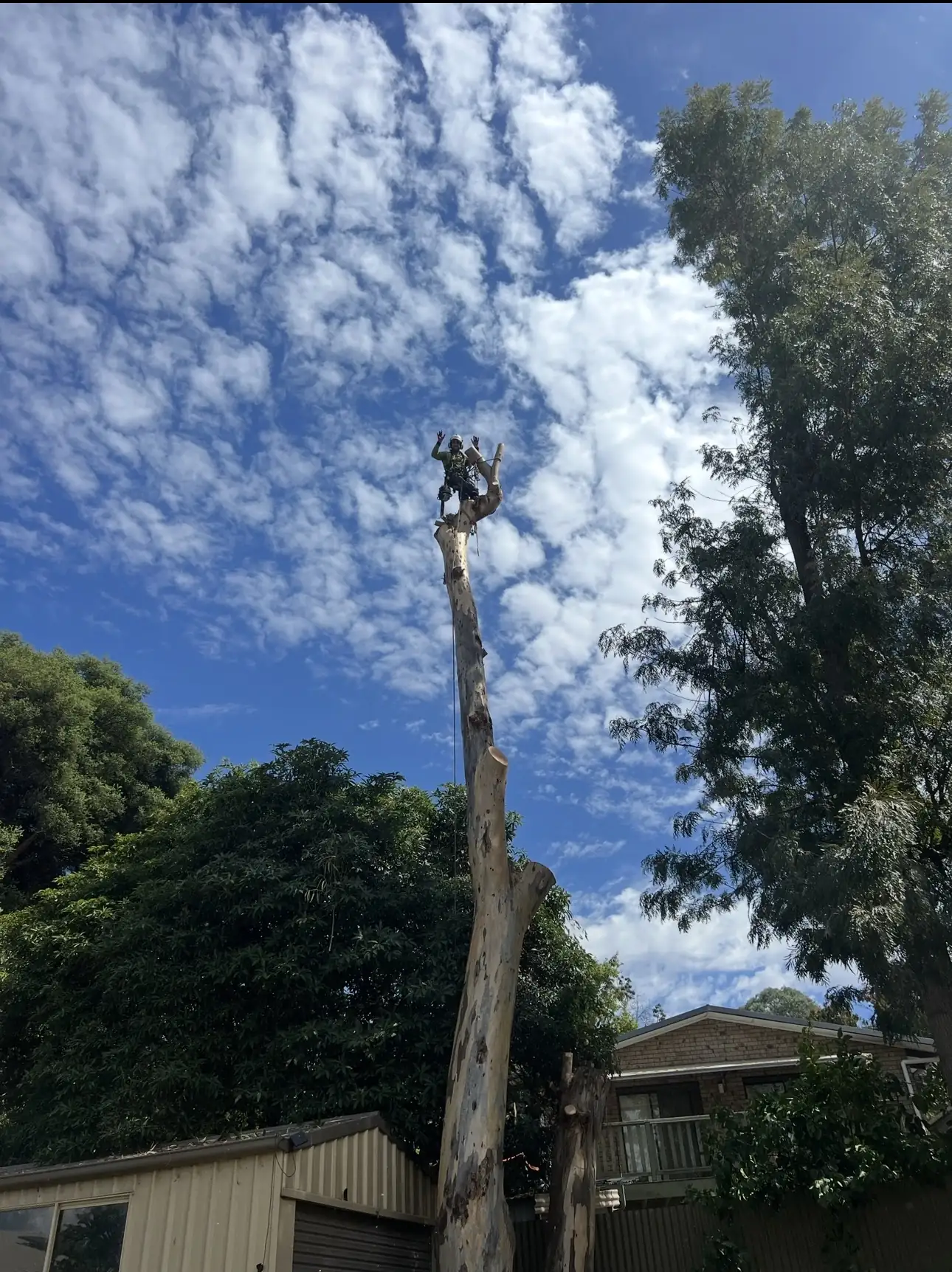
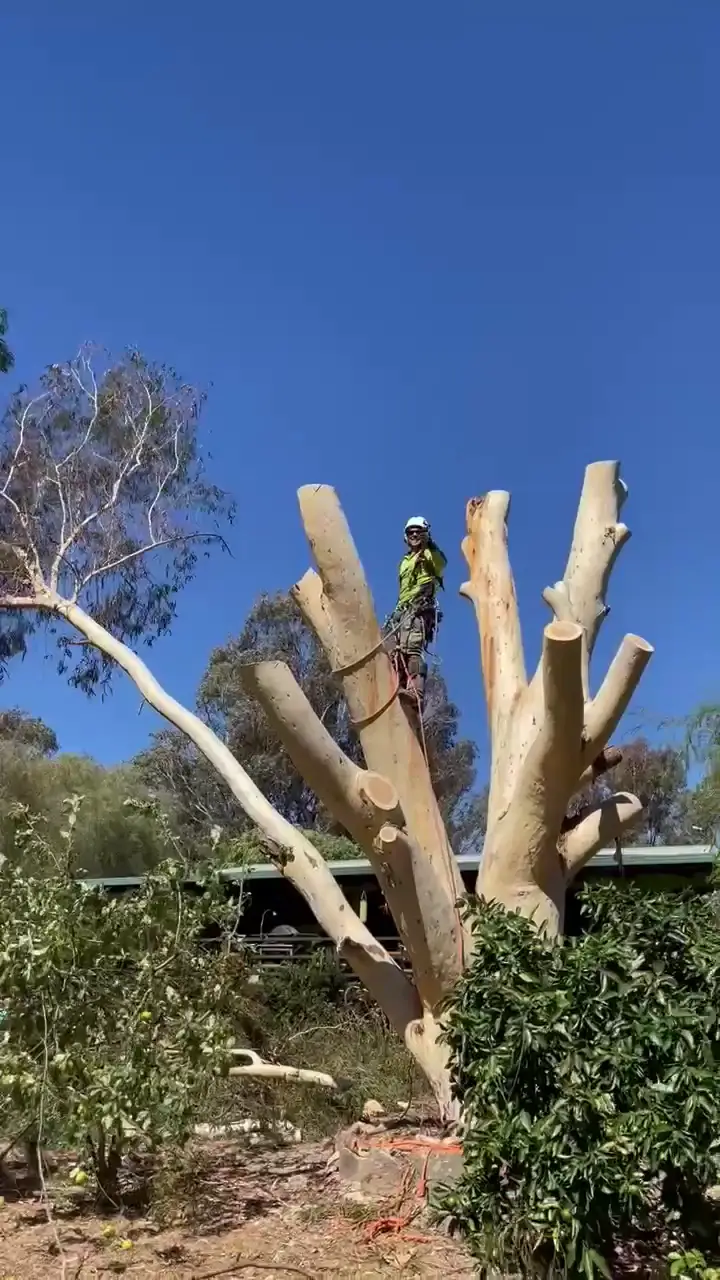
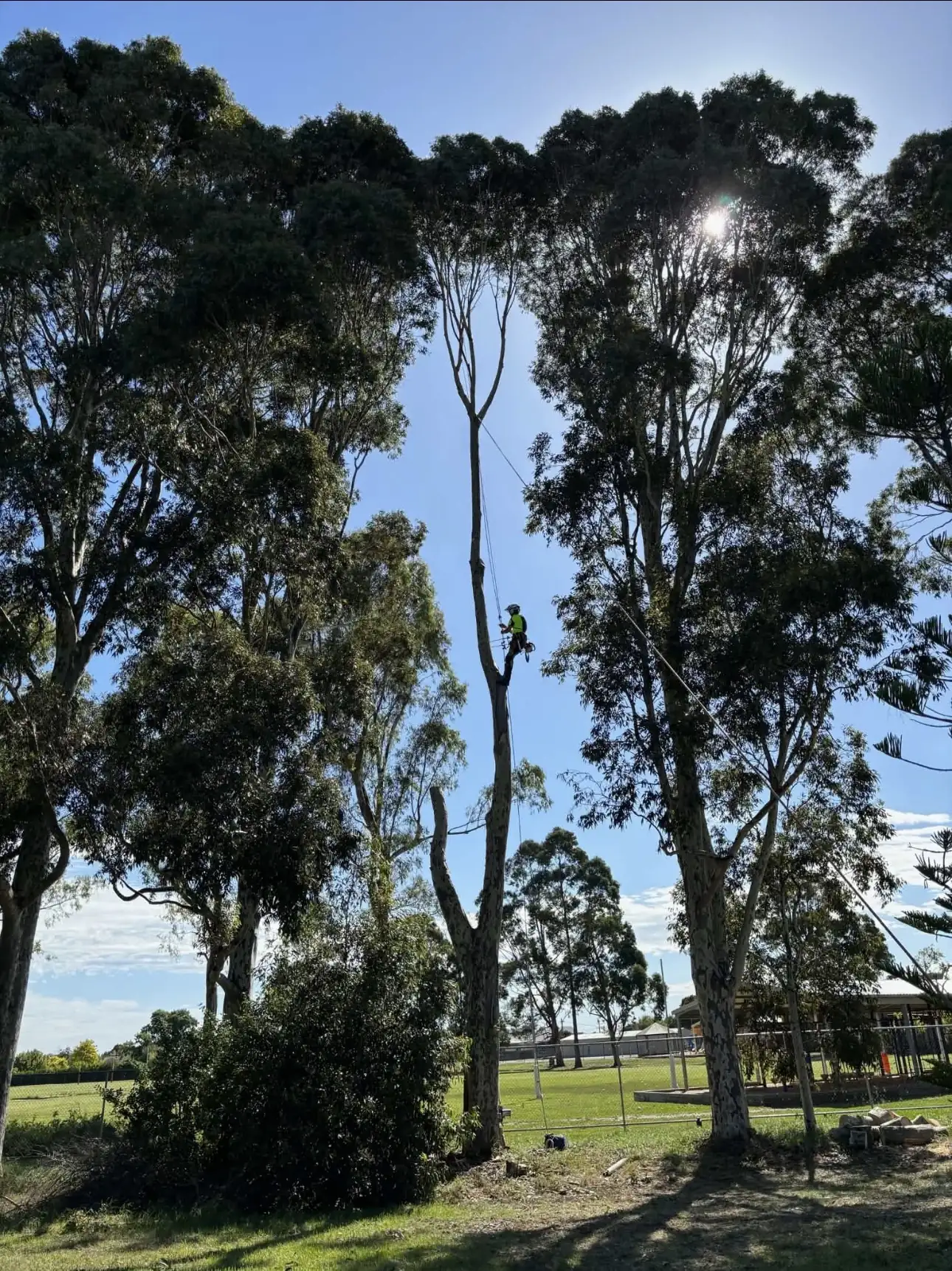
Safe Work Australia’s tree work guide says working at height in trees is dangerous, and that it should be left to people who have proved their skill against the national standard [2]. It wants a keep-out area under the tree, so that no one stands where something could land [2]. Reaching the crown from an elevated work platform is one of the access methods it describes, and so is rope climbing [2]. That matches how our team works on a tall palm. We climb, or we use an elevated work platform, and a crane can lift a big palm out in sections when there is access.
Spines are the other hazard on some palms. Gardening Australia warns that the spikes at the base of a Canary Island date palm frond can pierce almost anything, and that fallen fronds leave them facing up [3]. Its advice is to leave routine work to experienced arborists, and to go to hospital rather than pull out a spike that has lodged in the skin [3].
How the clean-up of a tall palm runs
- Drew looks at the palm and at what sits below it, then quotes on site.
- Our team picks the method: a climb, or an elevated work platform.
- Dead and dying fronds and the seed pods come off, working from above.
- Green growth stays. We do not over-trim, and we advise you if you want more taken off than the palm will handle.
- Fronds, trunks and seed heads are cleared and taken away, unless you want to keep them.
Drew came same day to give a quote which was accepted and came that week to do the job. He did an excellent job cutting down 2 palms, very professional. The mess was all cleaned up and taken away with no effort. I would recommend him to others as we were very satisfied with his work.. Thanks Drew for your help.👍
Which dead palm fronds to cut and which to leave
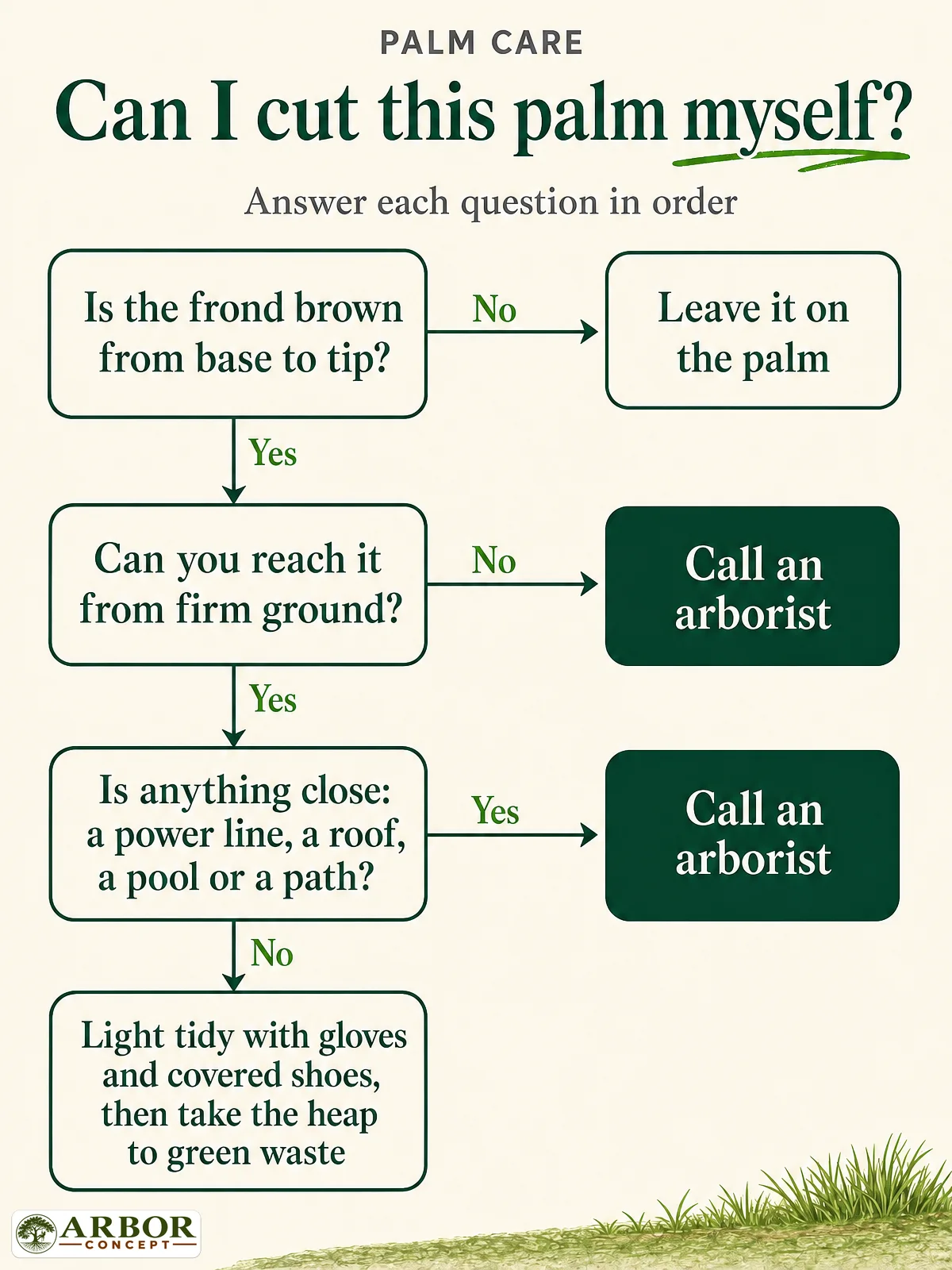
The picture changes when a palm is short, every frond is visible from the ground and nothing hangs overhead. You can sometimes do light tidying with gloves and a hand tool, with both feet on solid ground. No ladder, no chainsaw, and nothing near a power line.
Stay with the brown ones only. Keep your hands clear of the spiny stalks on some palms, and wear gloves and eye protection. And do not climb a palm with spikes on your boots, because they wound the trunk.
A palm does not need a haircut to look neat. Cutting green fronds for a tidy outline is a common mistake. Green leaves feed the palm, and a palm cut back too far can end up weaker than it started.
Timing matters less than people think. A palm does not have a pruning season the way a rose does, so you can clean one up whenever a frond is truly dead. Our worst weather comes in the hot, wet months. A good time to look is straight after a big storm or a run of wind, because loose fronds tend to hang by a thread until the next gust.
If you are not sure whether a frond is ready, leave it. A brown frond left another month does little harm. A green one cut too soon cannot be put back.
Where the heap of dead palm fronds can go
Cutting is only half the job. A single palm can drop a surprising mound. Fronds are long, stiff and awkward, and they do not squash.
Garden bins are the easy route, with limits. One council accepts palm fronds in the garden bin only when they are cut shorter than a set length, and it will not empty a bin that is over a set weight [4]. The lid has to close fully, and plastic bags are not accepted [4]. Other councils set their own limits, so check yours.
Bigger heaps can go to a council recovery centre. Brisbane City Council lists palm fronds as green waste, and asks people to sort a load so that like items are packed together [5].
Choosing where the heap goes
| Option | Suits | Watch for |
|---|---|---|
| Council garden bin | A few fronds, cut short | Length and weight limits, a lid that must close, no plastic bags |
| Recovery centre | A large heap after a full clean-up | Pack fronds apart from other rubbish; check what your centre accepts |
| Taken away by us | Tall palms and big jobs | Tell us at the quote what you want done with the wood |
A small habit helps a lot. Cut long fronds into short lengths as you go, and stack them in one place, away from the house wall. Bins fill faster than you expect, so plan two or three collection days, not one. A heap that waits a fortnight for a bin is a heap that collects spiders, damp and the odd lizard.
Whatever you pick, do not dump fronds in a bushland reserve or on a verge. It is rubbish in the wrong place, and it can be a fire fuel.
Want this looked at on your own property? The on-site quote is free.
Burning dead palm fronds is a poor idea
Some people reach for a match. It looks like the quick answer, but the rules and the risk both say no.
One regional council spells out the position. Council cannot issue a permit to burn. A fire bigger than the stated size has to be cleared with the state fire service, and a small fire must not be used to burn rubbish or waste [6]. Smoke, ash and fumes that annoy neighbours can also be a council matter [6].
The state fire service tells people to check for current fire bans and local laws before any outdoor fire, and says plainly not to burn garden vegetation or other rubbish [8].
Each council words its own rules, and the wording gets updated. Look up yours before you light anything. Dry fronds also flare up quickly, which makes a small fire hard to control. The green waste route is simpler, and it keeps you out of trouble.
What lives in a palm that is left to droop
A palm that is never cleaned up becomes a thick, dry curtain. That is cover for small animals, including snakes and rodents, and an untended palm can draw in bats too. A clean crown leaves less shelter.
The Queensland Government’s snake advice is a good guide for handling the heap too. It says to tidy the yard in the colder months, when snakes are less active, to stack timber neatly so rodents and snakes cannot hide in it, and to wear gloves, long pants and covered shoes when gardening [7]. It adds that you should lift objects so they face away from you, in case a snake is sheltering under them [7].
Handling a heap of fronds
- Wear gloves, long pants and covered shoes.
- Move the pile to the bin or centre soon after cutting.
- Lift fronds so the cut end faces away from you.
- Do the tidy-up in the cooler months where you can.
- Leaving a heap against the house or the fence for weeks.
- Reaching under a frond pile with bare hands.
- Stuffing fronds into a bin until it will not close.
- Burning the heap without checking your council.
Animals come before the schedule on our jobs. Say our team spots a nest or a creature up in the crown. We pause, and the plan is reworked so that nothing is hurt. That can mean a different day. If you already know something has moved into the palm, mention it to Drew at the start.
Quick and easy to organise a visit/quote. Job done the following week. Cut down 4 palms and clean up. Would definitely use again if needed.
Calling in an arborist for dead palm fronds, and when not to
Not every frond calls for a professional. A short palm with a few brown fronds in easy reach, standing in a clear spot, is a light job for a careful person on the ground.
Call in an arborist when the palm is tall, when the fronds hang over a pool, a roof, a car or a path, when any frond or stalk is close to a power line, or when the skirt is thick and dense. Get one in too if the palm looks sick, leans, or has a rotten trunk. A palm like that may need to come out, not just be cleaned.
A qualified person looks over the job first and brings the right gear for it. That protects the palm and everything under it.
How we deal with dead palm fronds
Drew is the first contact. He looks at the palm and at what is underneath it, and he quotes on site for free. He will tell you if the palm only needs a clean-up, or if it needs more.
Our team then does the work. We take off the dead and dying fronds and the seed pods, tidy the crown, and clear the heap. You choose what happens to the waste. Palms that drop a lot are usually tidied every three to six months, though a quiet one may need less.
You can read more on our palm tree maintenance page, and the way a palm job gets priced is set out on the quote page. To book a free look at the palm, reach out any time. Pensioner and local discounts are available.