How often to trim a palm tree, and what to leave alone


How often to trim a palm tree depends on what you mean by trim. The palm itself needs very little: dead fronds and spent seed pods, taken off when they are ready. A yard with a palm over a pool, a path or a car often wants a clean-up every three to six months.
This guide separates the two ideas. It covers what a palm really needs, what your yard needs, which palms tidy themselves, and which cuts do harm.
A palm that looks scruffy is not always a palm in trouble, and a neat palm is not always a healthy one. Looking at the real tree, and what sits under it, is the only way to set a sensible rhythm.
Ask five people how often to trim a palm tree and you will get five answers. They are all a bit right. The trick is knowing what each one is trying to fix.
How often to trim a palm tree, in two lines
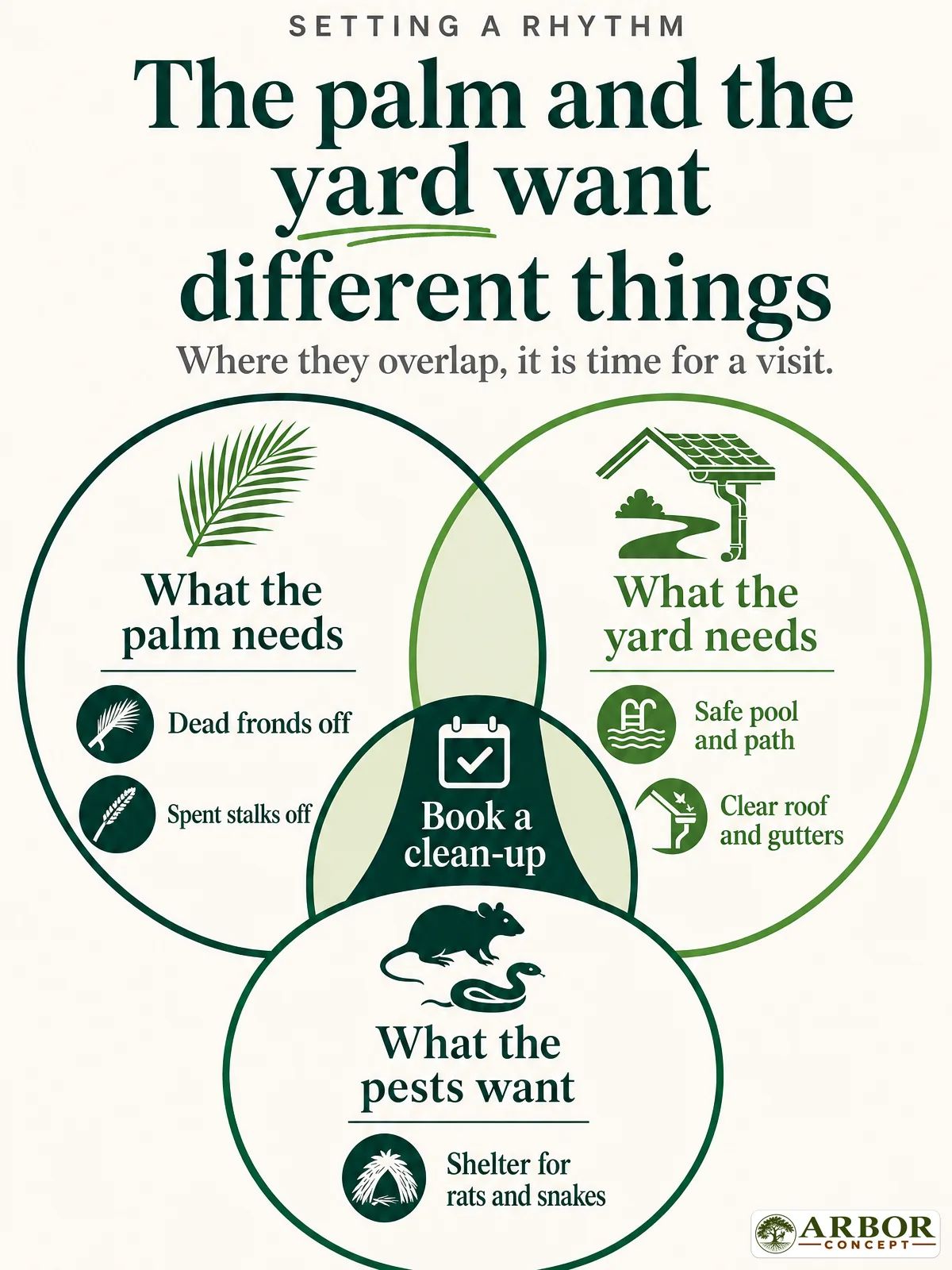
Here it is in two lines. The palm needs trimming only when something on it is dead or dangerous. The yard under the palm may want that done on a steady schedule.
For the palms we see most, a clean-up every three to six months keeps a yard safe and neat. Every three months is the usual rhythm for palms over pools and paths, because pods and fronds grow back fast, though small. Treat that as a guide. A palm in a quiet corner with nothing beneath it can go much longer. The only way to know is to look up and see what is hanging.
Picking a rhythm
| Where the palm stands | Rhythm to expect | Why |
|---|---|---|
| Over a pool or a play area | Every three months | Heavy pods and loose fronds fall where people are |
| Beside a house, shed or car space | Every three to six months | Fronds scrape walls and drop onto roofs and gutters |
| In an open garden bed | When it needs it | Little is beneath it, so dead fronds can wait |
| A self-cleaning kind | Often little at all | It sheds old fronds without help |
A palm needs less trimming than you think
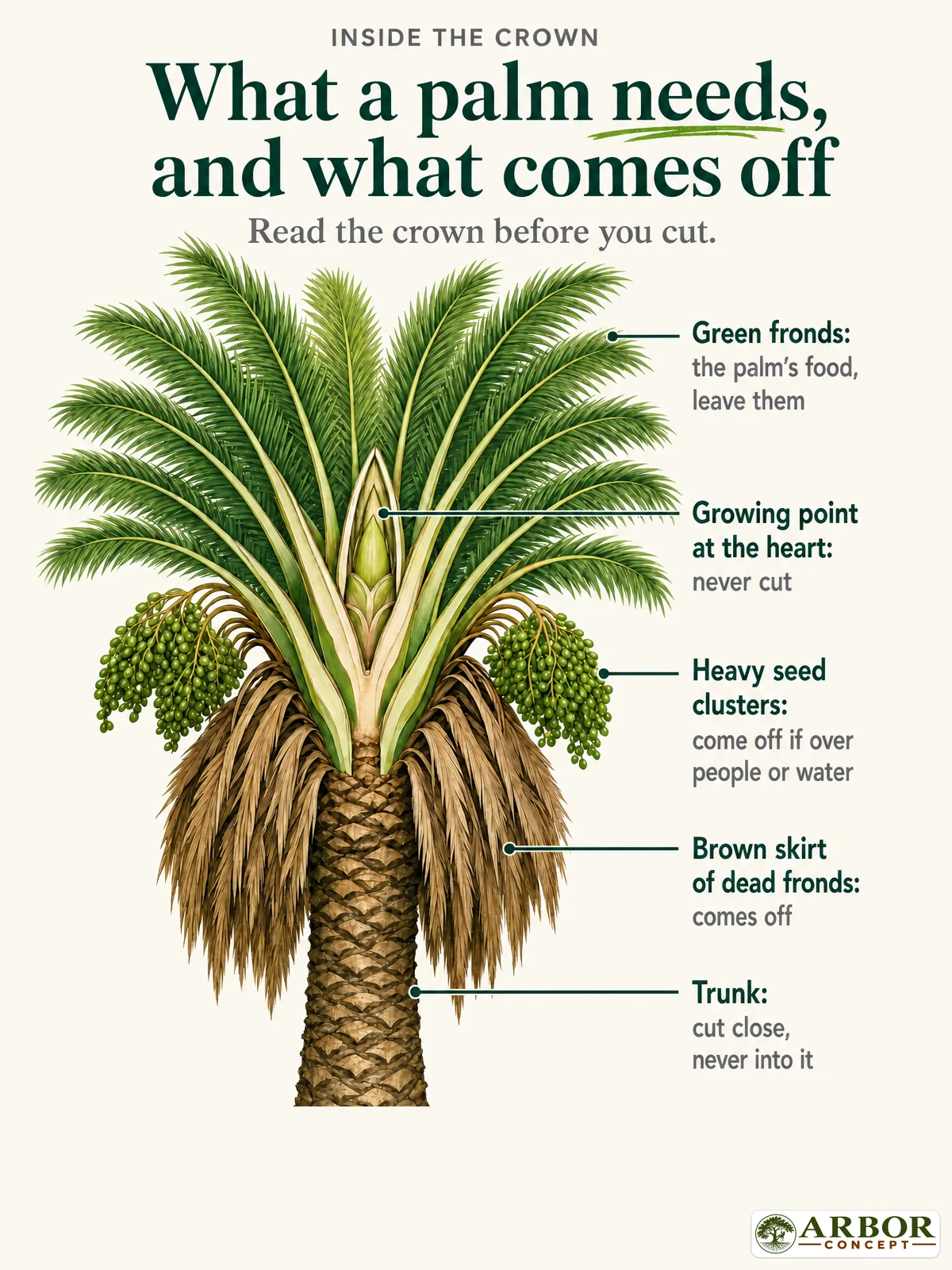
Ask any arborist and you will hear the same thing. Palms need less pruning than most people expect, and a hard cut is the commonest way to hurt one. Many people believe more cutting means faster growth. It does not.
The reason is simple. A palm makes its food in its green leaves. Take the green leaves away, and you take away the food. Cutting green or part-yellow fronds also leaves the palm weaker against pests and disease.
So the palm’s own to-do list is short: fully dead fronds, spent flower and fruit stalks, and anything damaged.
A frond is a long investment for a palm. One that looks a little tired is often still working, so it does not need cutting the moment it fades.
Your yard may need more than the palm does
Here’s where the three-to-six month rhythm comes from. A palm doesn’t care if a seed cluster hangs on. Your pool does.
Our palm clean-ups deal with weight and mess. A cluster of seed pods is heavy. Over a pool, a path or a play area, one falling can seriously hurt someone. Falling pods and fronds can also crack pavers and damage structures.
Gardening Australia shows the safety side with the Canary Island date palm. Its fronds carry sharp spines that point up once they land, and the advice is to have experienced arborists do the routine work, taking fronds off before they fall [1]. Fire is the other worry. The same program’s notes on Washingtonia fan palms say dead and decaying foliage can be a fire risk and is best removed [2]. Both are safety jobs first.
There’s a third reason that people overlook. A palm left alone gets dirty, and bats, snakes and other creatures start sheltering in it. A properly cleaned palm leaves less shelter, so keeping palms pruned helps keep those visitors away.
Drew removed a problem palm for me last year before it caused any damage. Great quote, quick and efficient and great outcome. Very happy (and relieved) and would recommend highly.
Some palms tidy themselves
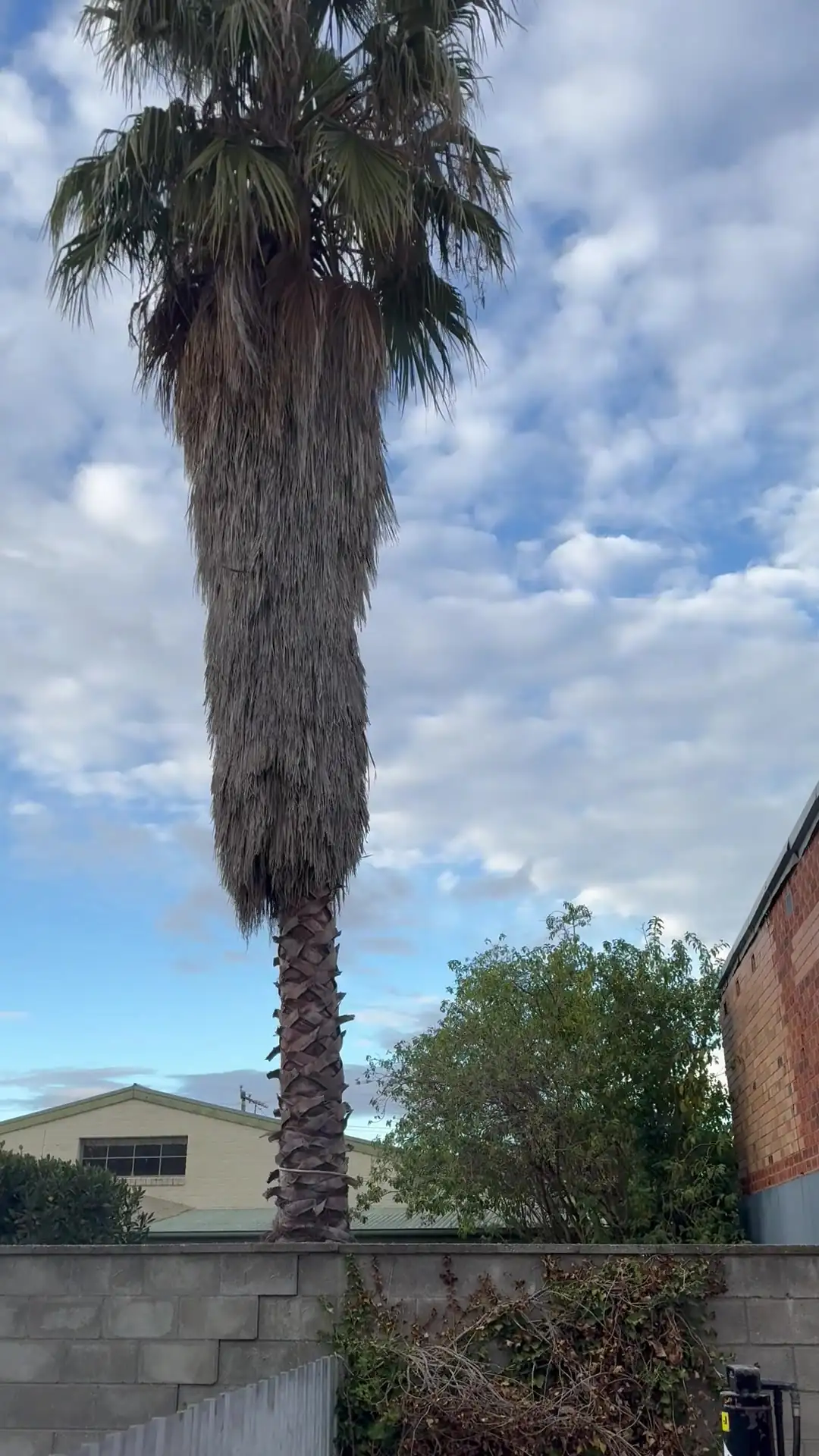
Not every palm needs a visit. The bangalow palm, a favourite in Queensland gardens, sheds its old fronds without help, so it needs little frond work [3]. Other kinds hold on to dead fronds for a long time, and those are the ones that build a thick brown skirt. Washingtonia fan palms form a thatch of dead fronds around the trunk [2]. Cocos palms keep old fruit and dead leaves hanging, which gives them an untidy look [4].
If your palm is a self-cleaning kind, a clean-up is mostly about the pods, and maybe the odd frond that hangs. If it holds its dead fronds, the skirt is the job. Phoenix palms need care. Gardening Australia says the trunk is scarred where old leaf bases fell away, the lower leaflets are stiff, sharp spines, and old fronds should be removed with care [9]. One look at the trunk tells Drew which kind you have, and so how often it will really want attention.
Cocos palms and phoenix palms are the ones we see most. Both can carry heavy pods and a good deal of dead growth, so they are often on the schedule.
Signs a palm is due
What to cut and what to leave
The rule of thumb is a good one: remove only fully brown fronds. A frond that is partly yellow is still helping, and yellow can also signal a nutrient problem that cutting won’t fix.
Arborists work to the same plain standard: only dead or broken fronds come off. Fronds that sit level or point upward are the working part of the crown, so they stay. The aim is a round, full crown, not a bare stick with a tuft.
Flower and fruit stalks are a slightly different case. A spent stalk can come off without harm to the palm. One still in flower feeds bees and birds, so it can wait until the blooms have dropped. If heavy fruit hangs over a pool or path, though, the safety reason can win.
What comes off, and what stays
- Fronds that are fully brown or broken.
- Spent flower and fruit stalks.
- Heavy seed clusters over people, cars or water.
- Fronds that touch a roof, wall or line.
- Green fronds, even tatty ones.
- Partly yellow fronds that still feed the palm.
- The growing point at the heart of the crown.
- A full, round shape.
Cut fronds are not all waste. A Gardening Australia palm collector calls them good mulch and adds them to his garden, though he also warns that prickly and very large palms are poor choices near verandahs or where children walk [8]. One more detail. Fronds should be cut close to the trunk without cutting into it, and not pulled or torn off. Tools should be cleaned between palms. A New South Wales council lists undisinfected pruning tools as one way Fusarium wilt can spread, a disease that has hit Phoenix, desert fan and cocos palms [5]. That’s how a trained person works, and it’s part of why we’re careful.
Want this looked at on your own property? The on-site quote is free.
Why heavy cutting hurts a palm
You may have seen a palm cut so hard that it looks like a feather duster. Or one with a pointed top like a sharpened pencil. These cuts are common, and they are bad.
Some owners cut a palm hard before the storm season, hoping it will ride out the wind. It does not work that way. A palm with a full crown is the healthier palm, and stripping green leaves only removes the food it lives on. Take off what is dead or loose and leave the rest.
A single-trunk palm has one growing point, deep in the heart of the crown. One NSW weed guide shows how final damage there is: it says a cocos palm cut through below its lowest leaf will not grow back [4]. A careless cut that reaches the heart of a prized palm can end it the same way.
Taking most of the fronds off several times a year can harm the tree. That’s why we don’t over-trim. If you ask for more than the palm can take, we say so and suggest the best way to protect it. Most people are glad of that advice.
Palms, wildlife and flying-foxes
Palms are homes. Along with the pests above, they can shelter birds, bats and other animals. Checking for them is part of the job.
Queensland has rules for trimming around flying-fox roosts. The Queensland Government says minor trimming of roost trees is allowed under its low impact code, within a set limit in any twelve months, and that more than that needs the department’s involvement [6]. It also says a branch must not be removed while flying-foxes are roosting in it, and that trimming may need to wait until after dark when they have left [6]. The guidance is about roost trees in general. If bats are using your palm, tell us before anything is cut, and check what applies to you.
Had Drew here for my palm trees. I can’t recommend him highly enough. Great job and great price and really nice guy. I’ll be having him back.
Who should do the work, and who can skip it
A small palm that you can reach from solid ground, away from any line, is a garden job. Pulling off a loose dead frond with a gloved hand is fine. Some palms have sharp spines, so wear gloves and eye protection. Anything that needs a ladder is a different matter.
A tall palm, a palm near a line, a roof or a pool, and any palm with a heavy crown should go to a qualified arborist. The national tree work guide describes practical tree work at height as dangerous, work for people assessed as competent against the national qualification [7]. It also asks for an exclusion zone below the tree, so nobody stands where something may fall [7]. It says the wind and weather should be assessed before anyone goes up [7]. Falling debris is one of the hazards that guide asks workplaces to plan for, and a crown full of dead fronds and heavy pods fits that description.
Done badly, palm work can take out gutters, pool pumps, fences, sheds and pavers, and bring fronds down on people. That is why Drew looks at the palm and its surroundings before anything is cut. Drew holds a Cert III, has spent two decades up trees, and carries public liability insurance.
How a palm clean-up goes
- You talk straight to Drew, who looks at the palm and what is around it.
- The quote is given on site, free, and covers what comes off and what is carted away.
- Our team climbs the palm or uses an elevated platform and takes off the dead fronds and pods.
- The mess is cleared, and the palm is left full and green.
If a palm is rotten, diseased, leaning or simply in the wrong place, it may be better removed. When there is access, a crane is often the best way in, lifting the palm out in big sections. We tell you if one is worth it for your palm.
Setting your own rhythm
The best answer to how often to trim a palm tree at your place comes from looking at the palm, the pool and the roof together. A little and often beats a big cut after years of neglect, and it usually costs less over time.
In subtropical Queensland the storm season runs through the warm, wet months. Palms push out new growth fast then, and a strong blow can leave fronds hanging by a thread. A look after each big storm beats a fixed date on the calendar.
Try a simple check each season. Stand well back on the ground and look up. Is there a thick skirt of brown? Is a fruit cluster sagging over somewhere people walk? Are fronds touching the roof? If the answer to any is yes, it is time to ask for a visit. If all three are no, leave the palm alone and look again next season.
Our palm tree maintenance service covers cleaning, tidying and removal. Pensioner and local discounts are available. We quote every palm free on site, because photos hide the details that matter. Read about how we quote, then ask for a quote and tell Drew about your palms.