What is tree cabling and bracing, and which trees suit it?

What is tree cabling and bracing? It is a support fitted high in the crown of a tree, linking limbs or stems that are at risk of splitting apart. The support shares the load, so a tree with one weak spot can often be kept instead of removed.
This guide explains how the work is done, how the modern rope systems differ from the older steel ones, and which trees are good candidates. It also says plainly what the work cannot do.
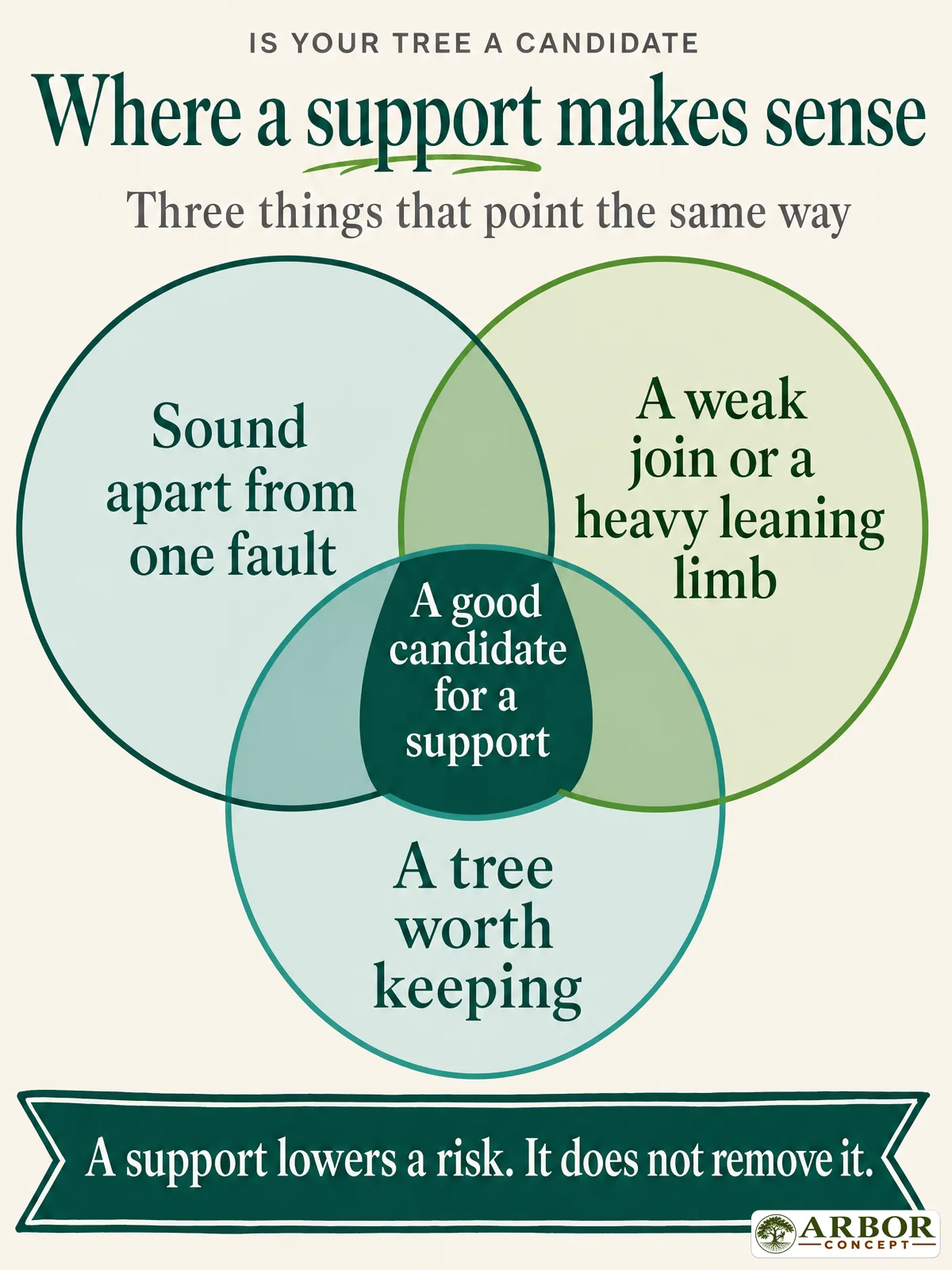
Looking at the real tree matters, because a support only works when the tree is sound apart from one fault. That is a judgement made with your tree in front of you, and not from a description.
Picture a big limb on a spreading gum, leaning out over the lawn. It has grown that way for decades. It is healthy and green, and the family loves the shade. Yet it is long, heavy and held on by a weak join. Most people are told to take it out. There is another answer.
What is tree cabling and bracing?
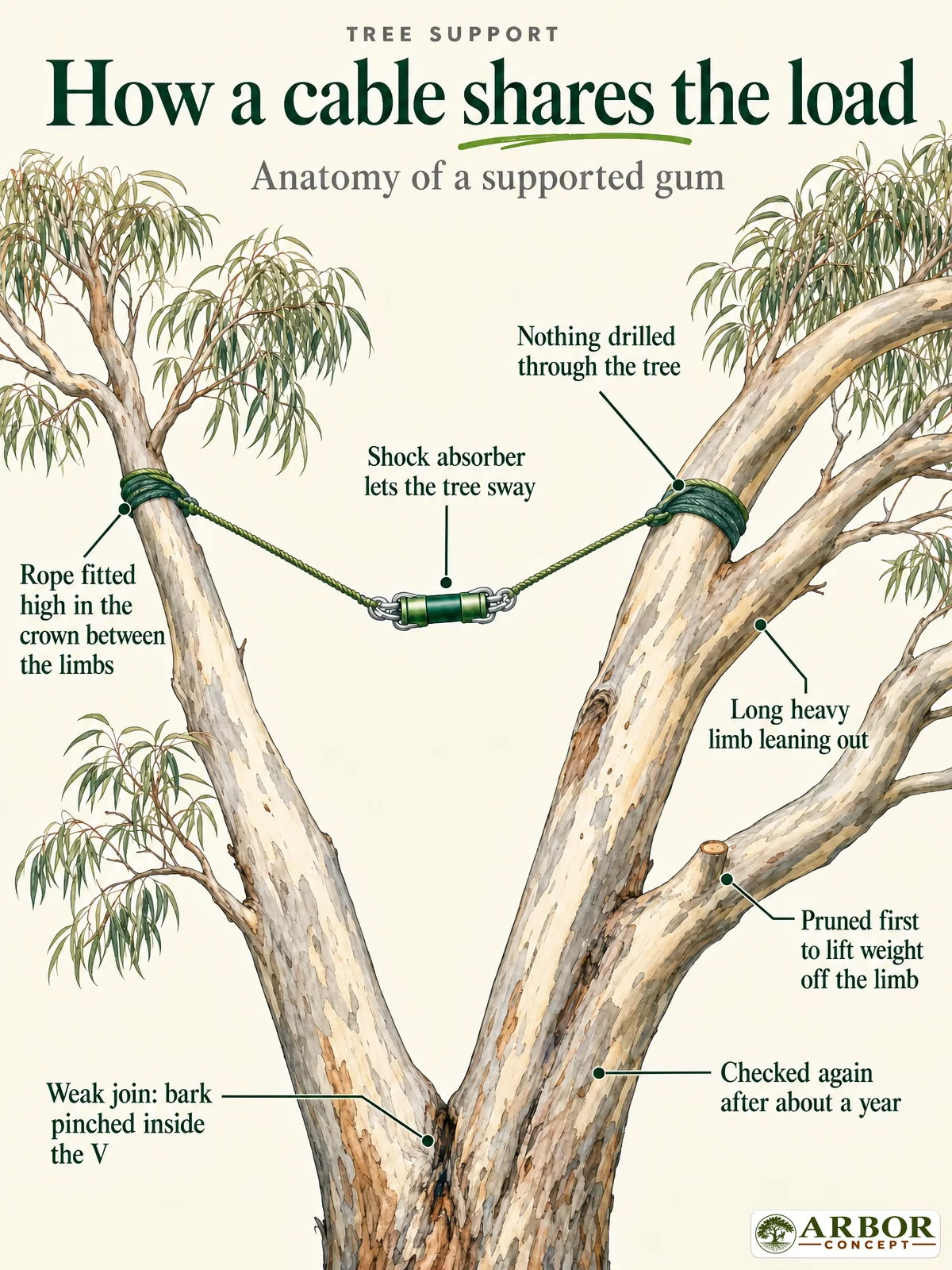
Cabling and bracing is a way of supporting a tree from the inside. A cable links two limbs or stems high in the crown. A brace does a similar job at a weak join. Both are meant to share the load, so one part of the tree is not left to carry everything alone.
This is recognised trade work in Australia. The national training unit for it, Install tree support systems, covers fitting cable and bracing hardware into the structure of a tree [1]. Brimbank City Council, in Victoria, counts cabling or bracing as one job a professional arborist takes on, for branches that are poorly attached to the tree [2].
A mature tree takes years to replace. Shade, shelter for birds and a sense of place all go when it goes, and a new sapling cannot bring them back for a long time. If a weak spot can be steadied, that is worth knowing about before any saw is started.
So the idea is old and simple. A tent pole is steadied by a guy rope. A bridge is steadied by a cable. A tree with one weak spot can be steadied too.
Why some trees need holding together
Most weak joins in trees have one of two stories behind them.
The first is the shape of the tree. Two or more upright stems of near equal size compete for the lead, and arborists call them codominant. With two stems of equal size, neither one is in charge, and there is no collar to bind them.
The second is bark trapped in the join. When two stems grow tight together, bark can fold into the seam. Bark is not wood, so it cannot bind. Think of two hands pressed together, palm to palm, rather than fingers locked.
Neither fault shows from the street. A tree can look full and green and still hold a hidden flaw in its frame. A union like that can carry a tree for years. Then a wet-season storm, a heavy crop of fruit or a long dry spell broken by a deluge arrives, and the weak spot opens. A support leaves the join as weak as it was and takes the strain off it.
This is why the national unit makes tree defects, and the support solutions that suit them, part of what an installer must know [1].
Signs a tree may be a candidate
Cable or brace: what each one does
In everyday talk the two words travel together, but they are not quite the same.
A cable is a flexible line fitted high in the crown, between limbs. It limits how far a limb can swing or lean. It is the part of the system that does most of the work for a long, heavy limb.
A brace is a more rigid fixing, and the older kind is a steel rod set through the wood at a join. It is the part people picture when they think of bracing. Our team treats a fixed brace as a last resort, because it means drilling into the tree.
Which one suits a tree depends on the fault. A leaning limb usually needs a cable. A split that has already opened may need something firmer. Sorting this out takes a close look from the ground and from within the tree. Cracks, old splits, the angle of the join and the length of the limb all play a part, and each one is checked before a plan is made.
Chose Drew and the team as they had great reviews. Wasn’t disappointed at all. Drew gave me a quote to remove a pine that split and advice on another tree that was looking at doing the same. They were able to get it done quickly and to a great standard. Very happy with the service.
Steel and rods, or flexible rope?
Support systems fall into two broad families. The first is steel cable and rod, which is stiff. The second is synthetic rope, which gives a little. Three kinds of work sit in the national unit: steel cable, textile or synthetic cable, and bracing [1].
The choice changes how the tree lives with the support. The same unit expects an installer to understand the effect on the tree’s natural range of movement, on its flexibility and on its reactive growth [1]. Reactive growth is the extra wood a tree lays down where it is under strain.
Two families of support
| Feature | Steel and rods | Synthetic rope |
|---|---|---|
| Fixing | Hardware through the wood | Nothing drilled |
| Tree movement | Much less sway at the join | Most of the natural sway kept |
| In the weather | Steel can rust over time | Does not rust, shrugs off sun and rain |
| Our view | A last resort | The method we choose |
A rope also needs sound wood to sit on. The unit has installers examine the stems for defects before the system goes in [1]. That is one more reason a close look comes first.
Our team uses a hollow-braid rope of strong synthetic fibre. It is light and flexible, it resists sun and water, it does not rust, and it stretches a little so the tree can move. A shock absorber is fitted with it. Nothing is drilled through the tree, so the fix does not hurt it.
How a cabling job goes
The order of work matters as much as the rope. Here is how it runs.
From first look to follow-up
- Drew studies the whole tree: its health, its structure and what sits beneath it.
- Our team climbs and prunes first, lifting weight off the limb that needs help.
- The support is fitted high in the crown, between the limbs it is meant to link.
- Tension is set so the rope takes the strain only when the limb moves too far.
- About a year later we return to see how tight the support has become, then adjust or prune again.
Pruning first lightens the load before the support goes in, so the support has less to carry. The national unit lists pruning ahead of installation as part of the job [1]. The second visit pays off too. The unit also lists checks and adjustments over the years among the things an installer must know [1], and how tight the rope has become shows how much weight the tree has put on.
Before anyone climbs, a competent person looks over the tree. Safe Work Australia’s national guide asks for a visual assessment of the whole tree. It looks at structural soundness, decay, hollows, how well the roots hold and what wind and ground conditions add [3]. The guide also lists climbing to fit cables as work it can help with [3].
That is why each tree gets its own plan. Once someone is up in the crown, two lookalike trees can turn out to need very different supports.
Want this looked at on your own property? The on-site quote is free.
What a support cannot do
Honesty matters here, because a support is not magic.
It cannot bring back dead wood, and it cannot heal a trunk that is rotten or failing at the base. A support is for one weak area on a tree that is otherwise healthy.
Timing matters too. Shaping a young tree early is far easier than mending a grown one, because its branch structure is still forming. A tree that has already grown a weak union cannot be reshaped that way. A support can be the next best thing.
A support also lowers a risk. It does not remove it. Nobody honest can promise that a tree will keep every limb for life, and we will not pretend otherwise. We will tell you what we see, what we would do, and what is left over afterwards.
Questions worth asking about any support
- Ask whether the tree is sound apart from the one fault.
- Ask if the system drills into the tree.
- Ask when the support will be checked again.
- Ask how the support copes as the tree keeps growing.
- Treating a cable as a cure for rot or decay.
- Fitting a support and never looking at it again.
- Hanging swings or loads from a cabled limb.
- Letting anyone work without a check for rules on that tree.
Rules, owners and neighbours
Whoever owns the land where a tree grows is the tree-keeper. The Queensland Government says that person is responsible for caring for and maintaining the trees on their land [4]. A tree with a known weak union, standing over a house, is a good example of why that matters.
Protected trees add another layer. Noosa Council says it is an offence to damage or remove protected trees and plants without a permit or exemption, and that vegetation can also be protected by covenants or conditions of approval [5]. Fitting a support is a gentler act than felling, but pruning ahead of it may still count. Each council writes its own rules, and rules get updated, so ask yours before work starts. Our team can help you find out what applies to your tree, and we will not claim a rule covers it until it has been checked.
The tree-keeper duty has force behind it. QCAT says tree keepers must properly care for and maintain trees on their property under the Neighbourhood Disputes (Dividing Fences and Trees) Act 2011, and that it can appoint a qualified arborist to inspect a tree and report on the work needed [7].
A tree near a boundary also touches the neighbours. We are happy to explain the work to them so there are no surprises.
Drew was fantastic. Responsive, efficient, knowledgeable and accommodating. Will definitely be calling on Drew and his team again.
When to get an arborist in, and when you do not need one
You do not need anyone for a healthy tree with a single strong leader and no cracks. Leave it alone, water it in dry spells, and look it over after storms.
Do get a qualified arborist when you see a split in the join, a long limb leaning over the house, a crack, or new damage after wind. Get one before you buy or build near a big tree, too. Ask what the report will cover. Brisbane City Council describes an arborist report as a record of a tree’s structural integrity and any risks, written by a qualified arborist [8]. It asks for AQF Level 5 in arboriculture or an equivalent qualification, with experience in tree risk assessment [8].
Please do not attempt the fitting yourself. SafeWork NSW names falls from height, falling objects and work near power lines as major risks in tree work [6]. The same national guide calls climbing work in trees dangerous, and says it belongs with people who have been assessed against the industry’s national qualification [3]. Supports are fitted high in the crown, which is exactly where those risks sit.
When you choose who does the job, one council suggests asking for proof of insurance and for references [2].
An honest arborist will also tell you when a support is the wrong answer. Sometimes the tree is too far gone. Sometimes pruning alone is enough. Sometimes removal is the safest choice. Our team will say which one fits, even if the answer costs us the work.
How we approach cabling and bracing
So, what is tree cabling and bracing worth on a property like yours? Often, it is the difference between shade kept and shade lost. Drew is your first contact. He visits, studies the tree and its surroundings, and explains the options in plain words. The quote is free and always given on site. Our team then does the work, to Australian Standards. Drew is a Cert III qualified arborist, has been in the trade for 20 years, and is covered by public liability insurance.
If the tree can stay, you will hear it from us. If it cannot, you will hear that too. Pensioner and local discounts are available. Payment is split: half secures the day, and the balance follows when the work is done.
More detail on the service sits on our cabling and bracing page. Our how we quote page shows how prices are set. If a tree on your block worries you, get in touch and ask about it.