Is cabling a tree a good idea? A fair look at both sides

Is cabling a tree a good idea? For a healthy tree with one structural weak spot, it often is. A support can lower the chance of a limb or stem failing and can keep a tree that would otherwise be lost. For a tree with rot, decay or a failing base, it is the wrong tool.
This guide sets out the case for cabling, the case against it, the trees that should not be cabled, how it compares with removal, and what upkeep it needs afterwards. It also lists the questions worth asking before you agree to anything.
The deciding facts sit in the wood: how sound it is, where the weakness is, and what stands underneath. A look at the real tree is what turns "maybe" into a clear yes or no.
Most owners meet this question after a worrying moment. A limb drops in a storm, an arborist points out a split, or a quote arrives with the word removal on it. Then someone asks if there is another way. There may be, and this guide helps you judge it.
Is cabling a tree a good idea? A fair first answer
Short version: sometimes, and the tree decides.
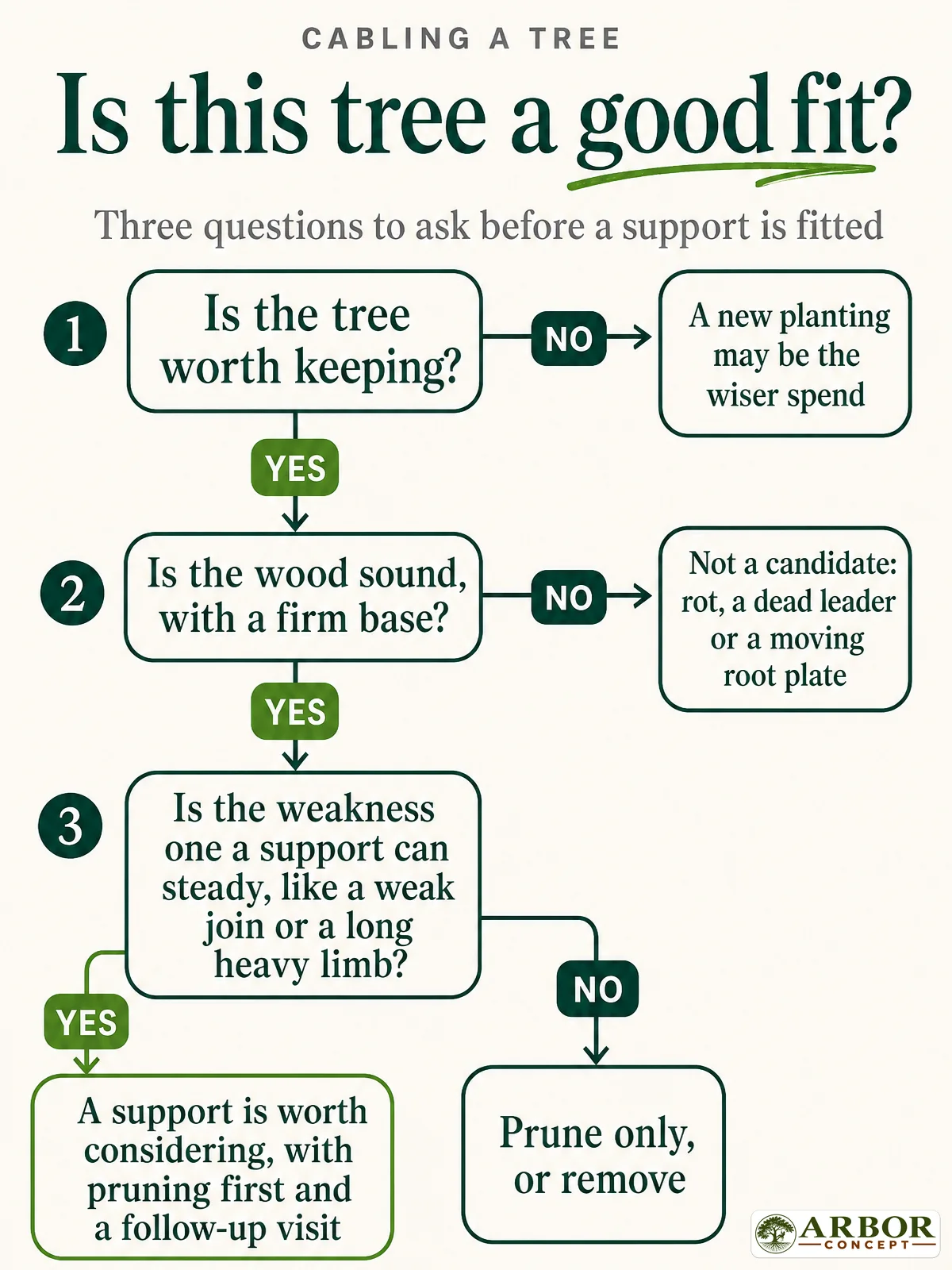
It is a good idea when three things are true. The tree is worth keeping. The wood is sound. And the weakness is one that a support can actually steady.
It is a poor idea when any of those fail. Brimbank City Council lists cabling or bracing among the services an arborist can offer for branches that are weakly attached [1]. The target is a weak attachment, not a rotten trunk or a tree leaning on failing roots.
A fair adviser does not sell cabling to every tree. They sort the trees that suit it from the ones that do not, and say so even when the answer is no.
What a support can and cannot do
Those four points are working knowledge in the trade. The cable sits high in the crown and takes a share of the strain. The tree still does most of the standing.
What a support is meant to buy you
Is cabling a tree a good idea as a way to buy time? Yes, if you think of it as time and safety for a tree you value. A flawed tree stays flawed, but it becomes safer to keep.
Queensland tests its trees. Summer storms arrive with hard gusts. A wet season leaves soil soft and crowns heavy with water. A weak join that coped for years can give way on one bad afternoon.
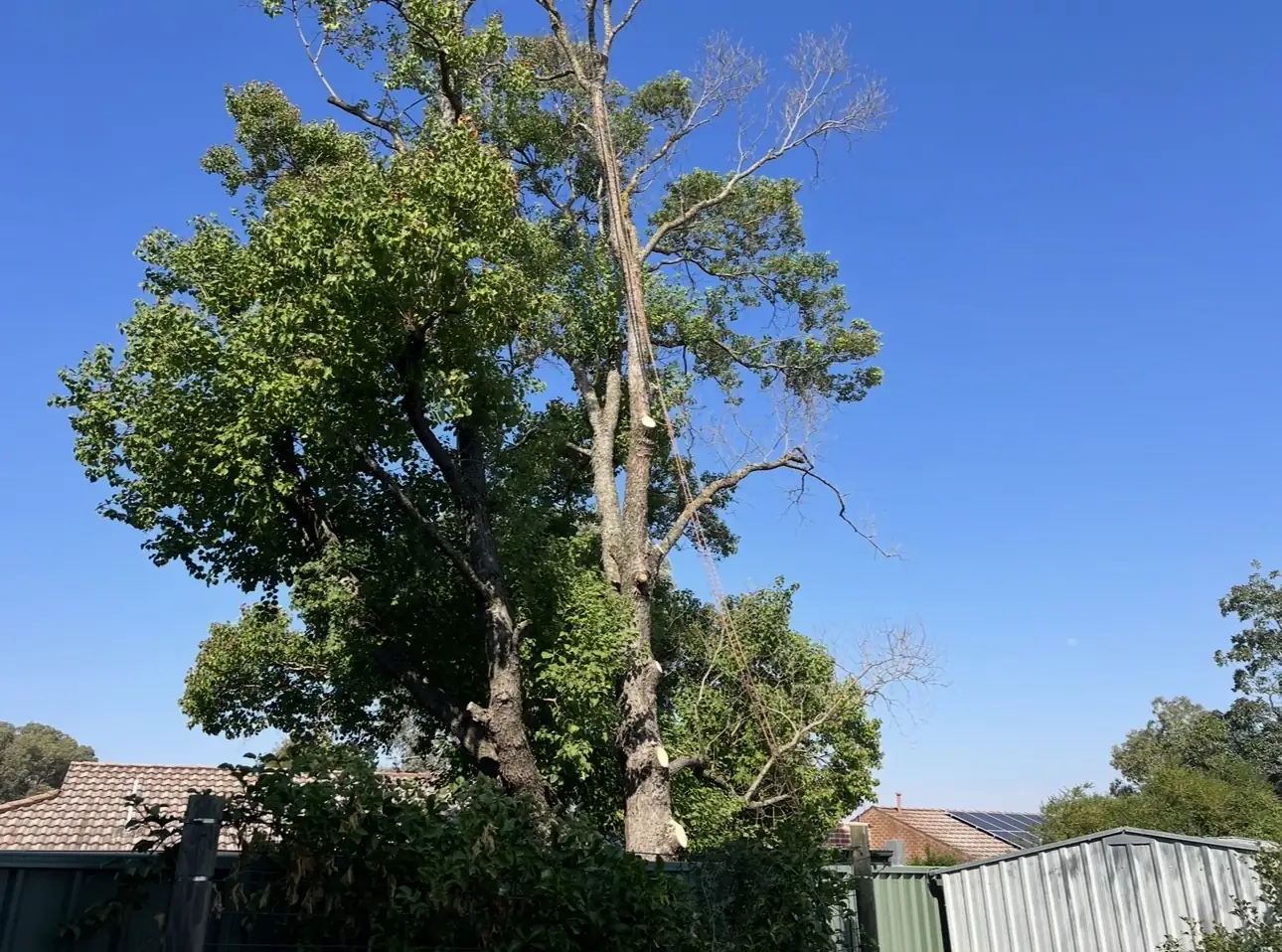
The usual targets are two. One is a pair of main stems of near equal size that split in a V. The other is a limb that reaches far out with its weight at the tip.
Gardening Australia shows how the first one ends. On a Brisbane block, a Bribie Island pine was split in half by a storm and had a weak fork, because it grew two trunks as a young tree and they never joined securely [2]. The program says that was easy to prevent while the tree was young, by removing one of the two leaders [2]. Once a tree is grown, that early fix is gone. A support is what is left.
The case for cabling a tree
The strongest argument is what you keep. A mature tree gives shade, shelter and a sense of place, and a new planting cannot match that for many years.
Removal is often the only thing people are offered. Cabling is not practised much in Queensland, and many owners never hear of it. So they never get to weigh it up. Where the wood is sound and one part is the problem, a support is worth putting on the table.
There is a second argument: the modern rope kind is gentle. Our team uses strong synthetic cable systems, not steel cable and not bolts. Nothing is drilled through the tree, the rope can be tightened or loosened as the tree grows, and the tree is free to move and flex.
There is also the habitat. A tree with years behind it often shelters birds and possums. Keeping it standing keeps that home in place, which removal cannot do. Where a tree cannot stay whole, a habitat tree or nesting boxes can soften the loss, and we will say so when it applies.
The third argument is peace of mind. If you have worried about a leaning limb over the house, a plan that lowers the risk and comes with a follow-up visit is a real comfort.
Drew was great to deal with from the very first call. He stayed in touch throughout the job and sent photo updates along the way which was great. Drew and his team got there on time and did a fabulous job. Prices are reasonable and you can see there is a sense of pride in their work, super easy to deal with, polite and friendly. Thanks Drew and team, i am very happy with the end result.
The case against cabling a tree
The first mark against it is that it does not remove the risk. A support lowers the chance of failure. A badly fitted one can add its own hazard, such as a line set in the wrong spot, or hardware that cuts into the bark. That is why who does the fitting matters so much.
The second is upkeep. Every system has a limited life, and ropes, hardware and the tree itself all change over time. Brimbank City Council advises a regular inspection of mature trees at least once a year [1]. A cabled tree is a good reason to follow that advice.
The third is cost against value. Is the tree worth the spend, or would a new planting be the wiser buy? That is a fair question for a tree of little worth.
A fourth is the older style of fitting. Steel cable is usually held by bolts that pass through the wood. Drilling leaves wounds. If you are offered that style, ask why.
Keep it, prune it or take it out
| Choice | What you gain | What you accept |
|---|---|---|
| Support the tree | The tree stays, with its shade and its birds | Risk is lowered, not ended, and the system needs checking |
| Prune only | Less weight on the weak part, and no hardware | A weak union stays weak, and large cuts can stress the tree |
| Remove the tree | The risk ends for good | The tree is gone, and a new one takes years to grow |
Trees that are poor candidates
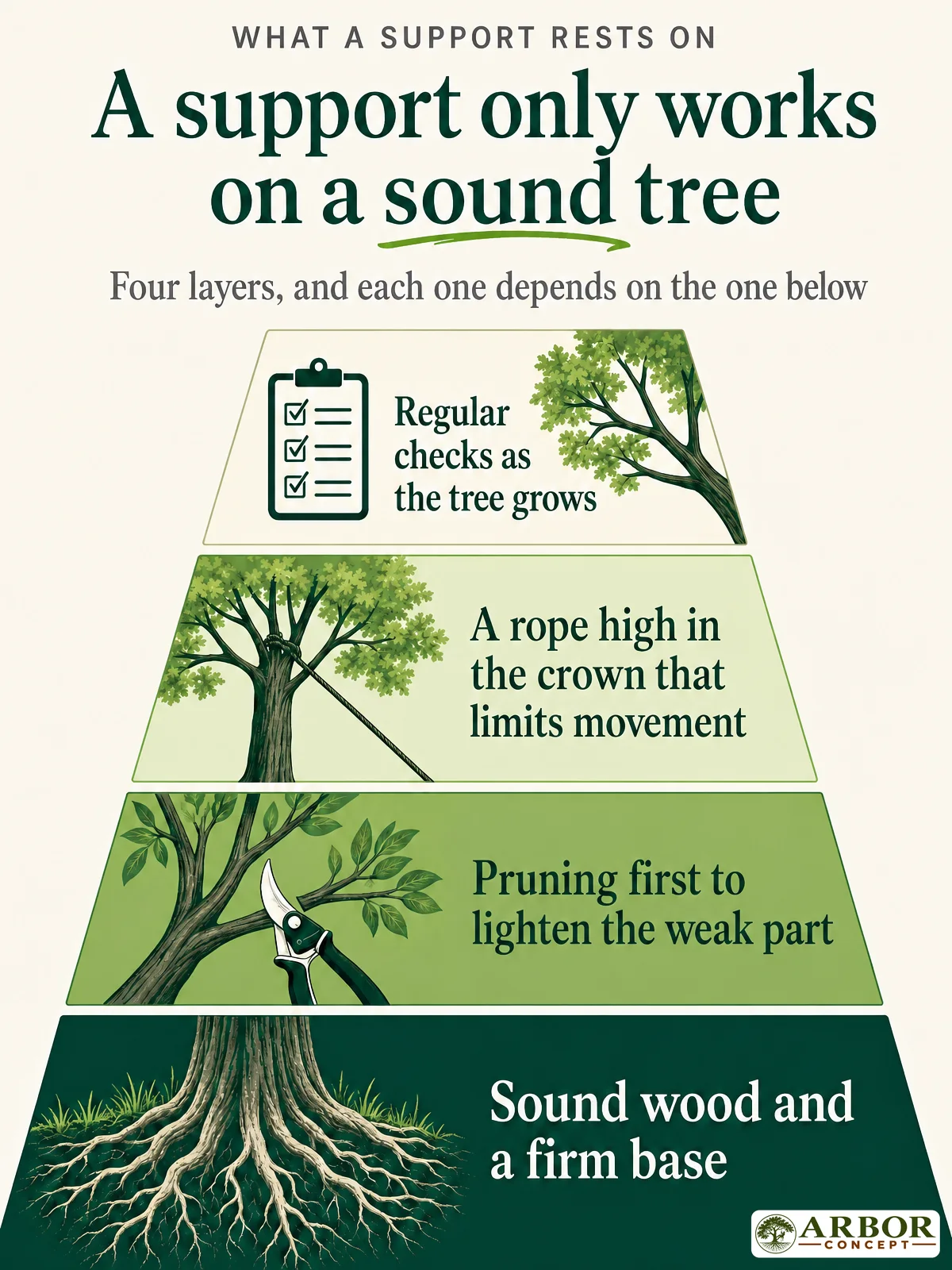
Some trees should not be cabled. A rotten trunk, a dead leader, soil that has heaved or a root plate on the move are all warning signs. A cable can only help a tree whose wood can hold hardware or rope and whose base can hold the tree up.
Gardening Australia points to one early sign. A bracket fungus at the base of a tree, such as the ganoderma on a Bribie Island pine, signals long-term decay that could affect the structure of the tree [2]. If the problem is below the crown, the answer is usually not a support.
Sometimes pruning alone does the job. Sometimes removal is the safest path. We name the right one for your tree, including when that means no work for us.
Want this looked at on your own property? The on-site quote is free.
Weighing support against removal
A quote for removal and a quote for a support are not the same thing, so comparing the totals tells you little. One buys the end of a risk. The other buys a lower risk and a living tree.
The Queensland Government advises getting at least three written quotes before you buy expensive services, and checking that each quote covers every part of the job and that you have read it, terms included [3]. Brimbank City Council adds that you should look at the credentials and written specifications, and not simply take the lowest price [1]. Apply that here. Ask each business to put the plan in writing: the method, the pruning, the follow-up and what is left over.
A sensible way to decide
- Ask a qualified arborist whether the wood and the base are sound.
- Find out exactly where the weakness is and what it threatens.
- Ask for the options in writing: support, pruning and removal.
- Check what each option leaves you to look after later.
- Choose the one that fits the tree, the site and your comfort with risk.
Upkeep: what happens after the day of fitting
A support is not a one-visit job. We come back about twelve months after fitting. A tighter rope tells us the tree has put on weight, and we then prune again or adjust the line. The tree keeps growing, so the system has to be tuned to it. Australia’s national training unit for fitting cable and bracing points the same way. After the fitting, the arborist is to decide whether more pruning is needed to restore the tree’s natural habit and form [7]. A companion unit expects knowledge of checks and adjustments to a fitted system over time [8].
Between visits, these are the signs worth watching for on any system.
Signs a system needs another look
| Sign | Why it matters |
|---|---|
| Wear or fraying | The line is losing strength |
| Bark growing over an end | The tree is swallowing the fixing |
| Line now sits too low | The tree has grown, so the support no longer reaches the right spot |
| Slack or rubbing | The line is not working, or it is damaging the bark |
Put faults right as soon as you spot them. After a big storm, look at the crown from the ground and book a check if anything looks different.
I needed two massive gumtrees removed from my back yard, which were over house and shedding. Drew and his boys did an amazing job cutting them down to ‘bird habitat size’… From the very start, drew was professional, and easy to work with. Kept me updated on where they were at, and well below other quotes I had received. They are trustworthy, take pride in their work and really listen to what the customer wants. Which is very rare nowadays. Highly recommend these guys if you want a proper job done. Ps… good job boys on not dropping anything onto existing buildings !….
Council rules, and why a trained person fits it
Cabling is not the same as felling, yet council rules can still matter. The Sunshine Coast Council says permit-required work includes cutting down trees and pruning that is likely to kill a tree [4]. Noosa Council says a permit is needed under its planning scheme to clear vegetation on any private land in the shire, and calls harm to protected trees without a permit or exemption an offence [5]. It adds that pruning must follow the Australian pruning standard [5].
The pruning that comes before a support is tightly handled in places. The City of Ryde in New South Wales says pruning must be done by an arborist with at least an AQF Level 3 qualification, and that improper pruning can cause weak regrowth and structural defects [6].
Councils set their own tree rules, and those get revised. Put the question to yours before work starts. We cannot say whether a rule reaches your tree, and we will not guess.
The fitting itself belongs to a trained person. Gardening Australia says that when tree work needs climbing, or sits near power lines, it is wise to call a qualified arborist [2]. Brimbank City Council says pruning large trees can be dangerous and is best left to a trained arborist when it means working above the ground with power equipment [1]. The national training unit shows what a trained person does first. They examine each branch for health and for how well it is attached, assess the structure of the tree, and prune before fitting anything [7]. The companion unit lists steel cable, synthetic cable and bracing as separate systems, and expects an understanding of how a support affects the tree’s natural movement and its flexibility [8]. The first unit also notes that this work may be subject to local tree protection laws [7].
This is not a job to try yourself.
Questions worth asking any arborist
- Ask what is wrong with the tree, in plain words.
- Ask why a support suits this tree and not just any tree.
- Ask what pruning comes first.
- Ask when it will be checked and by whom.
- Accepting a promise of a permanent fix.
- Agreeing to anything before the plan is in writing.
- Cabling a tree with rot because removal feels hard.
- Hanging loads from a cabled limb.
When to ask an arborist, and how we handle it
So, is cabling a tree a good idea on your block? Only a look at the tree can say.
A healthy tree with one strong leader and no cracks needs nothing from you but a drink in dry spells and a glance after storms. A split, a long limb leaning toward the house or fresh damage is the time to ask a qualified arborist to look.
Drew is where it starts. He walks around the tree, checks the ground beneath it, and says whether a support suits it or pruning or removal is the better road. The quote is free and given on site, and it spells out what each option involves. A tree that can stay will be told it can stay. One that cannot will hear that as well.
Our team does the work in two stages: pruning to lighten the load, then fitting the rope. Drew is a Cert III qualified arborist, and we carry public liability insurance. Discounts for pensioners and locals are available. Half is paid to hold your day, with the balance due at completion.
There is more on the cabling and bracing page, and on how we quote. If a tree on your block has you wondering, get in touch and ask.