What is a tree risk assessment, and when do you need one?

A tree risk assessment is a structured check of one tree. It asks how likely the tree, or part of it, is to fail, what stands underneath, and how bad the result would be. The answer is a rating, plus a plan to bring that rating down if it needs to come down.
This guide explains how an assessment is built, the levels it comes in, who is qualified to do one and how councils and tribunals use them. It also covers what the rating means for your tree, and what a sensible next step looks like.
No article can rate your tree for you. Two trees with the same cracks can sit in very different places, and the place changes the answer. An assessor has to stand in your yard and look.
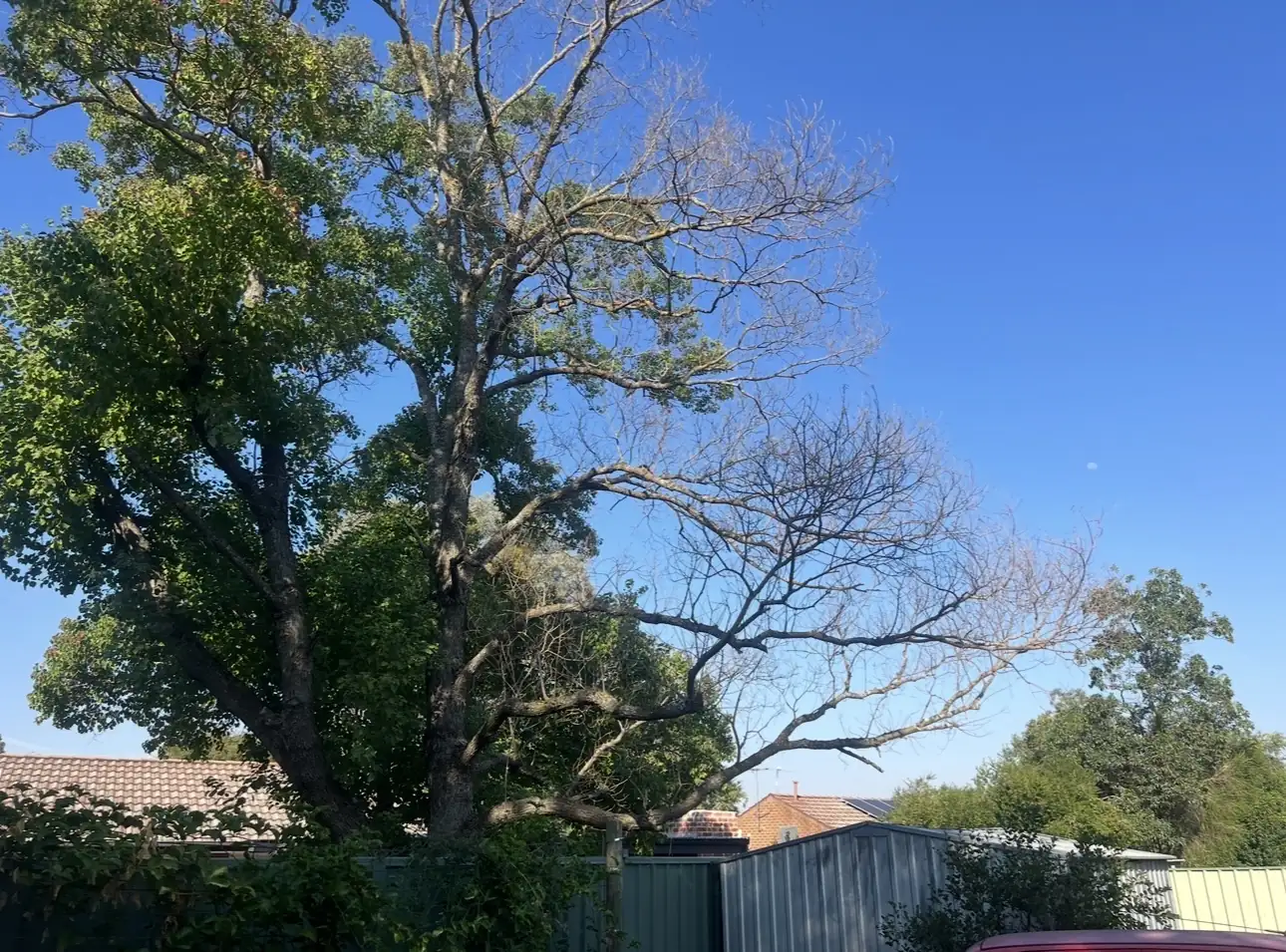
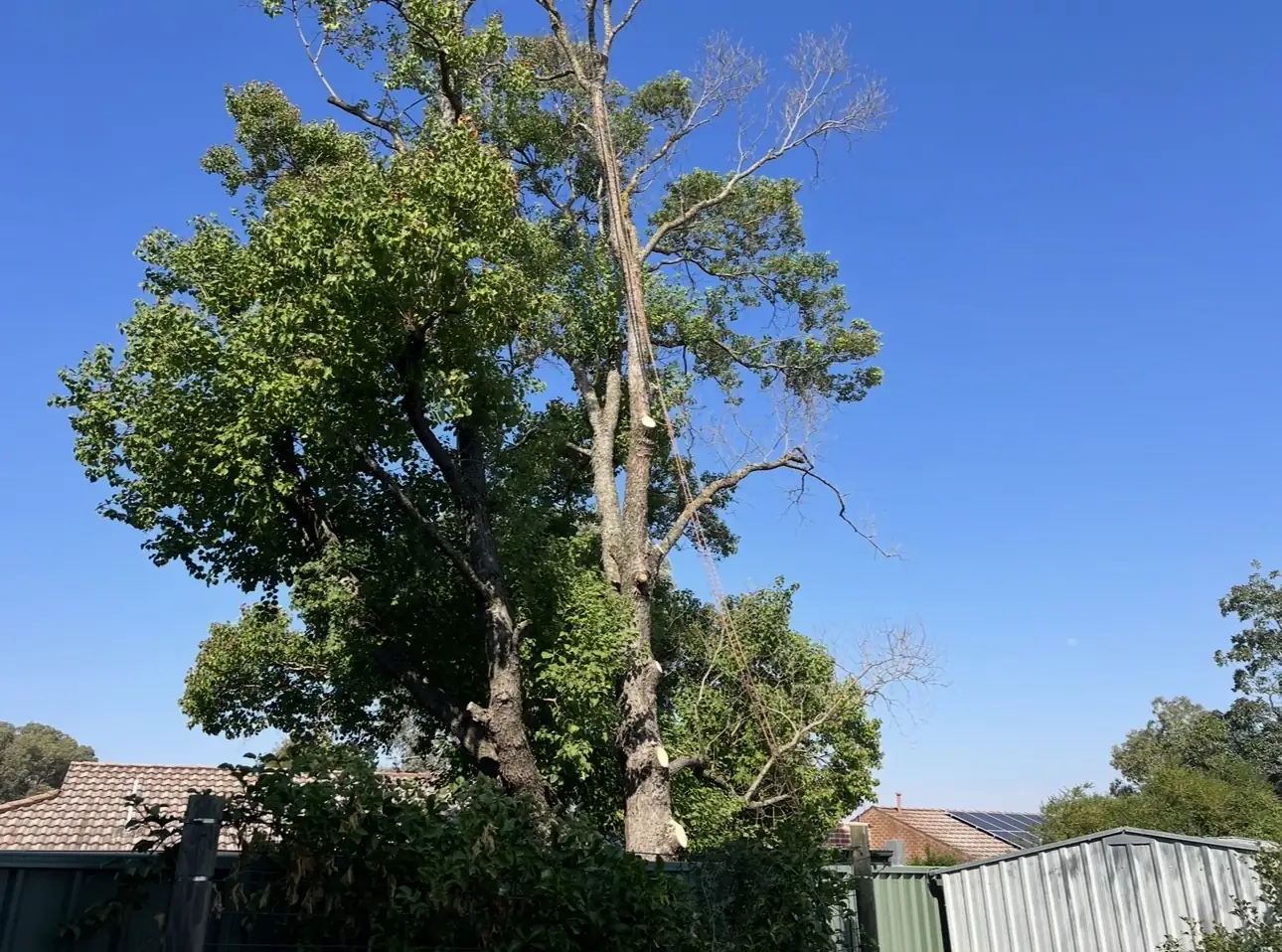
A tree doesn’t fail without a reason. Most of the time, something was visible for years: a crack, a dead stem, a lean, a soft patch of wood. A tree risk assessment is how that evidence gets turned into a decision, before a storm makes the decision for you.
What a tree risk assessment is
Think of it as a health check, with a question about safety added on. The assessor looks at the tree, then at the ground beneath and around it, and then gives a rating.
Redland City Council says its arborists use a method called TRAQ to assess tree work requests, and describes it as an internationally recognised approach that gives a systematic process for assessing tree risk [1]. The word to notice is systematic. Each tree is checked in the same order, so the result doesn’t depend on someone’s mood or a hunch.
A tree risk assessment is not the same as a tree report for a building application, and it is not a sales pitch for removal. Redland says it preserves trees whenever possible, and considers removal only when a risk cannot be managed in a practical way [1]. That is the right spirit. The point is to find out what is true about the tree, and to act on that and nothing more.
How an assessment visit unfolds
- The assessor learns why you asked: a storm, a crack, a sale, a neighbour's worry.
- They walk around the whole tree and look at the ground, the roots and the trunk base.
- They look up into the crown for dead wood, splits, weak unions and signs of strain.
- They note what could be hit: a house, a car, a play area, a path, a power line.
- They rate the risk, then list options to bring it down.
- You get the findings and the choices in plain words.
The three questions behind every rating
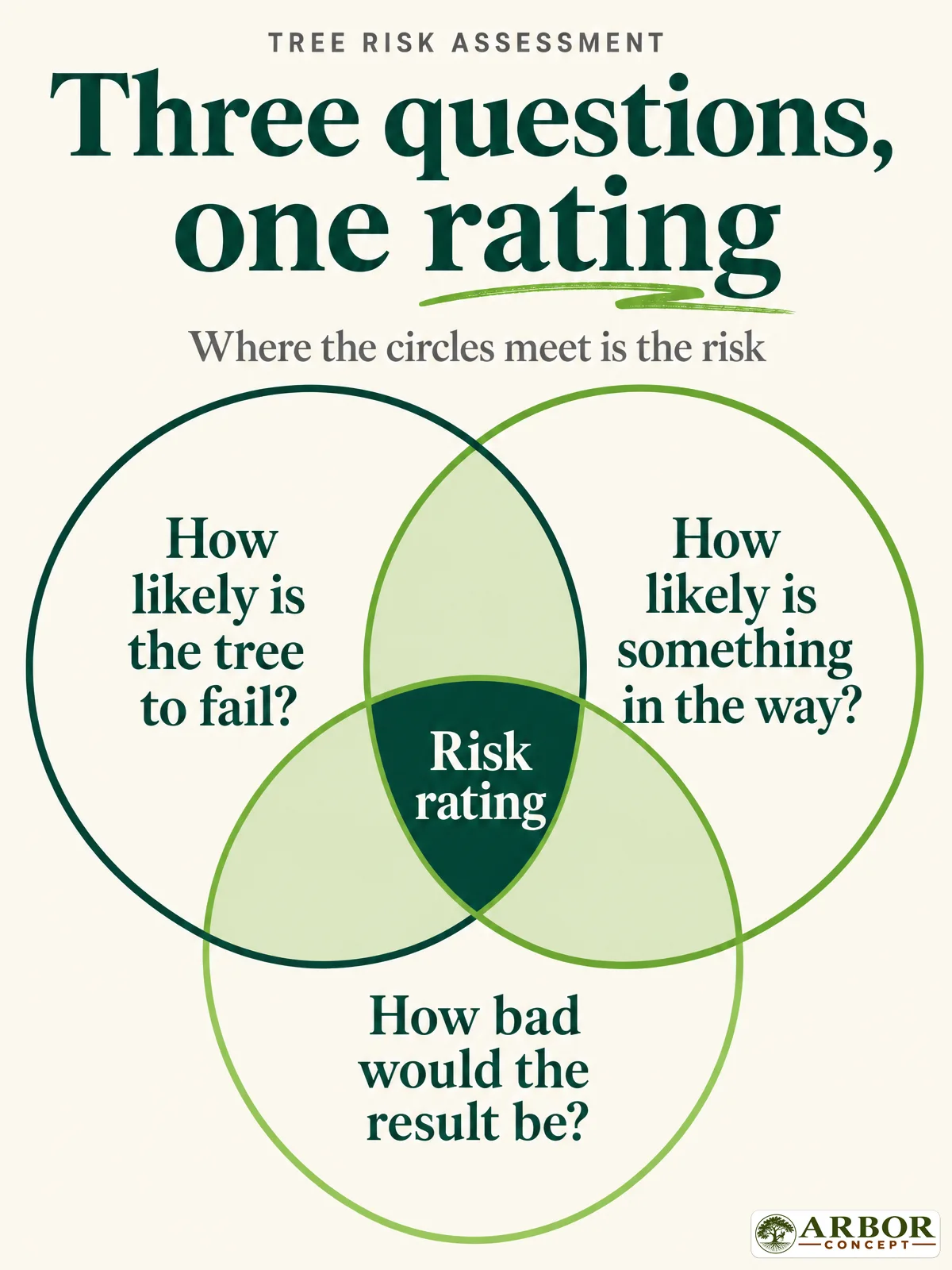
Every tree risk assessment rests on the same three questions. Arboriculture Australia’s TRAQ course teaches assessors to combine them into one rating: the likelihood of failure, the likelihood of impact and the consequences of failure [2]. In plain words, how likely is the tree to fail, how likely is it that a person or object is in the way, and how serious would the outcome be?
The first two combine into the chance that something bad happens. The third says how bad it would be. A rotten limb over an empty paddock is a small matter. The same limb over a bedroom is not.
This is why two identical trees can earn two different ratings. The tree is only half the story. The other half is where it stands and who or what is near it.
It also explains why “is my tree dangerous?” has no one-word answer. A tree can be weak and still low risk, because nothing is under it. A tree can look fine and still be a concern, because it leans over the place where children play.
The levels of assessment
Assessments come in different depths. The method most arborists here work to uses three: a limited visual look, a basic assessment and an advanced one. The limited visual look is a quick check on foot, often used when there are many trees to get through. A basic assessment is a walk right around one tree, on the ground, looking at species, defects and condition. An advanced assessment adds special tools or testing when the basic level leaves a question open.
Most home trees need the basic level, and many need only plain advice from an experienced arborist who has studied the tree. If it helps, our team can climb the tree and take photos, so you can see what the arborist sees.
Depth matters because more is not always better. An advanced test on a healthy young tree would be a waste of effort. A quick glance at a split old giant over a roof would be too little. The skill is matching the depth to the tree.
Chose Drew and the team as they had great reviews. Wasn’t disappointed at all. Drew gave me a quote to remove a pine that split and advice on another tree that was looking at doing the same. They were able to get it done quickly and to a great standard. Very happy with the service.
What the assessor looks at
The tree and the site are both part of the picture. Drew looks at the type of tree and how it grows, whether it is structurally sound, whether it has hollows or decay, and the condition of the ground around it. Dry soil, too much water and pests can each change how a tree behaves.
What goes into the picture
Redland City Council’s list for a formal assessment of a protected tree is similar. It names the tree’s health and structure, how close it is to buildings, wind exposure, drainage in the root zone, past limb failures and habitat value [3]. Habitat is worth noting. A tree with hollows may shelter animals, and that changes what is possible.
How a rating is reached
Under TRAQ, each part of the question gets a label. Failure is called improbable, possible, probable or imminent. The chance a target is struck is very low, low, moderate or high. The consequences are negligible, minor, significant or severe. The overall result is low, moderate, high or extreme.
Reading the labels
| What is rated | The labels used | In plain words |
|---|---|---|
| Likelihood of failure | Improbable to imminent | How soon the tree or part may come down |
| Likelihood of impact | Very low to high | How often someone or something is underneath |
| Consequences | Negligible to severe | How bad the harm or damage would be |
| Overall risk | Low to extreme | The combined result that guides the next step |
A rating is a judgement made by a person, not a reading from a machine. Two trained assessors can land on different labels for the same tree, so the person matters.
That is a good reason to ask how a rating was reached, not just what it was. Brisbane City Council asks that an arborist’s report name the methods used and set out the tree’s species, size, condition and structural integrity [6]. A careful assessor can show you the defect, the target and the reasoning in the same way.
Want this looked at on your own property? The on-site quote is free.
Who should do a tree risk assessment
Anyone can look at a tree. Rating the risk well takes training and experience. Arboriculture Australia runs the TRAQ course as the Australian host of a qualification owned by the International Society of Arboriculture. The course covers tree biology and mechanics, tree inspection, risk categories and risk reporting, and applicants need a base credential such as a Certificate III in Arboriculture [2].
Councils set their own bar. Redland says the arborist who assesses a protected tree must hold at least an AQF Level 5 qualification [3]. Noosa Council states that its tree condition assessments are carried out by arborists at that level or higher [4]. Brisbane City Council says its tree risk assessment reports must come from a qualified arborist, and it asks for AQF Level 5 competence in arboriculture [6].
Drew holds Cert III arborist qualifications and has spent two decades on the tools. For most home trees, that is enough to give you clear, honest advice on what to do. Drew does not write tree reports. If a council or insurer wants a formal written report, that comes from a consulting arborist, and our team carries out the work it sets out.
Choosing someone to assess a tree
- A recognised arboriculture qualification and years on the tools.
- Willingness to explain the defect and the reasoning, in plain words.
- Options beyond removal, such as pruning or support.
- A clear note of what was checked and what could not be seen.
- A verdict given from a photo or over the phone.
- Only one answer, and it is always removal.
- No questions about what is under or near the tree.
- Pressure to decide on the spot.
When a council or tribunal may ask for one
For many people the first reason to want an assessment is a rule. Under Queensland tree dispute law, a tree can affect a neighbour if it is likely to seriously injure someone or seriously damage property within the next twelve months. The tribunal can order that an arborist check the tree and write a report [5].
Councils use assessments too. Redland says council approval is generally needed to remove unsafe vegetation, unless removal is needed to reduce an imminent risk of serious injury or damage to infrastructure. It also advises photographing the tree and its surroundings in that case, in case the council later looks into it [3].
Each council writes its own rules and revises them, so ask yours before any cut is made. The owner of the land is usually the tree-keeper, and that includes the roots that reach a neighbour’s yard [8]. The same page says a tree should not seriously injure anyone or damage a neighbour’s property over the next year [8]. We cannot say whether an approval applies to your tree. What we can do is help you work out what is needed, and make sure you don’t get into trouble from bad advice.
Drew was fantastic. Responsive, efficient, knowledgeable and accommodating. Will definitely be calling on Drew and his team again.
What happens after the rating
A rating is a start, not the end. Noosa Council asks whether a tree presents an unacceptable hazard, and says it does not remove healthy, stable trees that do not present an unacceptable risk [4]. The same logic works in your yard.
Brisbane City Council shows the same spread of answers for its own trees. After a removal request, a qualified arborist assesses the tree, and the outcome may be no action, pruning, health management or removal with replacement planting [7]. Removal is one answer among several.
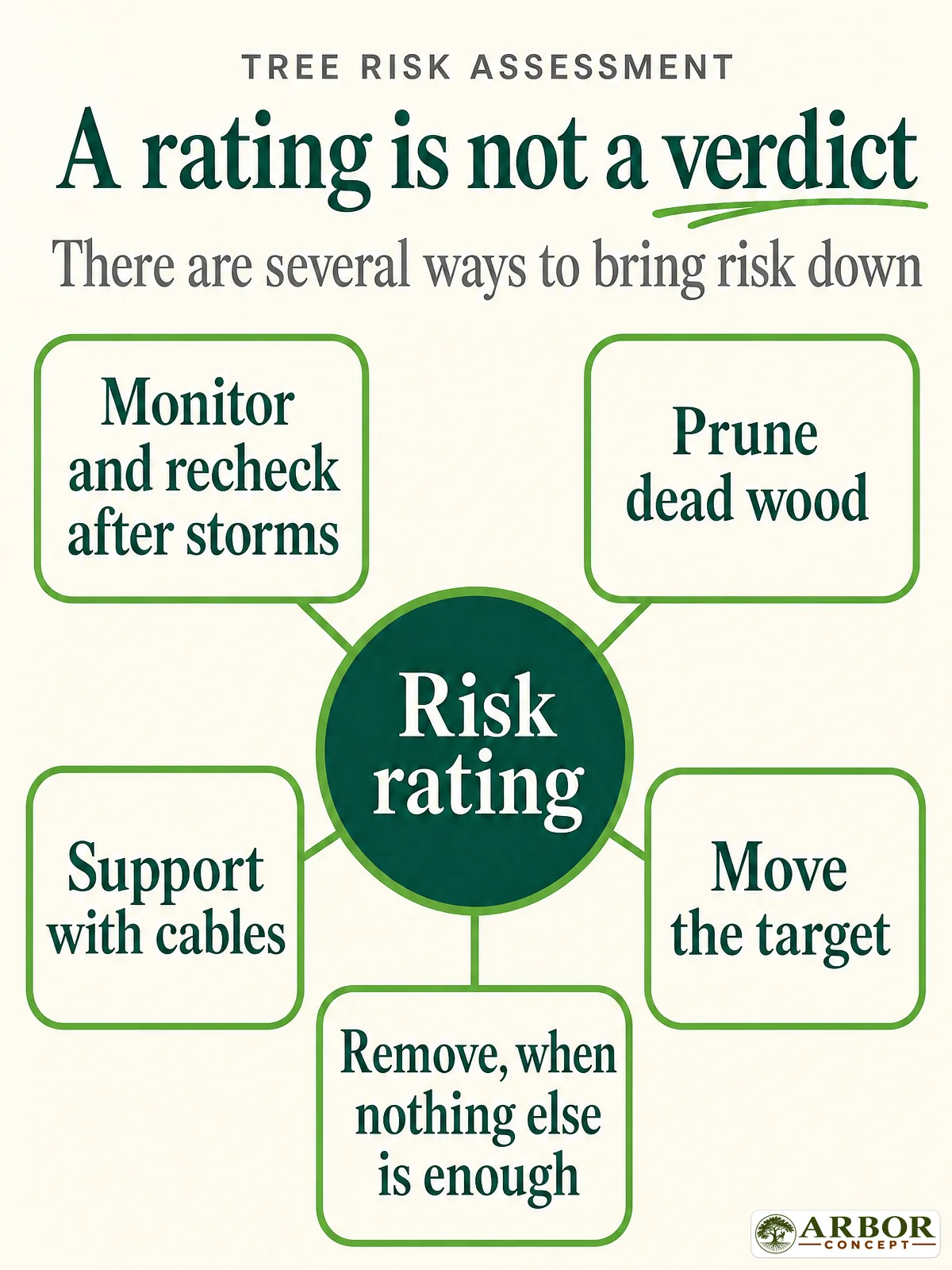
There are usually several ways to bring a risk down:
- Monitor the tree and look again after storms.
- Prune to take out dead wood or weight from a heavy limb.
- Support a weak union with a cable system.
- Move the target: shift the play area, the car park or the seat.
- Remove the tree, when nothing else is enough.
Fear can drive a decision too. After a bad storm, a tree can feel more dangerous than it really is, and some are taken out that only needed a prune. A good assessment cuts through that. It sets out the actual risk and the real choices.
Keeping the tree comes first for us wherever it is a real option. Cabling and bracing is a non-invasive way to support a weak tree high in the crown, and it is not offered much, so many people never hear about it.
Do you need a tree risk assessment?
You may not. A young, healthy tree in the open with nothing below it rarely needs one. A tree with no history of trouble and no worrying signs can just be watched.
An assessment is worth having when:
- A limb has dropped or the tree has cracked or leaned since a storm.
- You see dead wood, fungus, hollows or soil lifting at the base.
- A big tree stands over a house, a pool, a car space or a boundary.
- You are buying, selling or insuring a property with large trees.
- A neighbour or a council has raised a concern.
If you think something might fall, keep people, pets and cars away from underneath until it is checked. A tree that has only just started to worry you is the easiest kind to deal with, because there is still time to choose the gentlest fix.
Drew looks at the tree, at what is below it and at how it could be made safer. He explains what he sees and the options in plain words. The on-site quote is free, and our team can do the work you decide on, and nothing you do not need. You can read more about tree safety and tree management or how we quote and price. The first step is a free quote, and Drew will want to hear what worries you about the tree. Pensioner and local discounts are available.