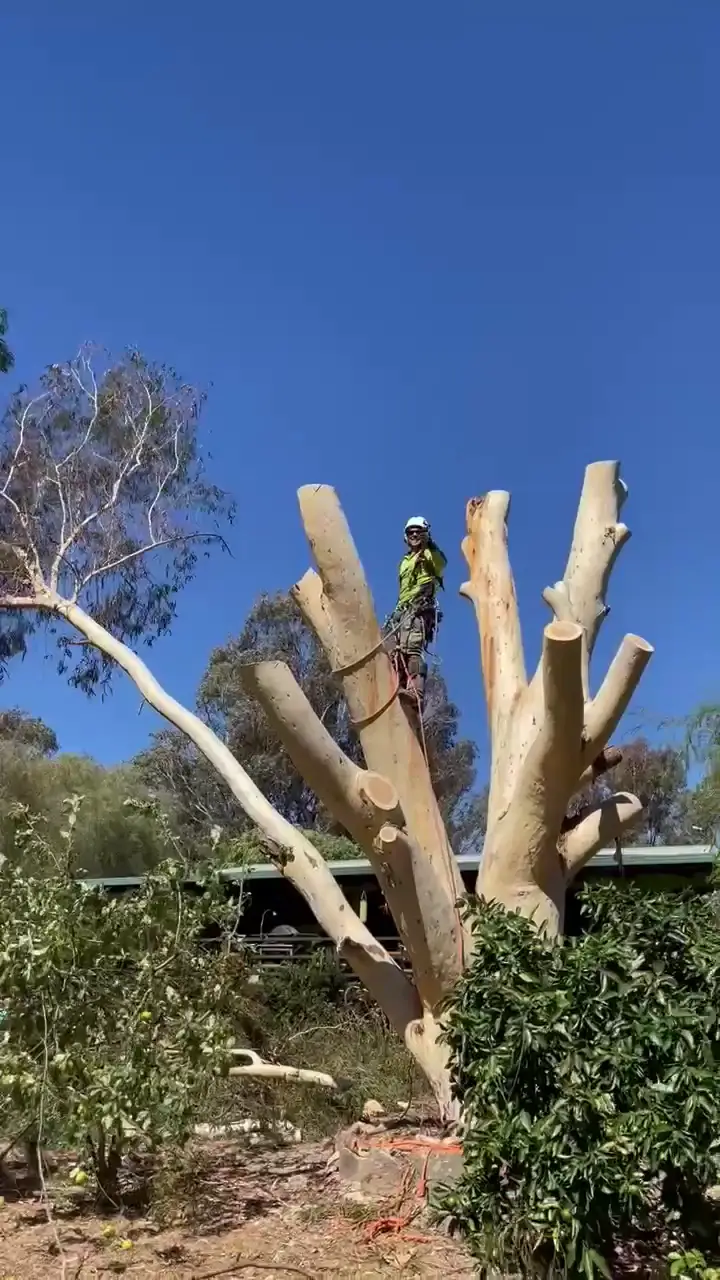
What happens to animals in trees being cut

Animals in trees being cut are a real part of tree work, because native birds, possums and others use trees as homes. When our team finds one, the job pauses and the plan is reworked. Cutting carries on only when it can go ahead without hurting the animal.
This guide explains what the Queensland government and council pages say about protected wildlife, what a careful team does on the day, and who looks after an animal that is injured.
No two trees hold the same residents, so the honest way to plan is a look at the tree itself, with someone who knows what to check.
Picture a tall gum on a quiet afternoon. A parrot is working at a seed pod. A possum sleeps in a dark fork high up. Neither of them is in a hurry, and neither knows a saw is coming.
Animals in trees being cut have legal protection
Native wildlife in Queensland is protected, and the rule covers the places animals live as well as the animals. On a council page about nesting birds, the Sunshine Coast Council names two Queensland laws, the Nature Conservation Act 1992 and the Animal Care and Protection Act 2001. Under both, native birds and the nests they build are off limits. Interfering without proper authorisation is prohibited, and penalties may apply [2].
Possums have their own line. Redland City Council says possums are protected under the same state law, and that it is illegal to trap or relocate them without a permit [4]. Gladstone Regional Council goes further. It lists possums, snakes and flying-foxes as protected, and says harming, taking or moving native birds is a serious offence unless it is authorised [5].
The pages differ in detail, but they agree on the main point. A tree that holds a nest, a den or a roost is a home as well as timber.
None of these pages is a guide to tree work, and none says what applies to your tree. Rules differ between councils and they change. What the pages do show is the principle: a tree is often somebody’s home, and the law treats that seriously.
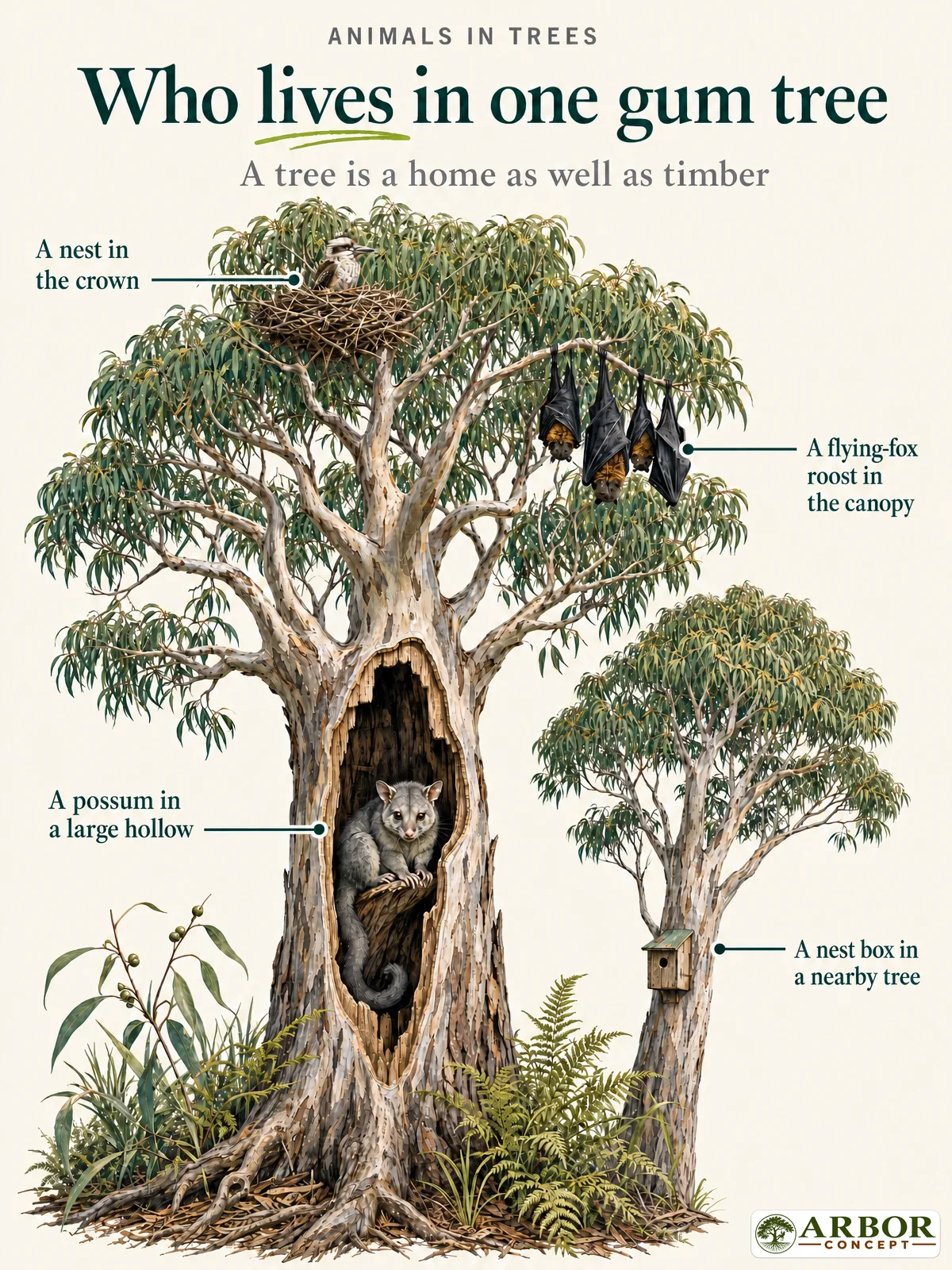
Who lives in the trees we cut
It helps to know who might be up there. The animals below turn up in council and government advice on tree dwellers, and each has its own wrinkle.
Residents and what the pages say about them
| Resident | What the page says | What it means for a cut |
|---|---|---|
| Native birds | Birds and their nests are protected [[2]](#source-2) | A nest in the way holds the job up |
| Possums | Protected; trapping needs a permit [[5]](#source-5) | A possum is not simply moved on |
| Flying-foxes | Protected, with separate roost rules [[6]](#source-6) | A roost tree needs extra care and approvals |
| Snakes | All snakes are protected [[5]](#source-5) | Handled by someone with the right authority |
Some of these live higher than you would guess. The Sunshine Coast Council notes that magpie-larks build mud nests up to 20m high, while butcherbirds nest within 10m of the ground [2]. A nest is not always where you can see it from the ground.
A dead tree can be a home too. Redland City Council says standing dead trees on rural properties are usually protected when they hold hollow-bearing limbs, and that pruning to keep the habitat can be an option [8]. On a town block, a dead tree may come out when it is a high risk and nothing else will fix it, and the council advises photographing it first [8].
What a careful team checks before the first cut
The time to meet an animal is before the saw starts, not halfway up the tree. So the first job is a proper look. Before any cutting, our team goes over the tree for nests, hollows and dens, and for any sign of a resident.
A look from the ground catches a lot. Droppings under a fork, feathers around a gap, scratched bark and noise at dusk all point to a resident. A closer look from the crown can catch the rest.
Spring adds a wrinkle. A tree that was empty in winter can hold a nest by September, so a check made months earlier may be out of date.
Your own eyes help here too. You know the tree better than anyone. If you have watched a bird come and go for weeks, or heard scratching in the night, say so. It changes how the job is planned, and it is far better to know on day one than on the day of the cut.
Drew and his team are very efficient and professional, taking care not to damage any property. They clean up the area once finished. They’re also polite and courteous! I highly recommend these guys for any arborist job.
What happens when an animal is found
Finding an animal does not end a job. It changes the order of things. The plan is set aside, and a new one is made around the animal.
When a resident turns up, in order
- Cutting stops at once, wherever the job has reached.
- The team checks what the animal is and where it is sitting.
- The plan is rethought: a different part of the tree first, a different method, or another day.
- Drew tells you what has changed and why.
- Cutting resumes only when it can go ahead without harming the animal.
Nothing about this is rushed. A pause costs a little time, and the animal keeps its home while the plan is sorted out. Drew keeps you across it, so the change never comes as a surprise.
Why the day sometimes moves
There are two reasons a job can shift to another day. One is the animal itself. The other is the season.
Many birds and animals breed in spring, so a tree that seemed quiet in the cold months may be busy by the time the weather warms. The Sunshine Coast Council says defensive behaviour in native birds, such as magpies guarding a nest, usually shows up between July and November [2]. Gladstone Regional Council gives a similar window for swooping birds, and ties it to breeding [5]. Our team plans around breeding time where the tree allows.
Sometimes the answer is another day. That is why a booked date is a plan that can bend. We would rather move the day than push on with an animal in the way.
If your tree is hazardous and cannot wait, say so. We talk through what can be done safely, and Drew gives you a plain answer.
Want this looked at on your own property? The on-site quote is free.
Who looks after an animal that is hurt
Sometimes an animal is hurt, whether by a fall or by something that has nothing to do with the job. A bird can hit a window. A possum can lose a fight. The advice from councils is consistent. Think about your own safety first. Then call for help, and do not try to be the rescuer.
The Sunshine Coast Council tells people to call the RSPCA for a sick, injured or orphaned animal, and lists local wildlife groups it supports [1]. It says never to handle bats or flying-foxes, and that only registered wildlife carers may keep or raise native wildlife [1]. Gladstone Regional Council points to the state wildlife hotline and a free app for injured or sick wildlife [5].
Who does what when an animal needs help
One more point is easy to miss. The Sunshine Coast Council says it does not attend or dispose of dead wildlife on private property [1]. If that is the situation you face, be aware that it may fall to you.
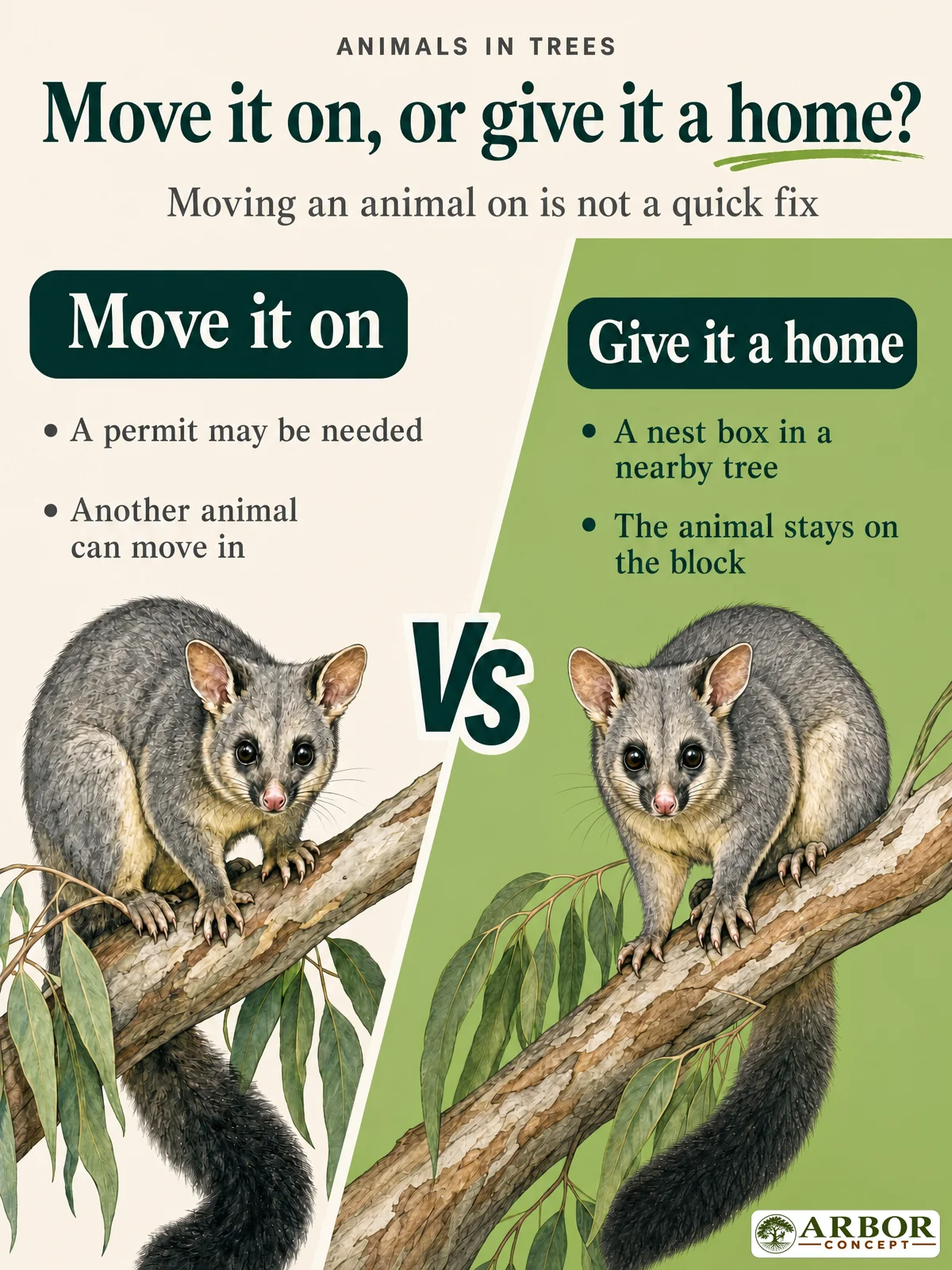
Moving an animal on is not a quick fix
People often ask why we cannot just take the animal out and carry on. It sounds tidy. In practice it is rarely simple, and it is hard on the animal.
For a start, it is not always allowed. Redland City Council says it is illegal to trap or relocate a possum without a permit [4]. The Queensland Government says pest controllers can remove possums with harmless traps, and that a trapped possum has to be released close to where it was caught [3]. Both pages warn that another one can move into the empty space [3] [4].
Snakes are similar. The Queensland Government says a catcher can relocate one, but that a relocated snake may be replaced by another living nearby [3].
The better answer is to give the animal somewhere else to go. Redland City Council says possums normally live in large tree hollows, and that a sturdy weatherproof box can offer an alternative home [4]. The Queensland Government makes the same suggestion: hang wooden nesting boxes or hollow logs in nearby trees [3]. Habitat is part of what we do, and you can read about habitat installation and animal rescue on our service page.
A box is not a perfect swap, and it will not suit every animal. Ipswich City Council says natural hollows can take from 80 to over 350 years to form, and that a nest box should not be seen as a replacement for them [7]. But it gives a displaced resident a place to go, which a bare stump does not. Fitting one in a tree away from the house is a gentle way to keep wildlife on the block after a big job.
A flying-fox roost is a different matter again. The Queensland Government says only minor trimming of a roost tree is covered by the light-touch rules, and that a removal needs to follow a separate code [6]. It also says lethal measures are prohibited as part of roost management [6]. Gladstone Regional Council adds that roost sites stay protected even after the animals leave, for a set period [5]. That is why a roost tree is never a casual job.
Drew was fantastic. Responsive, efficient, knowledgeable and accommodating. Will definitely be calling on Drew and his team again.
Calling an arborist about animals in trees
The line between a job for you and a job for a professional is simple. Watching is yours. Anything that involves a ladder, a saw or a hands-on look inside a tree is not.
You do not need to call anyone just because a bird visits your tree. Visitors come and go. Wait if the tree is healthy, nothing needs cutting and the animal is simply living its life.
Call an arborist when the tree has to be cut and you know, or suspect, that something lives in it. Call when a branch is dangerous, when a nest sits near the cut line, or when you are not sure what you are looking at. A trained person can read the signs. You should not climb to check.
Never poke, shake or smoke an animal out. It is dangerous for you and hard on the animal, and the Sunshine Coast Council says interfering with native birds or their nests without authorisation is prohibited [2].
If you think an animal lives in a tree you want cut
- Note what you have seen and when, and take photos from the ground.
- Tell the arborist before the quote, not on the day.
- Keep pets back from the base of the tree.
- Ask about a box or another home nearby.
- Climbing the tree to look inside a hollow or nest.
- Shaking branches or banging the trunk to scare it out.
- Trapping a possum yourself.
- Taking a hurt animal home to care for it.
How we handle animals in trees being cut
Drew is the first contact. He comes out, looks at the tree with you and quotes on site, free of charge. If you have noticed an animal, he wants to hear about it then.
Our team does the work. Drew stays your point of contact the whole way through, so you hear about any change from the same person who quoted the job.
We check the tree, we stop or change the plan if something lives in it, and we carry on only when it is safe for the animal and for us. That can mean a different day, and we say so early.
Our wildlife and habitat service page shows the rest of what we do for animals, and you can see how we quote. When you are ready, reach out and ask for a free quote. Pensioner and local discounts are available.