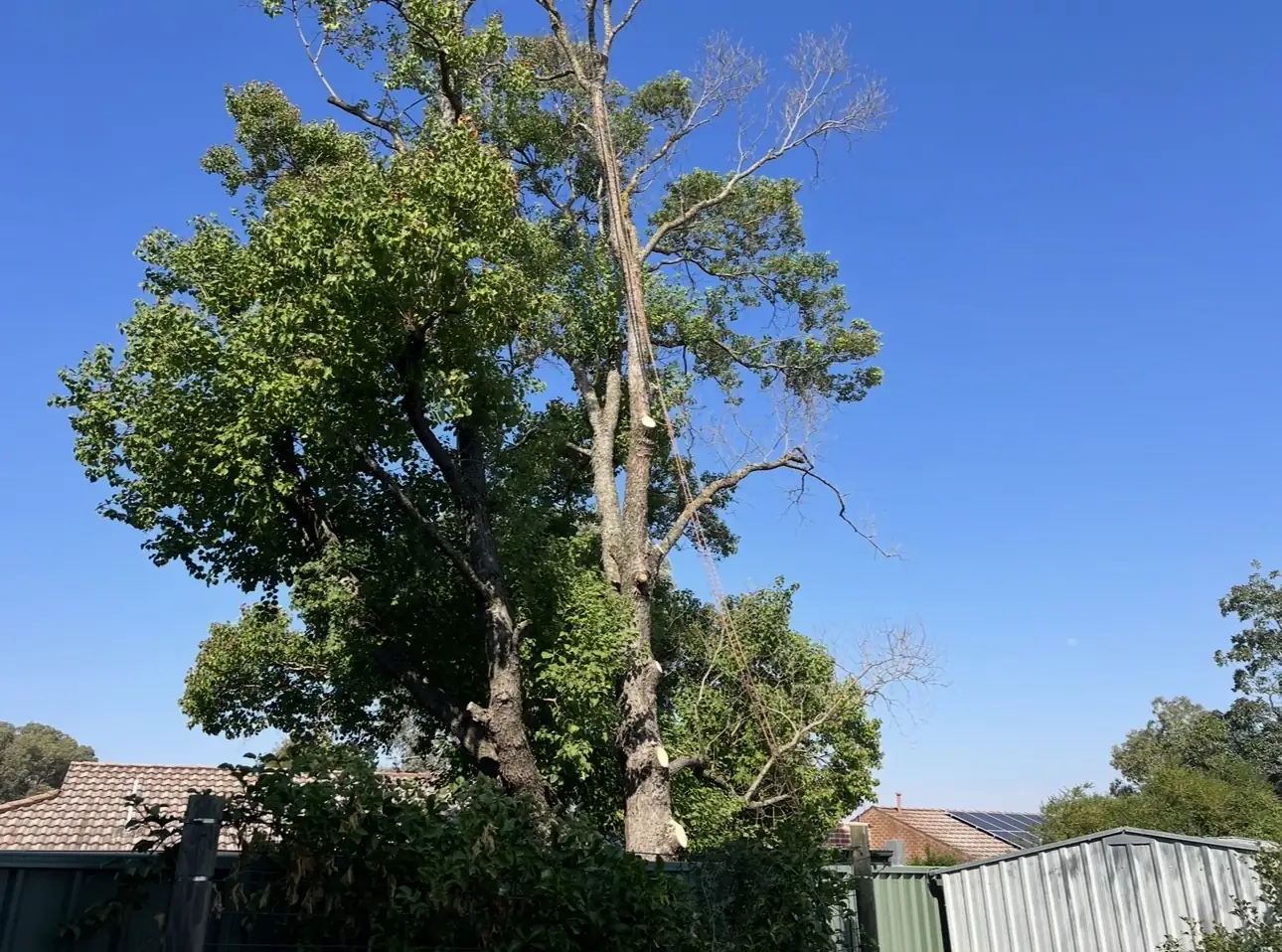
Hollow bearing trees and why they matter

Hollow bearing trees are trees with holes or cavities in the trunk or limbs that native animals use as homes. They matter because a hollow takes a very long time to form, and when the tree goes, the home goes with it.
This guide explains how hollows form, who lives in them and how to tell whether a tree on your block has one. It also covers dead trees, nest boxes and the steps to take before any cutting starts.
Every tree and every hollow is different. A look at the real tree, with someone who knows what might be living inside, is the only way to plan work that keeps people safe and wildlife looked after.
Walk under an old gum on a still evening and watch the trunk. Sooner or later something slips out of a dark hole in the wood. A possum, a parrot, a small bat. That hole is the reason this guide exists.
What hollow bearing trees are
A hollow bearing tree is a tree with one or more cavities in its trunk or limbs. The tree can be living or dead. What counts is the space inside, because the space is somebody’s home [2].
Most people picture a neat round opening high on the trunk. Real hollows come in every shape. Some are a slot where a limb once tore away. Some are a soft pocket that runs down the middle of the wood. Some are a narrow gap behind a flap of loose bark.
Councils name them in different ways. One south-east Queensland council counts a native tree as a habitat tree if it has a hollow, whether the tree is dead or alive [5]. In this guide we use the plainer name: a hollow bearing tree.
Small, medium and large hollows
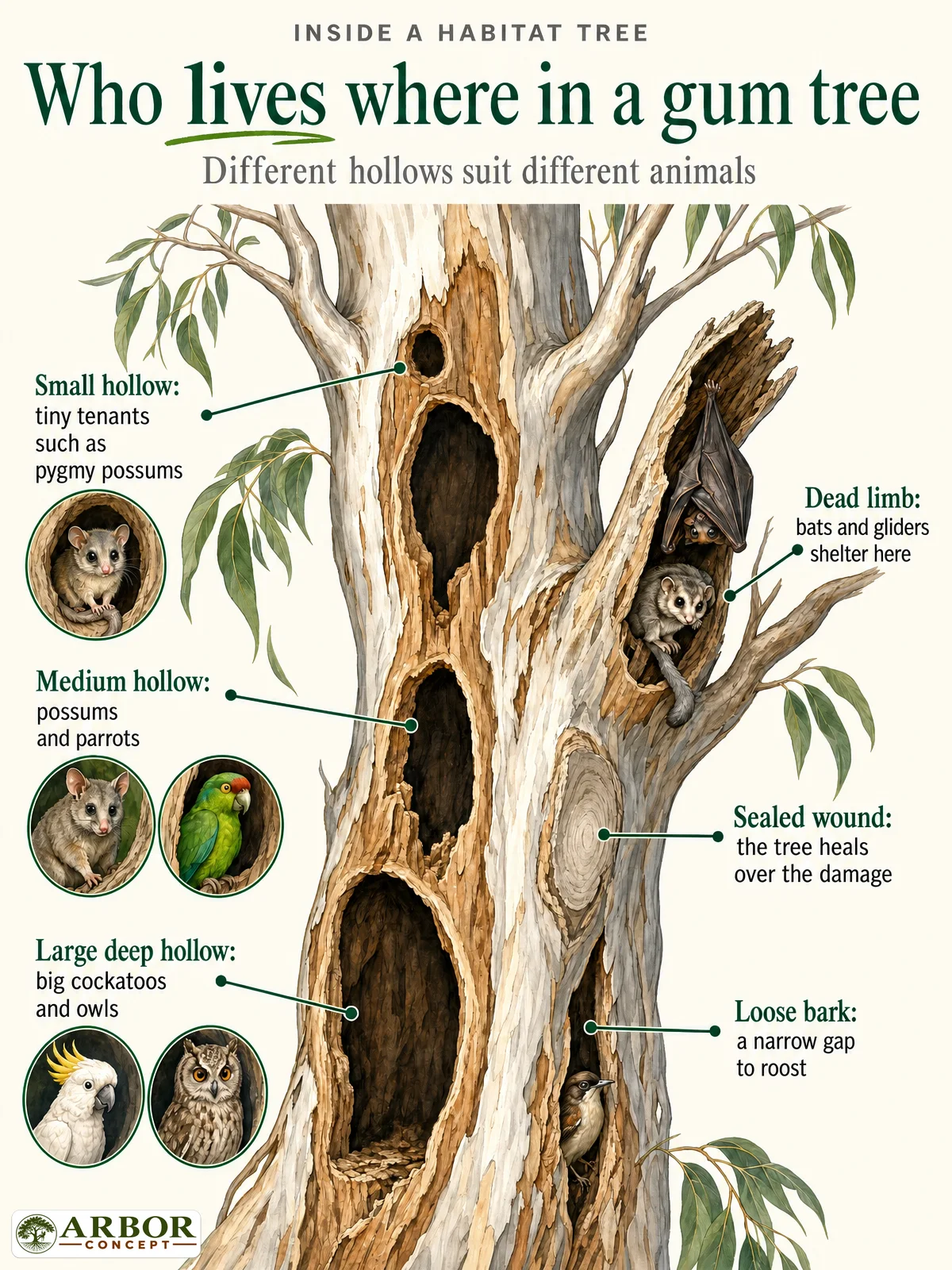
The sizes and examples in the box come from conservation research on hollow use [2]. A tenant needs a home of the right size, and not every tree offers one.
How a hollow forms
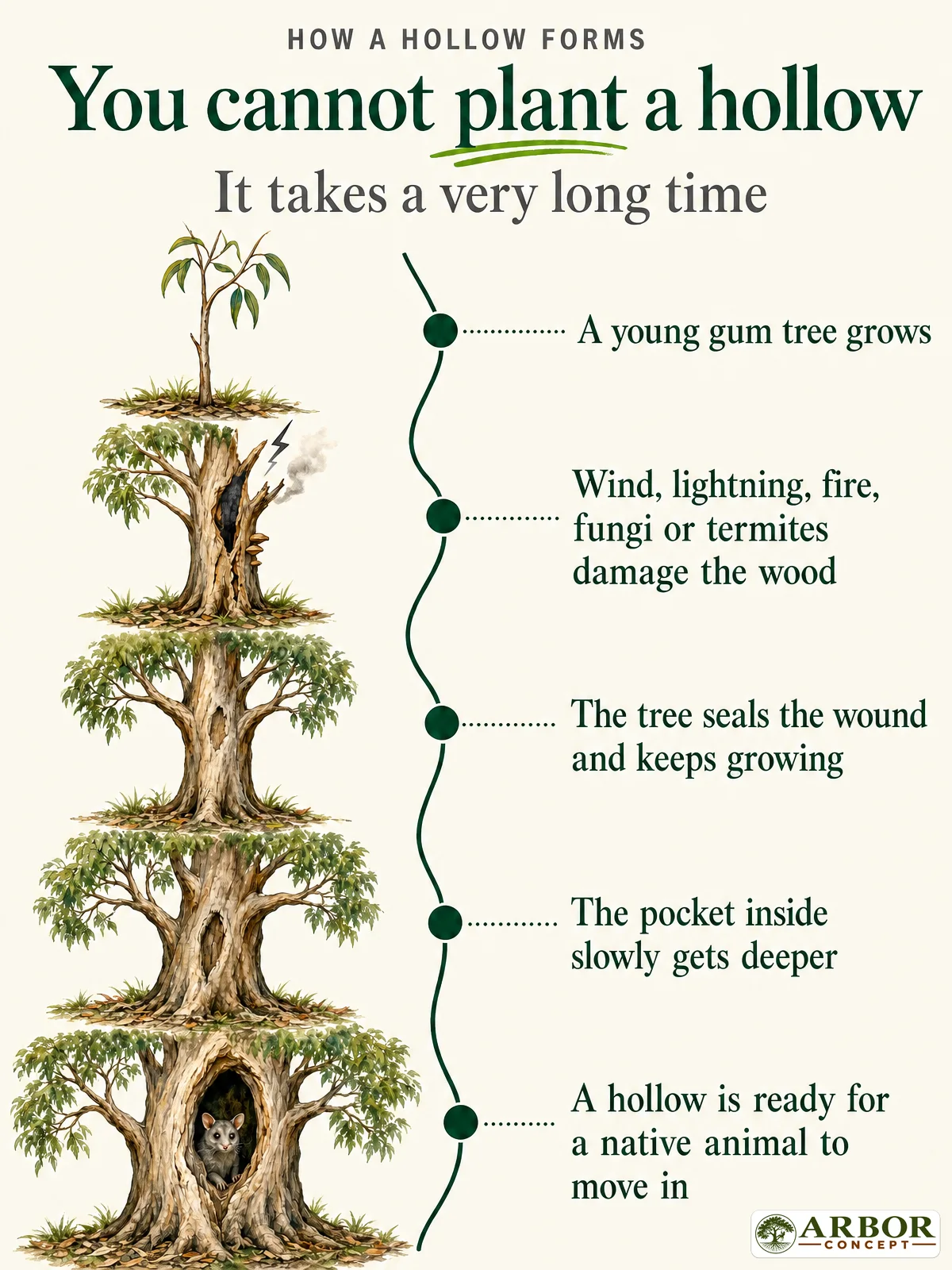
A tree does not make a hollow on purpose. A hollow is damage that the tree survives. Wind can snap a limb. Lightning can split a trunk. Fire can burn out a pocket. Fungi and termites can eat the heartwood from the inside [2]. The tree seals the wound with fresh wood and keeps growing, and over many years the pocket gets deeper.
The slow part is the whole story. Ipswich City Council says hollows can take anywhere from eighty to more than three hundred and fifty years to develop, depending on the species [1]. Hollows turn up mostly in old gums and are rare in wattles and pines [2].
You can plant a tree this week. You cannot plant a hollow.
A big old gum that has carried a hollow for generations is more than a tree. Once it is cut, the next hollow in that spot is a very long way off, and the animals that used it have to find another address.
Who lives in a hollow
Hundreds of native species use hollows to nest, breed, shelter and feed. That includes close to a third of native mammals and about one in seven native birds [2]. The Queensland Government lists parrots, treecreepers, bats and gliders among the animals that use hollows for shelter, nesting and food [3].
Spring is breeding season for many birds and animals. A hollow that looks empty in winter can be full a few months later. In some places, protected animals such as sugar gliders can mean a whole tree cannot simply be cut down. That is why we ask what lives in a tree before we plan anything.
Not every tenant is rare. Everyday possums and parrots use hollows too, and they are often the animals people enjoy watching most. Lose the hollow and you lose the show as well as the home.
Some animals are fussy. A greater glider needs a den hollow that is deep, with a wide enough entrance and a good height above the ground, and it uses more than one den tree in its range [8]. One old tree may be only part of what an animal needs.
Reading the signs on a tree
| What you notice | What it may mean | What to do next |
|---|---|---|
| Birds or small animals coming and going at dusk | The hollow is in use right now | Leave it alone and tell Drew before any work |
| A dark slot where a limb once broke away | A hollow may be forming, or already formed | Ask for a look at the tree before any pruning |
| Droppings or scratches around an opening | Something lives there, even if you rarely see it | Note the date and keep pets back from the base |
| A dead top with holes in the wood | A standing dead tree that still works as a home | Have it checked for safety before deciding anything |
I needed two massive gumtrees removed from my back yard, which were over house and shedding. Drew and his boys did an amazing job cutting them down to ‘bird habitat size’… From the very start, drew was professional, and easy to work with. Kept me updated on where they were at, and well below other quotes I had received. They are trustworthy, take pride in their work and really listen to what the customer wants. Which is very rare nowadays. Highly recommend these guys if you want a proper job done. Ps… good job boys on not dropping anything onto existing buildings !….
Why hollow bearing trees are so hard to replace
Nest boxes are a good tool, and we fit possum boxes and bird boxes ourselves. But Ipswich City Council is clear that boxes only make up a shortfall in natural hollows and should not be thought of as a replacement for them [1].
There is a second problem. Conservation groups warn that the younger trees that would grow hollows later are often cleared too, which sets up a shortage down the track [2]. So it is not only the old trees that count. The middle-aged ones are the future homes.
When a tree job takes a nesting place away, a box helps put something back. Our team fits them at the right height and facing the right way. You can read how that works on our habitat installation and animal rescue page. A box is a stopgap, though, and an existing hollow is always better than a new box.
Land for Wildlife South East Queensland describes a third option: carved hollows, cut into live or dead trees, often during limb reduction, which the tree then heals over [7]. Their thicker wood keeps them cooler and more humid than a box, and they must be carved by a skilled arborist so the tree is not harmed [7].
Dead trees can still be homes
A dead tree is easy to write off. Wildlife does not. Standing dead trees are an important source of hollows, and keeping them upright matters for wildlife [1]. Some animals need dead standing trees to live at all [3].
Fallen timber matters too. Ipswich City Council advises leaving hollow logs and fallen branches where they lie, because moving them takes habitat away from the place they came from [1].
Councils handle dead trees in different ways. Redland City Council says dead standing trees on rural properties are usually protected if they hold significant hollow-bearing limbs or have habitat value, and that such a tree can sometimes be made safe by pruning it to a habitat structure [4]. It also says to contact the council to check whether a dead tree is protected before removing it [4]. Each council words its rules in its own way, and they get updated, so ask yours directly.
Fire is a hazard for hollow trees. Hot fires can destroy them, and even low-severity management burns can remove large hollow-bearing trees [3]. Keep fire well away from the trunk.
If you have a hollow tree on your block
- Watch the tree at dawn and dusk to see if it is in use.
- Tell the arborist what you have seen before the quote.
- Leave fallen hollow logs where they lie.
- Ask about pruning, a habitat tree or a box before you ask about removal.
- Poking sticks or hands into a hollow.
- Filling or sealing a hollow to tidy the tree.
- Lighting fires or burning piles near the trunk.
- Pruning a tree in spring without checking for nests.
Want this looked at on your own property? The on-site quote is free.
When a hollow bearing tree is also a risk
A hollow does not make a tree weak. Many sound trees carry one and stand for years. But a large cavity with soft, crumbly wood around it, a new lean, or a hollow tree hanging over a roof is a different matter. Honest advice means looking at both the wildlife and the safety.
We do not reach for removal just because it is the larger job. If pruning, a cable brace or a habitat tree can fix the problem, we will say so, even if it means losing the job.
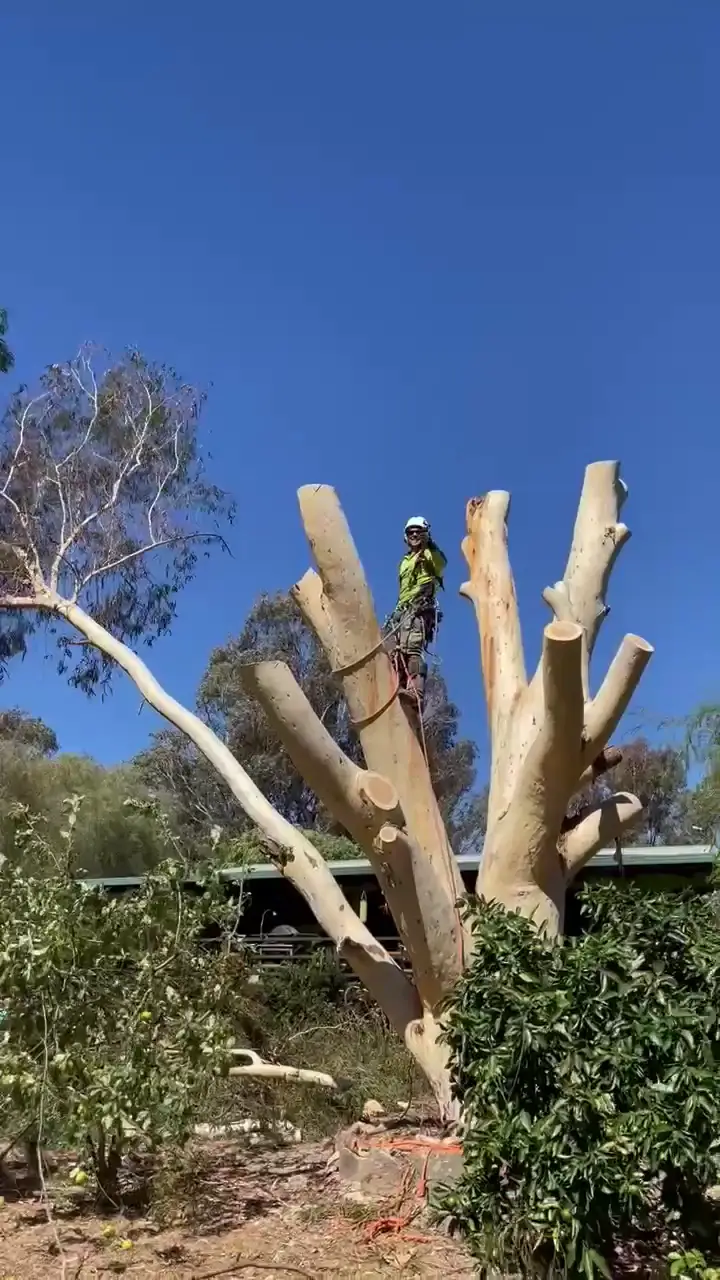
A habitat tree is the option people rarely hear about. A dangerous tree is cut back to a strong trunk and a couple of leaders that are not going to fail. It is treated so it does not grow back, and it stands as a large dead tree that birds and wildlife can live in. Boxes can be added to it. It is safer for your house, and it keeps the wildlife on your block.
Only a qualified arborist should climb a hollow tree or work near its weak points. Hollows can hide decay, and you cannot judge the wood from the ground.
There is also the matter of what happens after the work. A tree that has been pruned back or cut to a habitat shape looks different for a while. Birds and possums can still use it, and a box nearby can give them somewhere to go in the meantime. Before we start, we explain how the finished tree will appear, so nothing comes as a surprise.
How to spot a hollow on your own block
You do not need a ladder to look for a hollow. You need patience and a quiet half hour at the start or end of the day.
Stand back far enough to see the whole trunk and the main limbs. Look for dark openings, scars where a limb has fallen and patches where the bark has peeled away. Then watch. Animals tend to leave at dusk and return at dawn, so those are the best times to see traffic. Look on the ground, too, for droppings, feathers or chewed bark below an opening.
Do not climb the tree or poke around the opening to check. A disturbed animal can bolt or bite, and a weak limb can give way under you. Take a few photos from the ground and note the dates. That is plenty for an arborist to work with.
Drew and his team were absolutely fantastic. They were patient while we worked with council for the appropriate approvals, on time and very professional. Drew was also happy to assist us with adding on additional pruning and palm removal. Will recommend to everyone and definitely use again in the future.
What to do before any cutting starts
Good tree work begins before the first cut. Here is how we handle a tree that may hold a hollow.
How we plan around a hollow
- Drew visits, listens to what you know about the tree and walks around it with you.
- He looks for nests, hollows and dens, and for signs that something lives there.
- If an animal is found, the job stops or changes until the work can go ahead without harming it.
- Nothing is forced out. Young birds, possums and bats are handled gently and passed to a wildlife carer.
- Where a nesting place has to go, a box or a habitat tree goes in to replace it.
Councils may ask for the same care. Logan City Council, for one, asks applicants to identify trees with nests, hollows or other nesting or roosting values when they apply to clear protected vegetation [5].
If you find a hurt animal at the foot of a tree, keep pets and children back and do not handle it. The Queensland Government asks people to ring the national animal rescue line for advice, and after hours to use the RSPCA hotline website to find a local rescue group [6]. Anyone who finds a hurt native animal must hand it to a licensed carer or a vet within a set time [6]. If the animal came from a tree that needs work, tell Drew what you found.
When you need an arborist, and when you do not
You do not need anyone if the tree is healthy, nothing sits underneath and animals are coming and going. Enjoy it. A hollow bearing tree on a quiet corner of your block is a gift, and the best thing to do is nothing.
Get an arborist in when:
- a hollow tree stands over a house, shed, pool or play area
- the wood around a hollow is soft or crumbling
- a tree has a new lean, or limbs are dying back
- you plan to prune, reduce or remove any tree that might hold a hollow
- animals are living in a tree that needs work
The on-site quote is free. Drew is your contact for the call, the visit, the quote and the advice, and our team does the work. Pensioner and local discounts are available. If you would like to know how we price a job, read our how we quote page. When you are ready, get in touch and tell Drew about the tree and who you think lives in it.