How to reduce the height of a hedge without bare patches

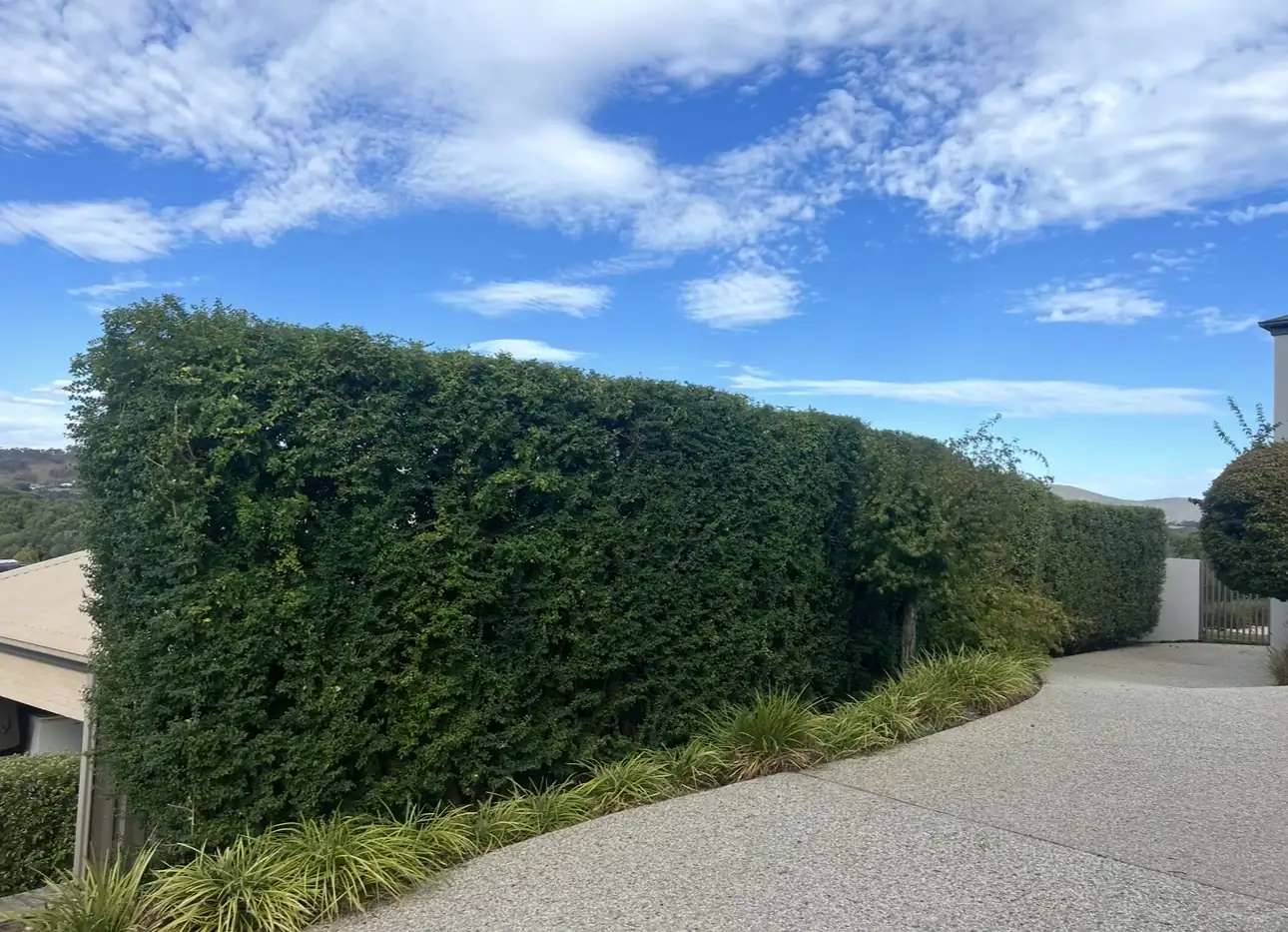
How to reduce the height of a hedge comes down to three choices: which plant you have, how much you take off in one go, and what time of year you cut. Some hedges forgive a deep cut. Others are left with brown gaps that never fill.
This guide runs through the plant types, a safe order of work, the tools, the timing, and the cases where a hedge should be cut in stages across more than one season. It also covers nests, neighbours and the jobs that need a lift.
Every hedge has a history of past cuts, and that history decides what it will put up with. A look at the real hedge beats any general rule, so we like to see it before we agree on a new height.
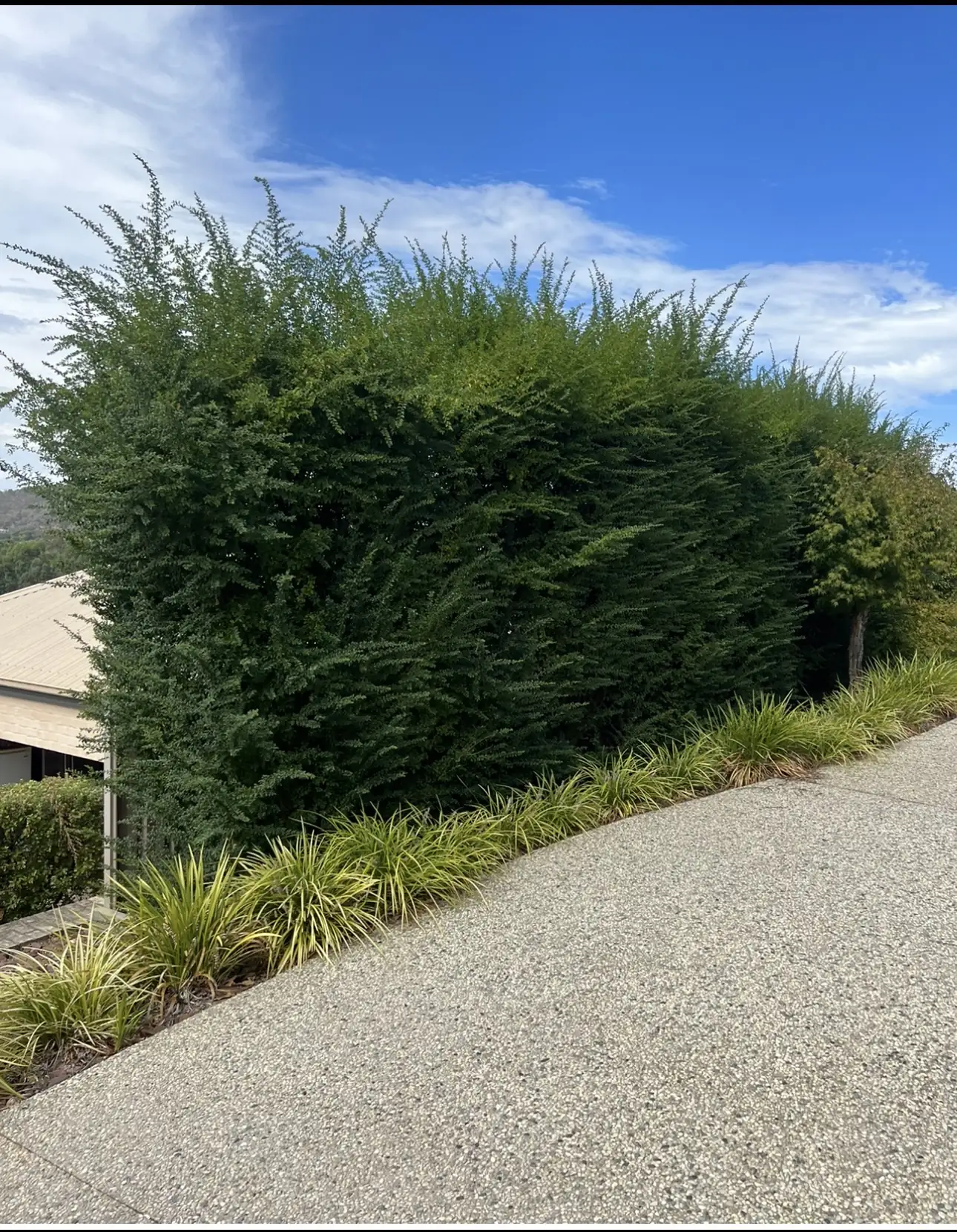
A hedge that has crept up past the fence line is a common problem. The good news is that most of them can come down. The key is to go about it in the right order.
How to reduce the height of a hedge: start with the plant
The same cut can be a tidy job on one hedge and a disaster on the next. So put the shears down and find out what the hedge is made of.
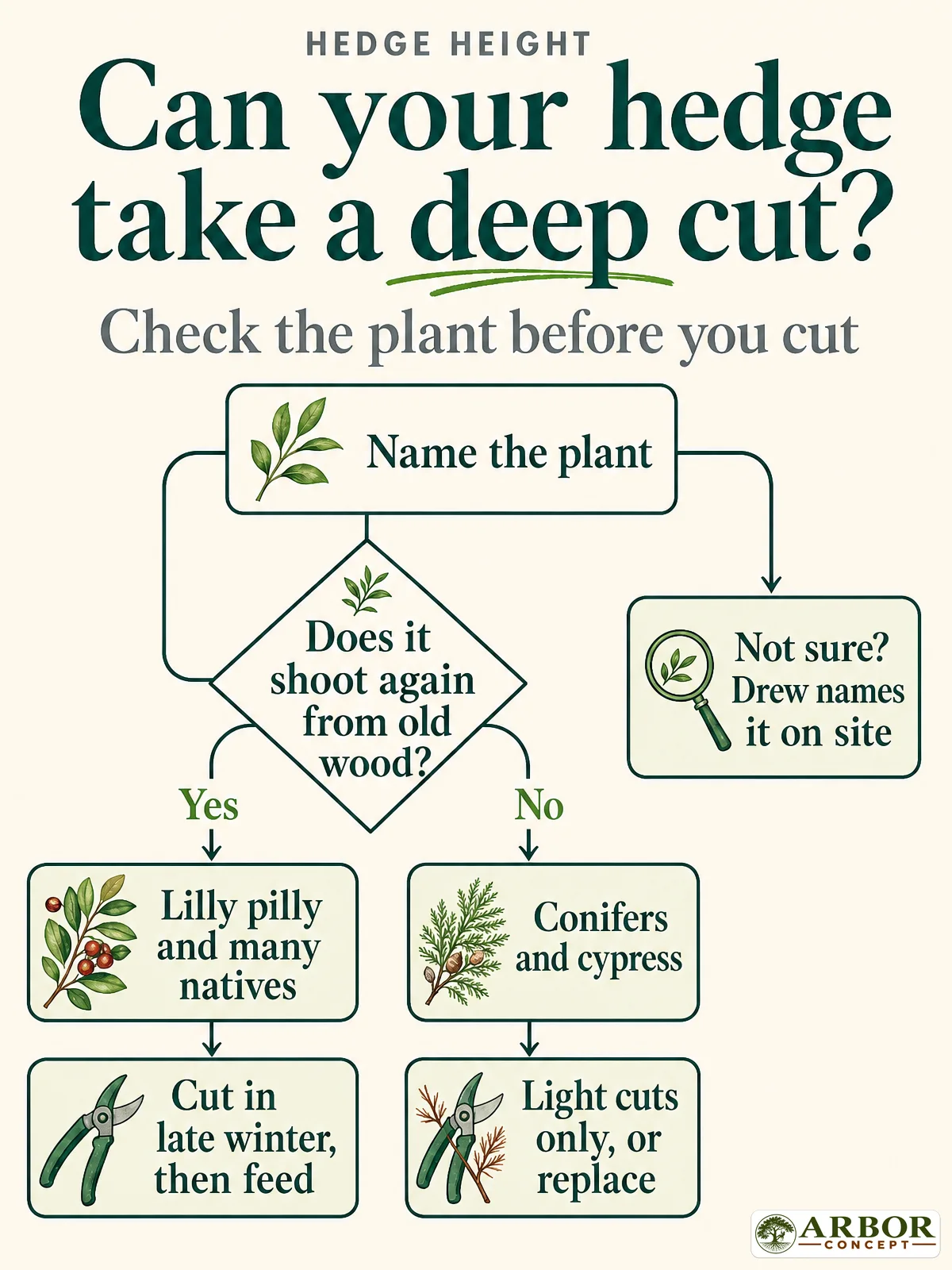
Gardening Australia says a lilly pilly can be pruned as softly or as hard as you like, even to ground level, and that late winter before spring growth is the best time [1]. In one case, a tired and messy plant came back with shiny bronze new growth by late spring. Many native shrubs behave in a similar way. Smaller eucalypts, bottlebrushes, lilly pillies and correas can all be cut back by half to renew them [4].
Conifers are the exception. The same program warns that most conifers do not shoot again from old wood, so a deep cut leaves a bald patch where only dry wood shows [3]. Their advice is to prune conifers lightly [3].
What to expect from a deep cut
| Hedge type | Deep cut risk | Plan |
|---|---|---|
| Lilly pilly and similar | Low. Most shoot again from old wood. | Cut in late winter, then feed. |
| Native shrubs, such as bottlebrush or correa | Low to moderate, if new shoots show below the cut. | Cut back to visible shoots. |
| Tip-pruned natives, such as westringia | Moderate. They like frequent light cuts. | Lower the top a little each round. |
| Conifers and cypress | High. Old wood stays bare. | Light cuts only, or replace. |
If you cannot tell which of these you own, that is fine. Send us the question and Drew will name the plant on site. It is a quick job for an arborist, and it saves a lot of guessing.
Why the height comes down in stages
It is tempting to take the hedge to its final height in one pass. For a plant that bounces back, that can work. For a hedge you are not sure about, it is a gamble.
A cut tip sends growth to the buds below it, so the plant becomes bushier [2]. That is why light, repeated cuts keep a hedge thick. A deep cut works differently. It removes the green skin of leaves the plant lives on, and the hedge then has to rebuild it from whatever buds are left.
Think of it as a budget of leaf. Every hedge has a store of green growth, and each deep cut spends some of it. If you spend it all at once, the plant has nothing left to feed new buds. If you spend a part now and a part next season, it can pay itself back between rounds. That is the heart of how to reduce the height of a hedge safely: never take more than the plant can afford.
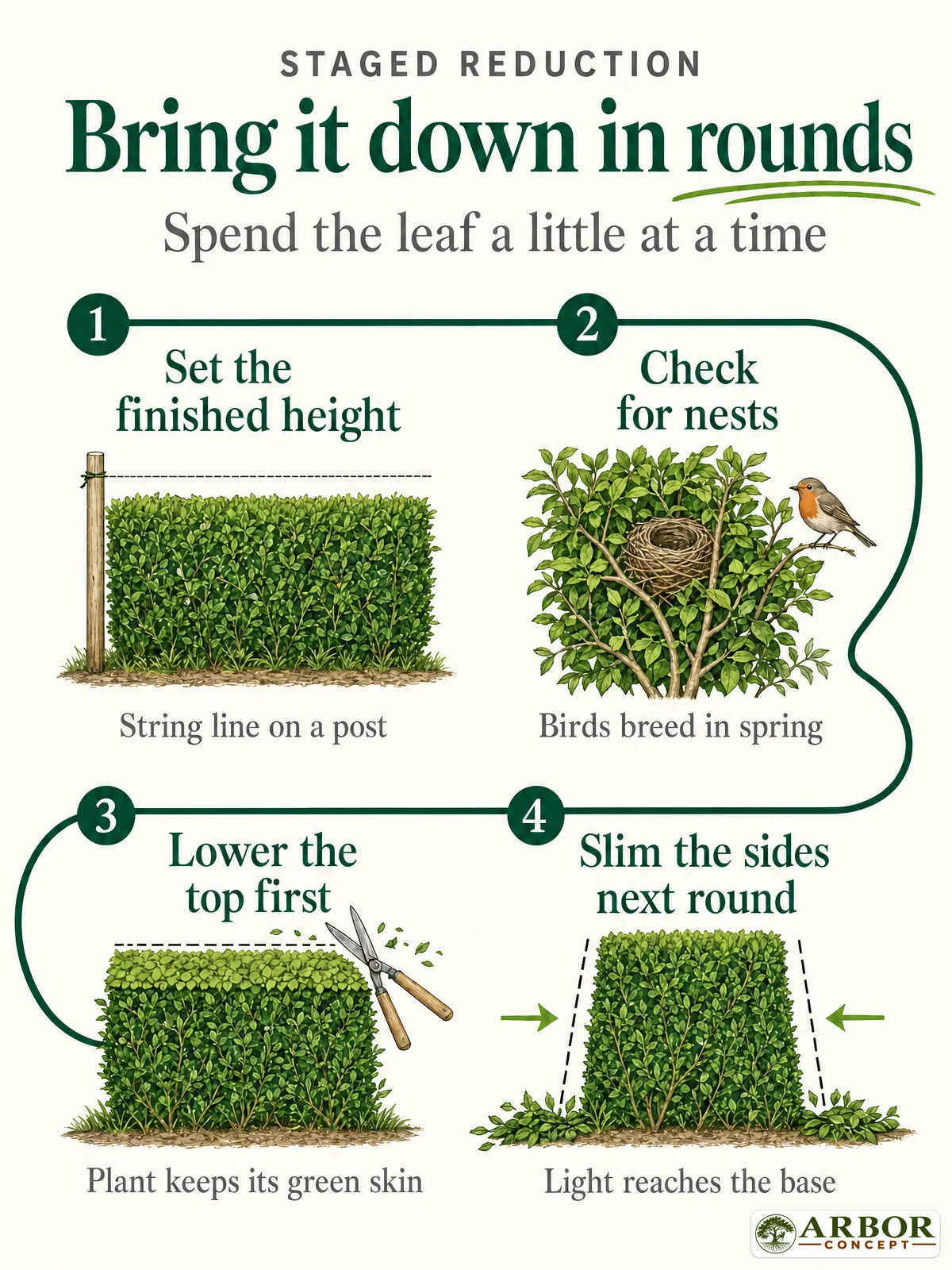
Staging spreads that shock. The top comes down first. The sides follow in the next round. Each round gives the plant time to grow new leaf before it is cut again. You end up at the same height, with fewer bare spots along the way.
A native hedge such as westringia can be handled in a different way. Tip pruning, which takes off the top couple of centimetres of each branch, makes every tip produce at least two new shoots [4]. If you lower a native hedge by a little at each tip pruning, it thickens as it shrinks.
Drews quick response and booking was fantastic. Lads were on time and great to deal with, very knowledgeable on the tree trimming and lopping safety all the way and cleaned up their mess to boot. 5-star rating for a reason
A safe order for lowering the top
A common mistake is to start at the top and work down without a plan. A better order is to set the finished height first, then work toward it.
Lowering a hedge, in order
- Decide the final height and mark it on a fence post or with a string line.
- Check the whole hedge for nests before any tool is switched on.
- Work the front face first, so the top is easier to reach [[5]](#source-5).
- Take the top down in stages, a little below the marked line if the plant is tough.
- Slim the sides so the top is not wider than the base.
- Clear the clippings and look at the line from across the road.
- Feed and water, then watch for new growth over the next weeks.
The string line matters more than people expect, and it costs almost nothing to set up. A hedge top that wanders looks untidy even when the height is right. A fence, a window sill or a taut line gives your eye something straight to follow.
Keep the sides in mind as well. If the top is lowered but the face stays wide and flat, the foliage can shade its own base. A hedge slightly narrower at the top than the bottom lets light reach every level, and that is what keeps the lower growth green.
Here is a quick way to judge a first cut. Run a hand into the hedge at the height you plan to cut. If you feel leafy twigs and small shoots, the plant has buds to work with. If you meet only thick, bare stems, a cut there is a risk, and the hedge should come down in smaller steps.
Tools and cuts that leave a clean finish
Hedges are forgiving about where each snip lands. Gardening Australia notes that dense shrubs have many closely spaced nodes, so shears or an electric trimmer do the job without precise cuts [2]. That is for the leafy outer growth.
Thicker stems need a different tool. Once a branch is more than a couple of centimetres across, loppers or a saw give a cleaner cut than a hedge trimmer [2]. A torn stem heals slowly and can let disease in. The same advice says to start with clean, sharp tools, because dirty or blunt blades spread disease between plants [2].
When you cut a stem, aim just above a leaf node, the point where new shoots form [2]. On a native that you are cutting back hard, cut to a spot where new shoots are already visible [4]. That gives the plant a bud to grow from.
At a glance: tools for the job
Want this looked at on your own property? The on-site quote is free.
The right season for a big cut
Timing decides how fast the hedge recovers. For a lilly pilly, late winter is the pick, just before spring growth kicks in [1]. In cooler places, wait until the frosts have passed.
For many native hedges, the guidance points to autumn for lighter tip pruning, and lists westringia, grevillea and thryptomene among the plants that suit it [4]. Flower buds are worth looking for, and they should be left alone. Gardening Australia’s general advice is to prune after the main flowering period so the plant has time to recover [2].
So the calendar depends on the plant. A lilly pilly wants winter. A flowering native may want to wait until the blooms are over. If the hedge has a mix of plants, the cut may be split across the year.
One more point on timing. Hedges that grow fast in a wet summer can be lowered again in a few months, while slow growers need a longer gap between rounds, so the calendar always follows the plant. Hot, dry weather is rough on fresh cuts, so a big reduction is best done in mild conditions. Wet ground matters too. Heavy gear on a sodden lawn leaves ruts, so we move the job until the ground has dried.
Nests, neighbours and shade
Before any reduction, look through the hedge for nests. Brisbane City Council says native birds breed in spring and summer, and that people should never interfere with birds or their nests [7]. The Nature Conservation Act 1992 gives every native species legal protection, and the council calls harming them a serious offence [7]. If we find a nest, we tell you and plan around it.
Neighbours live with a tall hedge too. The Queensland Government advises keeping trees and shrubs pruned so they do not cause excessive shade or litter on a neighbour’s property [6]. It adds that talking face to face is the best first step, and that issues should be raised early because that is quicker, less costly and less stressful than going to law [6]. A second Queensland page says tall growth that shades a neighbour’s window or roof can be unreasonable [8]. That page speaks of trees, so ask your council about a very tall hedge.
Before the cutting starts
- Look through the hedge for nests and young birds.
- Tell the neighbours what is planned and when.
- Name the plant, or have it named, before you pick a height.
- Decide what happens to the clippings.
- Taking a conifer down into dry brown wood.
- Cutting in a heatwave or on soaked ground.
- Climbing a ladder with a powered trimmer.
- Assuming the hedge has no local rules attached.
Rules differ between councils and they change. Some hedges and trees are protected, so check with yours before cutting anything large. We do not guess whether a rule touches your hedge. Ask the council, and we will talk through the answer with you before a single cut is made.
Drew and his team were absolutely fantastic. They were patient while we worked with council for the appropriate approvals, on time and very professional. Drew was also happy to assist us with adding on additional pruning and palm removal. Will recommend to everyone and definitely use again in the future.
Which hedge jobs need an arborist
Not every hedge needs a professional. If the top is at chest height, the plant is a forgiving one, and there are no nests or wires nearby, a keen gardener with sharp tools can manage.
Ask a qualified arborist when:
- the top is above your shoulder and would need a ladder,
- the hedge runs close to wires, a roof or a pool fence,
- you are not sure what the plant is, or whether it will shoot again,
- the reduction is large, and needs to be planned across two or more rounds,
- the hedge has become more tree than hedge.
Height is the real danger. Working off a ladder with a sharp powered tool is how people get hurt. A lift or platform lets the cutter work from a stable base, with both hands on the job. If your hedge needs that, it is not a job to try yourself.
If the plant has outgrown its spot altogether, we will say so. Gardening Australia’s conifer advice makes a fair point here: choose a plant whose mature size suits the site, rather than cutting it to fit [3]. Sometimes the honest answer is a replacement, not a trim, and we will tell you straight even if it is the smaller job.
How we reduce a hedge
Our hedge trimming includes reductions and reshaping as well as regular maintenance. You speak to Drew first. He walks the hedge, names the plant, hears what you want, and writes up a plan with the new height agreed. Our team then does the work.
On a tall hedge, our team brings a lift or platform, so nobody cuts from a ladder. We take the clippings away or leave them where you ask. The on-site quote is free and never done from photos, because photos cannot show the true height, the slope or the nests. Our how we quote page sets out the principles. To book a look at your hedge, get in touch. Pensioner and local discounts are available.