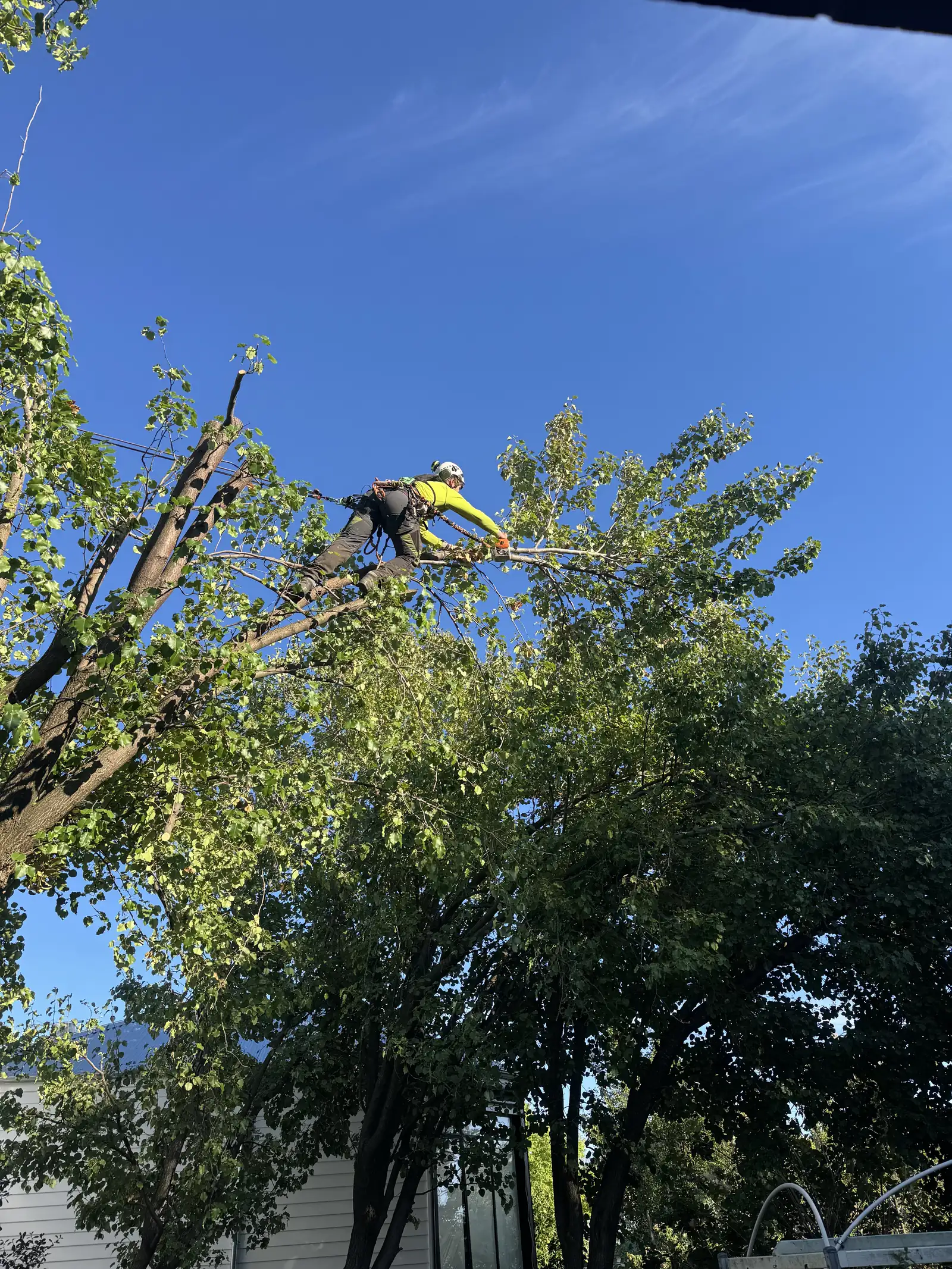
The common mistakes when pruning a tree, and how to avoid them

The common mistakes when pruning come down to a short list: taking too much, cutting the wrong way, cutting in the wrong place and cutting at the wrong time. Each one leaves a tree weaker than it was before the saw came out.
This guide goes through those mistakes one at a time. It shows what each one does to the tree, what a better cut looks like, and where the rules and your neighbours come into it.
A tree is not a hedge, and a photo cannot tell you what a good cut is. That turns on the species, its shape and its history, so nothing replaces someone standing under it.
Most pruning mistakes start with a good idea. The tree is too big, too dark or too close, so someone takes a saw to it. Then the tree pays for it for years.
Why the common mistakes when pruning happen
People prune for light, for safety, for shape or to stop a mess. Those are fair reasons. The trouble starts when the cut doesn’t match the reason.
Every cut is a wound. The City of Ryde puts it plainly: each cut uses energy the tree has stored, and too much or the wrong kind of pruning can stress a tree, weaken its structure and shorten its life [1]. So the first question is never “how much can I take?” It is “what is this cut for?”
Noosa Council takes the same line for its own trees. It says pruning should happen only when it is needed to keep a tree safe and healthy [3]. If there is no good reason, the best cut is no cut.
The mistakes at a glance
| The mistake | What it does to the tree | What works better |
|---|---|---|
| Taking too much | Starves it of leaves and opens wounds | Smaller cuts, spread over time |
| Topping or lopping | Forces weak, crowded regrowth | Cut back to a sound branch union |
| Flush cuts and stubs | Slows healing and invites decay | One clean cut just outside the collar |
| Stripping the middle of a limb | Leaves all the weight at the tip | Shorten the ends, keep the inner growth |
| Pruning at the wrong moment | Loses flowers or disturbs nests | Check the tree and its visitors first |
Taking too much off in one go
This is the big one. Of all the common mistakes when pruning, it turns up most, and it usually comes from wanting a quick result. The saw is already out, the tree is in the way, and one more branch seems harmless.
Leaves are the tree’s kitchen. Take too many and the tree has less food to heal with. It then puts out a flush of thin shoots to get its leaves back, and those shoots are not strong. Ryde lists weak regrowth, structural defects, pests and disease among the results of poor technique [1].
Noosa Council also warns that over-pruning can cause structural and decay problems [3]. So less really is more. On our jobs the rule is simple: remove only what the tree can spare. Sometimes the honest advice is a smaller prune than the one you had in mind.
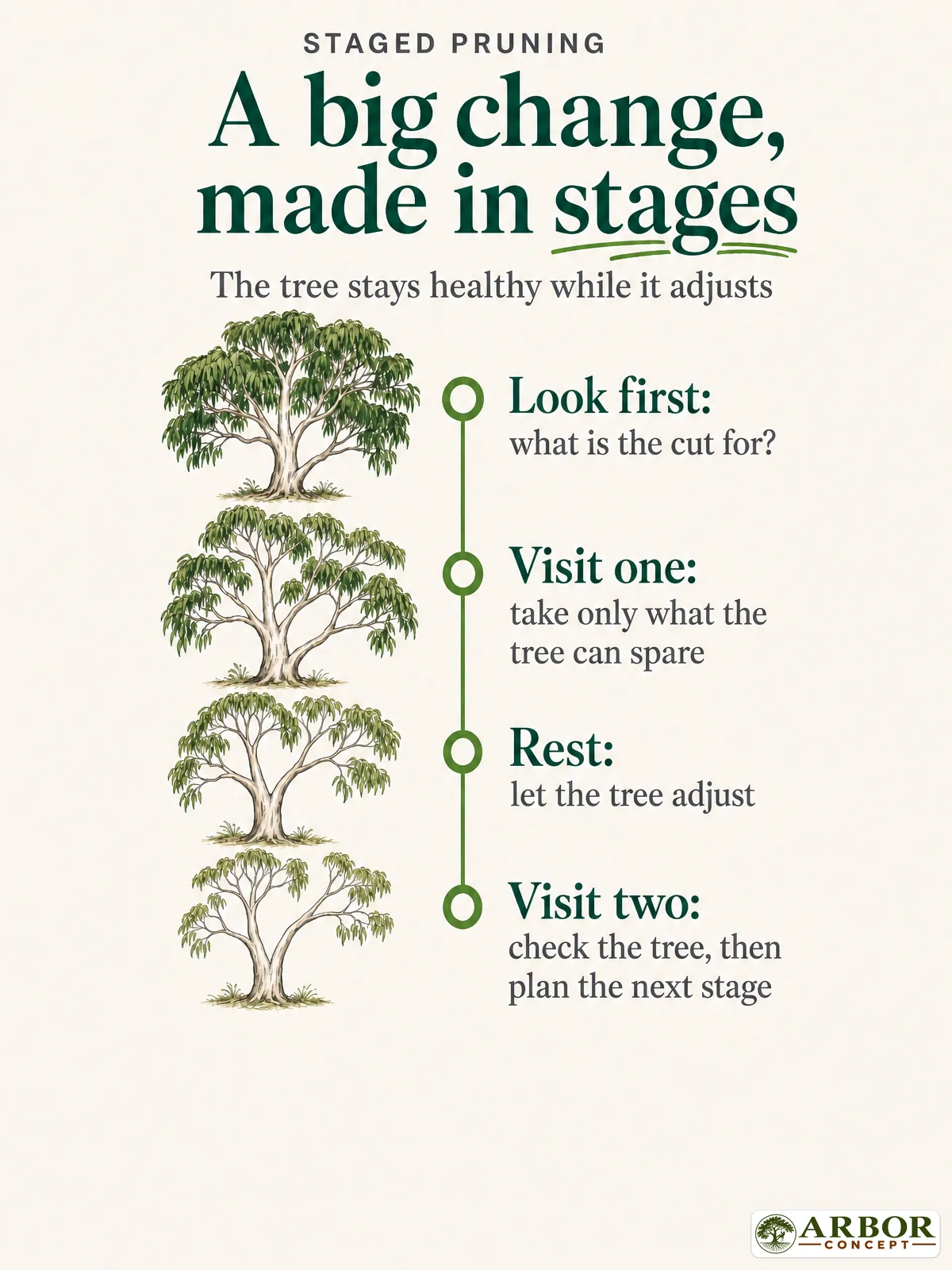
If a tree needs a big change, it can be done in stages over more than one visit. That is slower, but the tree stays healthy while it adjusts.
Topping and lopping a tree
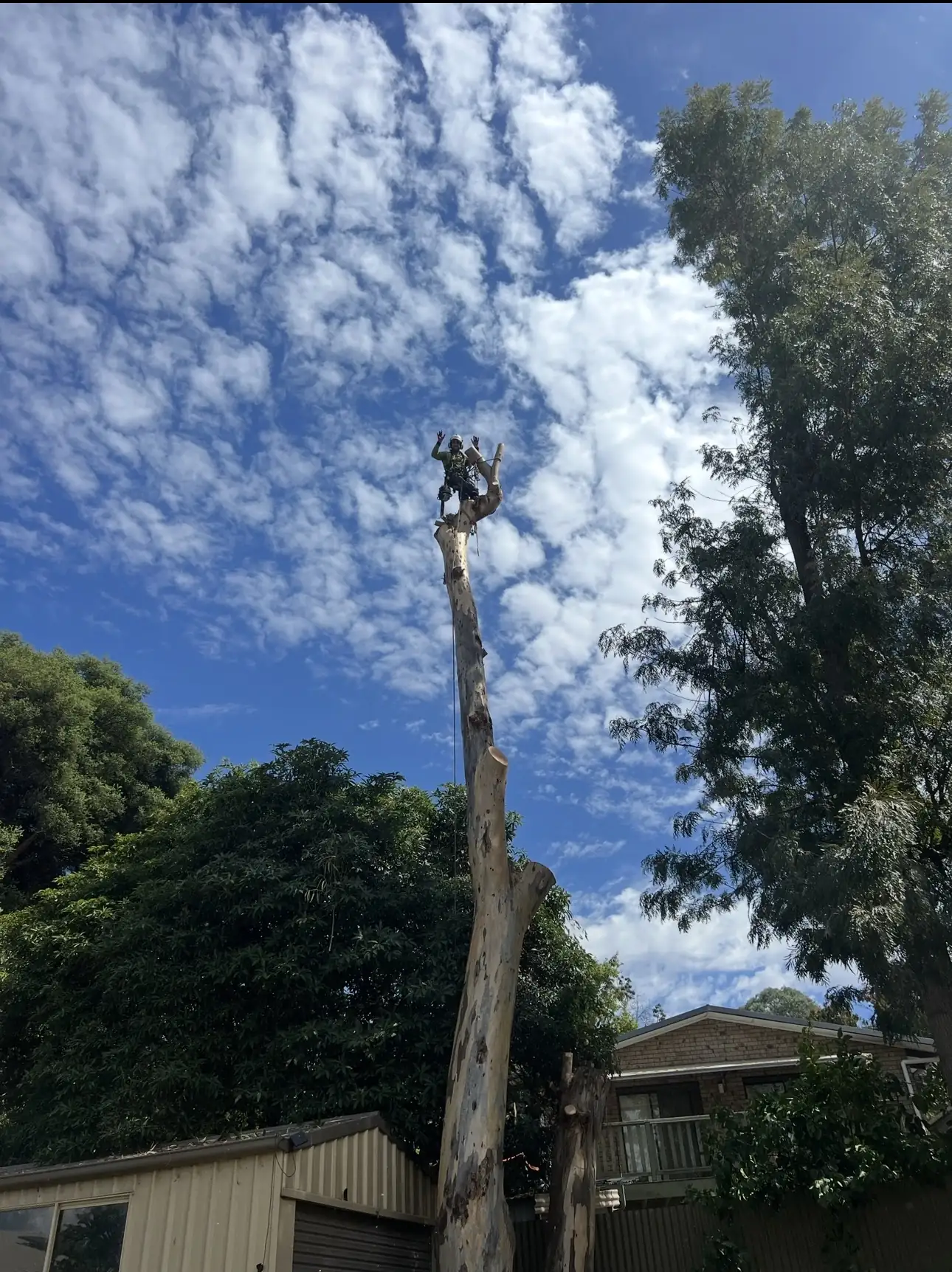
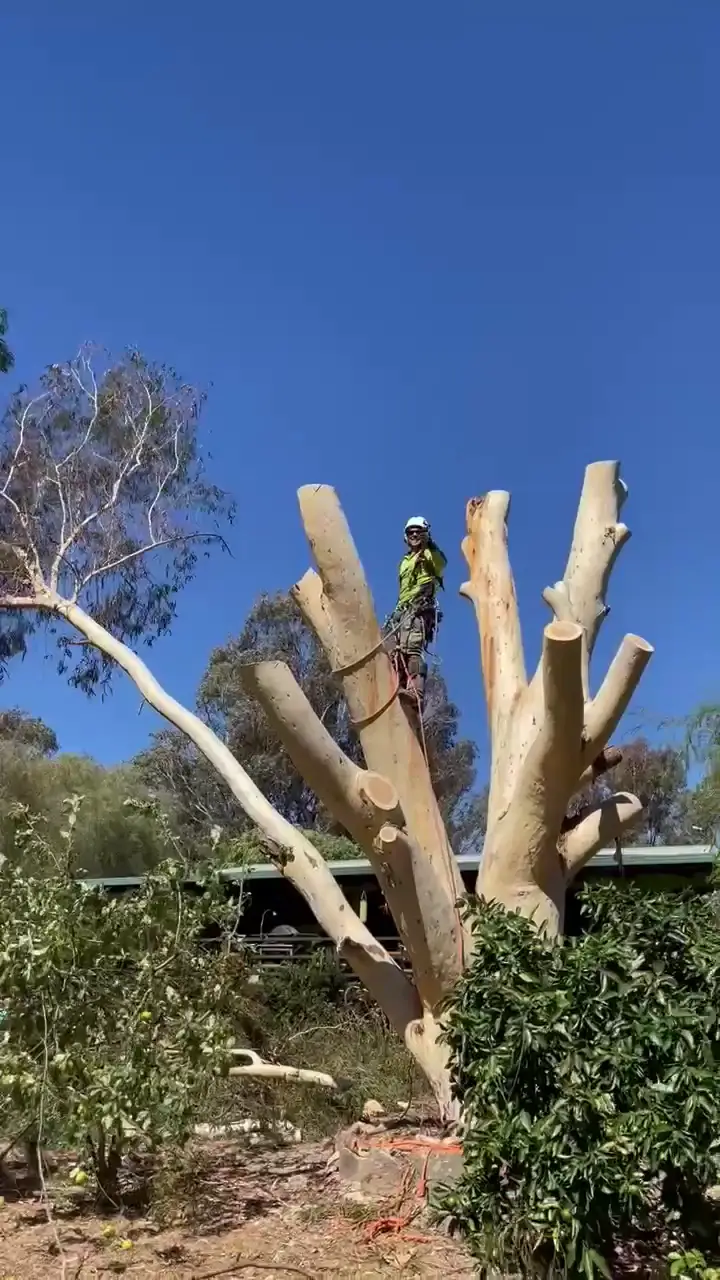
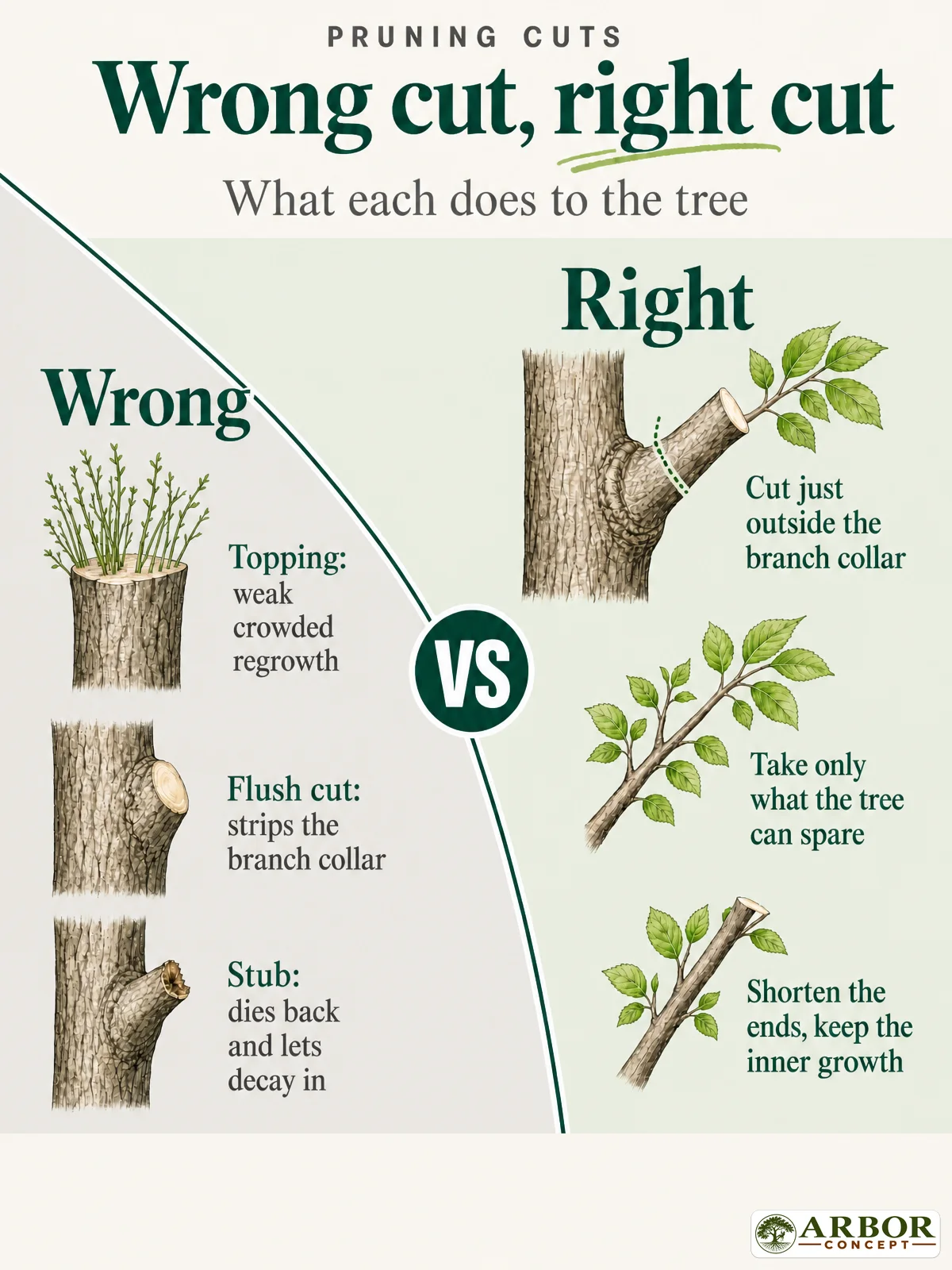
Topping means cutting the top out of a tree, or cutting limbs back to stumps. It is also what many people mean when they ask for a “tree lop”. It gives a fast result, and that is why it is so tempting.
The problem is what comes next. Whitehorse City Council calls lopping bad for a tree’s health and says it should almost never be done. It also notes that the bushy regrowth tends to be badly joined to the limb, which can turn the tree into a hazard [4].
The shoots are thick and fast because the tree is in a hurry. They sprout from the surface of the old wood, not from a proper branch union, so nothing anchors them well. A gust of wind can peel them away.
Then there is the repeat cost. A topped tree regrows, so it needs doing again, and again. Each round adds more wounds, and the old ones can rot behind the new growth, where you can’t see them. You end up paying to keep a problem going.
If the real goal is light, view or clearance, there are better ways. A shaped reduction, a lift of the lower branches or thinning through the crown can all do the job without wrecking the tree. We explain the options before any cut, and we show you where each one would go. Our tree pruning service is built around that kind of plan.
Drew and his team are professional in all aspects their business. We have used them from pruning, maintenance and emergency tree removal. I find them reliable, knowledgeable, helpful and thorough. Highly recommended. Maz Ashlarstays
Cutting in the wrong place
Every branch grows out of the trunk or a bigger limb with a swollen ring at its base. This is the branch collar. Whitehorse explains that the collar holds the tissue the tree needs to close a wound, so it should never be cut off [4]. The cut goes just outside it.
If you can’t see the collar, look for the wrinkled ridge of bark where the branch meets the trunk. That ridge shows the angle to cut along [4]. Some trees make the collar hard to spot, which is one more reason to let someone with experience make the call.
Where the saw goes
- Find the swollen ring where the branch meets the trunk or bigger limb.
- Make the final cut just outside that ring, not into it.
- Follow the angle of the bark ridge so the wound stays small.
- Leave no stub: a stub dies back and lets decay in.
- Leave no flush cut: it strips off the collar the tree needs for healing.
Heavy limbs add a rule of their own. A big limb comes off in stages, so its weight cannot rip a strip of bark down the trunk on the way down. That takes practice, ropes and the right gear.
Both Ryde and Redland City Council point to the Australian Standard for pruning of amenity trees, AS 4373, as the benchmark for good practice [1] [2]. Our own cuts follow it.
Inner West Council adds a sensible check: before you hire, make sure the arborist is insured and holds the certificate [8].
Stripping the middle and leaving the tips
Here is a mistake that looks tidy from the ground. Someone takes the small branches from the inside of a limb to “open it up” and leaves a tuft of leaves at the end. Arborists call it lion-tailing.
It looks light. In fact the opposite has happened. All the weight now hangs at the far end of the limb, like a heavy knot tied to the end of a rope. Wind then loads the join where that limb meets the trunk, and that join can fail. Nobody notices until the storm.
The better approach takes weight off the ends of branches and keeps the inner growth that gives the limb its balance. The tree keeps its natural shape, and the load stays where the tree was built to carry it.
It’s worth knowing about because it is so easy to ask for by accident. “Thin it out a bit” can lead to exactly this. A good arborist asks what you want to achieve, then shows you a cut plan that gets there without the trap. Ask to see where each cut will go before the first one is made.
Want this looked at on your own property? The on-site quote is free.
Pruning at the wrong moment
Timing mistakes are quieter than the others, but they cost real things. Some trees set their flower buds well before they open. A hard cut just before the display throws away a season of flowers.
Wildlife is the other half. Birds, possums and bats use trees all year. If our team finds a nest, a den or an animal in a tree, the work stops or changes until it can go ahead without harming them. Sometimes that means moving the day. Protected animals can add rules of their own, so tell Drew who lives in your tree.
Weather matters too. Heavy gear on sodden ground chews up a lawn, so unless the tree is in immediate danger the job can wait for dry ground. Dead or hanging wood is the exception, and it does not wait for a good season.
Three quick checks before any cut
Mistakes with rules and neighbours
Many people assume pruning is free of rules. It isn’t. Redland City Council says pruning that would damage a protected tree needs council approval, and that removing protected vegetation without approval is an offence [2]. That is one council’s wording. Other councils word it differently and the rules shift over time, so ask yours before you cut, and never take it for granted that a permit is or is not needed.
Neighbours are the other trap. The Queensland Government says you can remove branches that overhang your boundary, up to that boundary [5]. QCAT adds a warning: a local council order can protect a tree from having its branches lopped, and where one is in place the usual notice process cannot be used [6]. It also says you are not authorised to enter the tree-keeper’s land to do the cutting [6].
A bad cut on a neighbour’s tree can turn into a dispute. A chat first is far easier. Tablelands Regional Council says that speaking with your neighbour is sometimes better than giving formal notices, and that pruning an overhanging branch should follow correct techniques that avoid decay and other hazards [7]. If it helps, we will explain the job to the people next door.
Drew and his team are very efficient and professional, taking care not to damage any property. They clean up the area once finished. They’re also polite and courteous! I highly recommend these guys for any arborist job.
Doing it yourself: where it goes wrong
Pruning looks simple from the ground. Up a ladder with a saw, it is not. Falls are a real risk, and the tree often ends up worse off. Anything near power lines, over a roof or high in a crown belongs to a qualified arborist, not a keen homeowner.
A quick guide to who does what
- Snip a small, low shoot you can reach from the ground.
- Pick up fallen twigs and leaf litter.
- Watch the tree and note what changes after storms.
- Ask an arborist before you start anything bigger.
- Anything that needs a ladder, a climb or a chainsaw.
- Branches near power lines, roofs or boundaries.
- Heavy limbs that need lowering on ropes.
- Any cut on a tree that might be protected.
Councils say the same thing. Redland City Council recommends an arborist qualified to at least AQF Level 3 for tree maintenance [2], and Ryde says the work should be done by someone with that qualification [1]. Drew is Cert III qualified and has been at this for 20 years, and we carry public liability insurance.
Knowing when an arborist is worth it, and when not
You do not need an arborist for every twig. A small low shoot on a shrub, a bit of dead leaf on a palm you can reach, a stray sucker at the base: these are garden jobs.
Get an arborist when any of these are true:
- The branch is thick, high or heavy.
- It leans across a roof, a pool, a driveway or a boundary.
- It is near a power line.
- The tree has been cut hard before and has gone wild with shoots.
- You want more than a trim: a lower height, a lifted crown, more light.
- You are not sure whether the tree is protected.
A healthy tree in a good spot may need nothing at all, and Drew will tell you that straight, even when it costs us the job. When there is work to do, he comes out for the free on-site quote, studies the whole tree and talks you through each cut before a saw starts. Stay and watch if you like.
Our tree pruning page shows how a job runs from first visit to clean-up, and the how we quote page explains the pricing approach. To start, ask for a free quote and describe the tree to Drew. Pensioner and local discounts are available.